Maddy summaryThis bill requires manufacturers and sellers to attach a red tag to the charging cords of specific electric products, including low-speed e-bikes, e-scooters, motorized bicycles, scooters, and skateboards, as well as their lithium-ion or storage batteries. The tag must clearly state "UNPLUG WHEN NOT IN USE" and include additional safety information about proper usage. The Division of Consumer Affairs must provide a model tag and develop guidelines for the required safety content. This applies to all products sold, leased, rented, or distributed in New Jersey, directly affecting retailers and manufacturers of these devices.
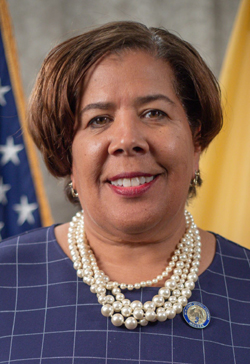
Asm. Linda Carter
Sponsored bills
Maddy summaryThis bill prohibits health club contracts from limiting the club's liability for injuries caused by the club's negligence (such as unsafe equipment or staff errors). It directly affects health club members who suffer injuries due to the club's own careless actions. The key provision requires all health club service contracts to include a clear statement that the club cannot avoid responsibility for such negligence-related injuries. This aligns with prior court rulings that such liability waivers violate public policy. The bill does not change other contract terms like refunds or cancellation policies.
Maddy summary# Summary of New Jersey Cannabis Regulatory Bill This bill amends the "Cannabis Regulatory, Enforcement Assistance, and Marketplace Modernization Act" (CREAMMA) and the "Jake Honig Compassionate Use Medical Cannabis Act" with several significant changes: ## Key Provisions: 1. **Municipal Medical Cannabis Limitations**: - Municipalities cannot prohibit medical cannabis dispensaries (operating without violations for 180 days) from selling adult-use cannabis at the same location - The Cannabis Regulatory Commission cannot require municipal approval for Class 5 Retailer Licenses for medical cannabis dispensaries co-located with existing medical facilities 2. **Application Processing Changes**: - Requires the commission to make a final decision on applications within 30 days after stating it needs more time to review (previously open-ended) - Eliminates the point scale system for ranking applicants - Removes requirements for submitting business plans and liability insurance plans 3. **Municipal Ordinance Portal**: - Requires the commission to create a public online portal for all cannabis-related municipal ordinances - Municipalities must submit their regulations to the commission for inclusion 4. **Family Involvement**: - Prohibits the commission from banning family members (other than spouses) of license applicants from obtaining their own licenses (invalidating N.J.A.C.17:30-6.8) 5. **Alternative Treatment Centers (ATCs)**: - Permits ATCs to redesignate medical cannabis to adult-use cannabis at any point in the supply chain, provided they hold the appropriate license at that point 6. **Other Changes**: - Allows the commission to give applicants more than 45 days to comply with additional conditions - Removes requirements for special consideration of higher education curriculum agreements - Clarifies ownership restrictions for cannabis businesses during a 24-month transition period This bill aims to streamline the licensing process, increase access to cannabis retail for medical dispensaries, reduce regulatory burdens, and create greater transparency with municipal cannabis regulations.

Maddy summaryThis bill (A5324) requires all New Jersey state, county, and municipal law enforcement agencies to report specific use-of-force incidents to county prosecutors within 24 hours. It defines "law enforcement incidents" as officer use of force causing death or serious injury, deadly force (including firearm discharge), or civilian deaths during encounters or in custody. The county prosecutor must immediately notify the Office of Public Integrity and Accountability (OPIA), which must select an independent investigator within 24 hours to conduct the investigation per Attorney General guidelines. The bill codifies existing Attorney General directives for these investigations, applying directly to law enforcement agencies and OPIA.
Maddy summaryThis bill modifies the list of transportation infrastructure projects eligible to receive loans from New Jersey's Infrastructure Bank for Fiscal Year 2025. It adjusts which projects qualify, changes their priority order, and modifies the allowable loan amounts for specific projects. The bill authorizes the bank to expend up to $61.4 million (an increase from $53.8 million) for these projects, which include bridge repairs, road improvements, pedestrian bridges, and trail projects across various municipalities. Local government units, including cities, counties, and townships, would be directly affected as they apply for these loans to finance transportation infrastructure projects.
Maddy summaryThis bill requires New Jersey telecom, cable, and internet providers to let customers pause or cancel service contracts without early termination fees when they move into a qualifying long-term care facility. It directly affects residents admitted to nursing homes, assisted living facilities, dementia care homes, or residential health care facilities for at least 90 days, as verified by a physician’s order or care plan. Providers must pause billing for a minimum 90 days upon admission, then cancel the contract if the resident remains in the facility beyond that period. The law mandates no fees for this pause/cancellation, though customers must provide physician documentation and typically give 45 days’ notice (or 48 hours in urgent cases).
Maddy summaryS 3879 amends the lists of environmental infrastructure projects eligible for loans from the New Jersey Infrastructure Bank for FY2025. The bill updates the "Storm Sandy and State Fiscal Year 2025 Clean Water Project Eligibility List" (152 projects) and the "Storm Sandy and State Fiscal Year 2025 Drinking Water Project Eligibility List" (67 projects) by adding new projects, removing some projects, and adjusting loan amounts for certain projects. This affects local governments, public water utilities, and other project sponsors seeking funding for clean water and drinking water infrastructure improvements. The bill authorizes the New Jersey Infrastructure Bank to provide loans for a total of 219 eligible projects for FY2025, with a total authorized loan amount of $2.47 billion (down from $2.73 billion).
Maddy summaryThis bill requires New Jersey's Division of Developmental Disabilities to create and distribute a satisfaction survey to clients using support coordination agencies. The survey will rate agencies on a 1-5 star scale based on client feedback, with quarterly updates published online. It directly affects clients receiving developmental disability services and the support coordination agencies providing those services, aiming to improve transparency and service quality. The rating system will be publicly available on the Division's website, with implementation required 90 days after enactment.
Maddy summaryThis bill amends New Jersey law to explicitly include virtual currency and non-fungible tokens (NFTs) in the definition of "gift" for public officials. It prohibits state and local government employees, elected representatives, and other defined public officials from accepting these digital assets as gifts. The change updates existing gift restrictions to cover new forms of digital value, ensuring virtual currency and NFTs are treated the same as traditional gifts under state ethics laws. This is a definitional update with no new penalties or enforcement mechanisms beyond current gift-prohibition rules.
Maddy summaryThis bill establishes the AI and Labor Market Study Commission to examine how artificial intelligence affects New Jersey's workforce. The commission, composed of 11 members including state officials and private experts (with at least four having AI expertise), will identify jobs at risk of displacement, develop worker transition programs, and recommend policies. It creates a Job Transition Fund - initially funded by existing state job training money - to support displaced workers through education, training, and job placement services. The commission must report findings and recommendations to the Governor and Legislature at least twice yearly.