

Maddy summaryThis bill would have New Jersey join the Social Work Licensure Compact, allowing social workers licensed in New Jersey to practice in other participating states without obtaining separate licenses. The compact establishes a system where social workers must meet specific requirements (including passing national exams, holding appropriate degrees, and completing supervised practice) to qualify for a multistate license. It creates a commission to manage the compact, handle data sharing among states, and address disciplinary actions. The compact aims to increase access to social work services, reduce duplicate licensing requirements, and support workforce mobility for social workers across member states. This would directly affect social workers seeking to practice in multiple states and the states' licensing authorities.
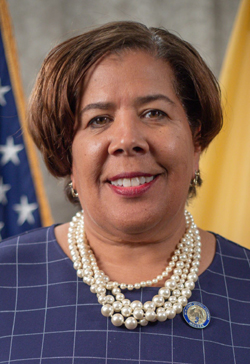
Asm. Linda Carter
Sponsored bills
Maddy summaryThis bill allocates 5% of constitutionally dedicated Corporation Business Tax revenues to a new Urban Agriculture and Horticulture Fund starting in fiscal year 2026, with $25 million to be deposited immediately. It authorizes the Garden State Preservation Trust to acquire urban land for farming and gardening purposes, prioritizing small parcels, and lease this land for agricultural use through a competitive bidding process. The bill also establishes a grant program to support activities that improve soil health and climate resiliency on acquired urban farmland. Additionally, it expands existing county and municipal trust funds to specifically include urban agriculture and horticulture as a purpose for land acquisition.
Maddy summaryThis bill (A5582) expands the list of eligible locations where behavioral healthcare providers can work to qualify for student loan redemption under New Jersey's program. It specifically adds for-profit community mental health providers to the current list of approved sites, which previously included nonprofits, schools, and government agencies. The program helps providers like psychiatrists, social workers, and counselors redeem up to $150,000 in qualifying student loans by contracting to work at these approved sites. This change directly affects behavioral healthcare providers seeking loan relief and the for-profit organizations that can now become participating sites.
Maddy summaryThis bill requires New Jersey colleges and universities to maintain FDA-approved opioid antidotes (like naloxone) in secure, accessible locations and develop policies for emergency use. It permits licensed campus medical staff and trained non-medical employees to administer antidotes in good faith when they reasonably believe someone is experiencing an opioid overdose. Institutions must ensure overdose victims are transported to hospitals after antidote administration and provide staff with required training on standardized protocols. The bill also provides liability protection for good-faith actions by campus staff, pharmacists, and prescribers under these guidelines.
Maddy summaryThis bill changes the title of New Jersey's "Chief Diversity Officer" to "Chief Equity Officer" and creates the "New Jersey Office of Supplier Diversity and Business Opportunities" within the Department of the Treasury. The new Office will support the Chief Equity Officer in monitoring state contracts awarded to "small and diverse business enterprises" (including minority-owned, women-owned, economically disadvantaged, socially disadvantaged, and disabled veterans' businesses), processing business certifications, and developing outreach programs. State agencies must submit annual procurement plans and data to the Office, which will analyze these plans and provide feedback to improve contracting with diverse businesses. The Chief Equity Officer will report directly to the State Treasurer and oversee all efforts to increase transparency and participation of diverse businesses in state procurement.
Maddy summaryThis bill establishes the "Minority and Women-Owned Businesses State Contractor Remedies Act" requiring New Jersey State agencies to set specific contract utilization goals for minority and women-owned businesses based on a 2024 disparity study. It sets detailed percentages for contracts across different categories, including 24.26% of construction contracts for women-owned businesses and 10.14% for Hispanic American-owned businesses. State agencies must develop annual plans to achieve these goals and make a "good faith effort" to meet them, with remedial actions required if they fail to do so. Prime contractors are also required to make good faith efforts to meet subcontractor goals for minority and women-owned businesses. The bill amends previous set-aside laws by removing goals for minority and women-owned businesses and shifting oversight to the Department of the Treasury's Office of Diversity and Inclusion.
Maddy summaryThis bill requires New Jersey's Board of Public Utilities (BPU) to create a program for building electrification and mandates electric public utilities to develop multi-year plans to replace fossil fuel systems with electric alternatives. The plans must meet specific greenhouse gas reduction targets and be cost-effective from a societal perspective, considering environmental benefits like reduced methane emissions. Key mechanisms include converting gas heating/water systems to electric heat pumps, replacing gas appliances with electric models (e.g., induction stoves), and funding contractor training programs. The bill directly affects electric utilities, building owners, and contractors by requiring systemic shifts toward electrified heating, cooking, and industrial processes.
Maddy summaryThis bill expands eligibility for wrongful imprisonment claims in New Jersey by allowing two new groups to sue: individuals wrongfully civilly committed as "sexually violent predators" under P.L.1998, c.71, and those who entered guilty pleas but were later exonerated. It also clarifies that claimants have two years from their release (or conviction vacatur) to file suit, with a special two-year window for those affected after December 27, 2013. Damages now include $25,000 per year for time served on parole, probation, or as a registered sex offender after incarceration, in addition to existing compensation for wrongful conviction. The bill modifies existing statutes without changing the core calculation of damages (twice prior income or $50,000/year for incarceration).
Maddy summaryThis bill prohibits force-feeding geese, ducks, or other poultry using tubes or apparatus to produce foie gras, except when done to improve a bird's health. It also bans selling or distributing foie gras unless the product originates from a state or jurisdiction that already prohibits force-feeding. Violations result in a written warning for first offenses, followed by $100 civil penalties for repeat violations (with each day of ongoing violation counted separately). The law takes effect 60 days after enactment.
Maddy summaryThis bill redirects leftover funds from New Jersey's 1989 Bridge Rehabilitation Bond Act to the Department of Transportation for immediate bridge repairs. It specifically allocates unspent money for emergency repairs on bridges carrying state highways (Section 1) and county/municipal roads (Section 2), with funds for local roads redistributing to counties after two years if unspent. The bill does not create new funding but realigns existing resources to address urgent bridge maintenance needs across the state.