

Maddy summaryThis bill requires New Jersey's Department of Community Affairs to reimburse emergency shelter operators for costs incurred when evicting individuals who refuse to leave after their authorized stay period ends. It applies directly to operators of homeless emergency shelters established under existing law, covering expenses and lost revenue during the eviction process. Shelters must submit a specific form within 30 days of an eviction warrant being served, detailing costs and supporting documentation. The state must annually fund these reimbursements through General Fund appropriations. The bill clarifies that shelters may legally pursue eviction for non-compliance with stay duration rules.
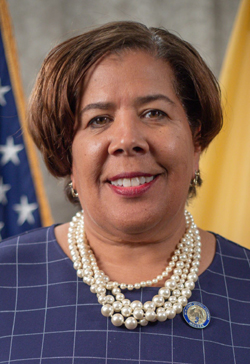
Asm. Linda Carter
Sponsored bills
Maddy summaryThis bill establishes a new "Graduate Physician" licensing category in New Jersey for medical school graduates who haven't completed residency training. It requires applicants to meet specific criteria (e.g., accredited medical school graduation, one year clinical practice, passing licensing exams, no disqualifying criminal history) and limits their practice to primary care in medically underserved areas under a collaborative arrangement with a fully licensed physician. Graduate physicians must wear identification tags, use specific clinical record notations, and cannot practice without a supervising physician except in emergencies. The license does not require more continuing education than standard physician licenses.
Maddy summaryThis bill requires New Jersey's State Police to notify local law enforcement when a background check reveals someone is prohibited from buying firearms or ammunition. Specifically, if a background check shows a person has a criminal record, domestic violence conviction, or other disqualifying history (as defined in N.J.S. 2C:39-7), the State Police must inform the local chief law enforcement officer. Retail gun dealers must run these background checks and submit results to the State Police, who then trigger the local notification. The law applies to all firearm and ammunition purchases requiring a background check, directly affecting dealers, State Police, and local police departments.
Maddy summaryThis bill requires all public colleges and universities in New Jersey to provide free menstrual products (tampons and sanitary napkins) in all campus buildings, including women’s restrooms, all-gender restrooms, and at least one men’s restroom in locations like lecture halls, residence halls, and libraries. Institutions must offer a variety of products - regular to super-plus, ultra-thin to overnight, and allergy-friendly options - and install dispensers or maintain existing ones that provide free access. The bill also mandates educational materials about toxic shock syndrome and proper disposal, with the state covering all costs through an $85,000 appropriation to the Office of Higher Education. Public institutions must submit reimbursement requests for expenses incurred.
Maddy summaryThis bill creates a program to reward employees who report tax law violations by employers in New Jersey's construction industry. Whistleblowers who provide specific, credible information leading to an administrative or judicial action against an employer can receive 15% to 30% of recovered taxes, penalties, and interest, or up to 10% if the tip came from media or government sources. It excludes employees who obtained information through their official duties or planned the violations themselves, and includes protections against retaliation under New Jersey's Conscientious Employee Protection Act. The program applies specifically to employers engaged in building, construction, repair, or maintenance work as defined in the bill.
Maddy summaryBill A 1691 requires New Jersey school districts to close all schools on the day of any general election or primary election for a general election. This directly affects all public school districts across New Jersey by mandating closures on these specific election days, removing the current discretion school boards have to decide whether to close. The key provision (Section 1) states that school boards "shall close the schools" on these election days, replacing the existing law that allowed districts to set their own calendar. The bill takes immediate effect upon enactment and is currently pending in the Assembly State and Local Government Committee.
Maddy summaryThis bill expands the Behavioral Healthcare Provider Loan Redemption Program by allowing for-profit community mental health providers to be designated as "approved sites" under the program. Previously, only nonprofit, educational, or government-run facilities qualified, but this amendment explicitly includes for-profit entities. Eligible providers (such as psychiatrists, psychologists, and clinical social workers) who work at these approved sites can apply to have their qualifying student loans partially repaid, up to a $150,000 limit. The change directly affects behavioral healthcare professionals seeking loan repayment assistance and for-profit clinics aiming to recruit staff through this program.
Maddy summaryThis bill requires that contracts between certain New Jersey governmental units (including counties, municipalities, and specific authorities) and online parking payment service providers include a provision prohibiting the service provider from charging users during certain times. It amends the Local Public Contracts Law to mandate this contractual requirement for such agreements. The bill directly affects local governments that contract for online parking services and the payment service providers they work with. The key mechanism is a stipulation in the contract that prevents service providers from imposing fees during designated periods, ensuring users are not charged during those times.
Maddy summaryThis bill provides additional state school aid to New Jersey school districts facing State aid reductions exceeding 1% of their 2023-2024 operating budget. Districts qualifying for this "Supplemental Stabilization Aid" receive funds equal to the amount their proposed cut exceeds that 1% threshold. To qualify, districts must submit a plan to the Commissioner of Education detailing how they will fund operations in future years without this aid. The aid, funded from the Property Tax Relief Fund, ensures no district experiences a larger aid reduction than 1% of its prior-year budget for the 2024-2025 school year.
Maddy summaryThis bill expands New Jersey's NJ FamilyCare Advantage program to make health coverage more accessible for low-income children under 19, their parents/caretakers, and adults without dependent children. Key changes include requiring simplified income verification (like pay stubs or tax record matching), implementing continuous enrollment to prevent coverage gaps, and allowing children to get immediate coverage during hospital visits if they meet income criteria (up to 350% of the poverty level). The program will also streamline renewal processes through preprinted forms and online options. These changes aim to reduce administrative barriers while maximizing federal funding for eligible residents.