

Maddy summaryACR 72 is a New Jersey legislative resolution requesting Congress and the President to enact specific federal gun control measures. It calls for requiring background checks on all gun sales (including at gun shows), reinstating and strengthening the assault weapons ban, funding smart gun technology research and a federal gun buyback program targeting assault weapons, and repealing the Dickey Amendment to allow CDC research on gun violence. This resolution does not create new law but formally urges the federal government to adopt these policies. It is directed at Congress and the President, with no direct impact on New Jersey residents or state law.
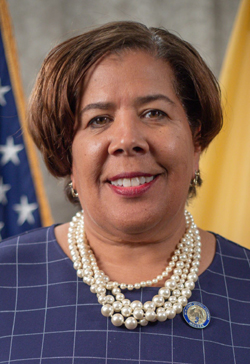
Asm. Linda Carter
Sponsored bills
Maddy summaryThis bill requires colleges and universities in New Jersey to report any allegations of sexual misconduct committed by health care professionals employed at their institutions to the relevant state licensing board. The licensing board must then investigate the allegation to determine if disciplinary action, license suspension, or restrictions are needed. Institutions making these reports in good faith are protected from civil liability. The law directly affects higher education institutions, health care professionals (like nurses or therapists), and the state licensing boards that oversee their credentials. It does not replace campus investigations or law enforcement reporting.
Maddy summaryThis bill (NJ A2377) reduces clinical practice requirements for teacher candidates seeking a "certificate of eligibility with advanced standing" in New Jersey. Currently, candidates must complete 175 hours of field-based experience (including 100 hours in the semester before full-time practice) over two semesters. The bill requires the State Board of Education to lower these requirements, directing the Commissioner of Education to develop recommendations for reduction after consulting education stakeholders. The change aims to allow candidates to fulfill clinical practice requirements in a single semester instead of two, directly affecting teacher training programs and aspiring educators.
Maddy summaryThis bill increases annual payments from New Jersey's Energy Tax Receipts Property Tax Relief Fund to municipalities by $15 million (from $740 million to $755 million) over two years. It directly affects most municipalities (excluding those with a municipal purposes tax rate of $0.10 or less per $100) by requiring them to subtract this additional aid from their property tax levies. The bill also prohibits municipalities from anticipating certain revenue when creating annual budgets. These changes aim to provide more direct property tax relief to local governments through the existing fund, which receives energy-related tax revenues.
Maddy summaryNew Jersey's A 1399 (now law as P.L.2025, c.255) creates a new criminal offense for possessing digital instructions that enable illegal firearm manufacturing. The law specifically targets digital files, guides, or plans that could be used to make firearms or components without authorization. It directly affects individuals who access or share such digital materials, making it a crime separate from actually manufacturing firearms. This provision adds to New Jersey's existing firearm laws by addressing the digital means of circumventing manufacturing restrictions. The law became effective upon enactment and does not change penalties for actual illegal firearm production.
Maddy summaryThis bill establishes a two-year pilot program to improve coordination of behavioral health services in New Jersey. It requires the Department of Human Services to identify eligible patients with severe behavioral health disorders using Medicaid data, then contract with community providers to deliver coordinated care. Key mechanisms include mandatory needs assessments, "rapid referrals" for timely access to services, "warm hand-offs" between providers, and hiring service navigators to help patients access treatment. The program directly affects patients with severe mental health or substance use disorders who are identified through Medicaid claims. The pilot will operate across three regions of the state, with managed care organizations administering the program.
Maddy summaryAJR 73 designates May of each year as "Older Americans Month" in New Jersey through a symbolic resolution. It requests the Governor issue an annual proclamation encouraging public recognition of older residents' contributions to community life, civic engagement, and the workforce. The bill does not create new programs, funding, or policy changes - it solely establishes a formal month of acknowledgment. This follows a national tradition that began in 1980, focusing on honoring older Americans' ongoing value and rededicating efforts to support their well-being.
Maddy summaryThis bill requires New Jersey's Higher Education Student Assistance Authority to grant a 12-week payment pause on NJCLASS student loans for eligible borrowers who become parents. To qualify, borrowers must submit proof of a child's birth or adoption within 120 days, with the deferment starting once proof is received and ending 12 weeks later. During this period, no interest accrues on the loan, directly affecting new parent borrowers enrolled in the NJCLASS program. The bill takes effect immediately upon enactment.
Maddy summaryBill A 2338 required public transportation employees, motorbus operators, hotel/motel staff, healthcare facility workers, and judicial personnel to complete one-time training on recognizing human trafficking signs and responding appropriately. The training, mandated as a condition for license renewals or employment, must include specific content about victim signals observed in public spaces and be reviewed biennially. It applied directly to licensed entities like hotels, healthcare facilities, and transit operators, with enforcement handled by the Department of Community Affairs and Department of Health. The bill was withdrawn on January 13, 2026, after being approved as P.L.2025, c.343.
Maddy summaryThis bill requires every New Jersey municipality to establish a local animal control program providing services like impounding stray animals and enforcing animal welfare laws. It mandates municipalities to appoint a health officer to oversee these programs and report quarterly to both their local government and the state Department of Health (DOH). The DOH will monitor compliance and handle public complaints about animal control failures, while appropriating $500,000 in grants to help municipalities cover program costs. The law directly affects all 565 New Jersey municipalities and their animal control operations, ensuring standardized enforcement of state animal welfare regulations.