

Maddy summaryThis bill (A 1723) requires prime contractors who win state construction, goods, services, or professional services contracts to notify subcontractors they listed on the bid within 30 days of receiving contract award notice. The notification, sent by certified mail, must include the state agency name, a description of the prime contractor's work, and the subcontractor's specific tasks with timeframe. Prime contractors who fail to provide this notice face penalties outlined in their contract. The law directly affects prime contractors and subcontractors working on state projects in New Jersey. It takes effect immediately upon enactment.
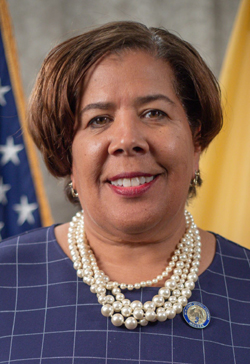
Asm. Linda Carter
Sponsored bills
Maddy summaryNew Jersey Bill A-1329 establishes the "New Jersey Pathways to Career Opportunities Initiative" to connect students, workers, and job seekers with training for high-demand careers. It creates Centers of Workforce Innovation at community colleges focused on 11 key fields like healthcare, cybersecurity, renewable energy, and manufacturing. These centers will develop public curricula, provide job-specific skills training, promote financial aid (including Community College Opportunity Grants), and expand apprenticeships. The bill was introduced in 2026 but withdrawn after being approved as P.L.2025, c.374.
Maddy summaryThis bill requires New Jersey county colleges to collaborate with county social services boards and state agencies to expand access to social services for low-income students. It mandates colleges to work directly with social services representatives to help students apply for programs like SNAP, TANF, and childcare subsidies, and to streamline enrollment processes. The bill also directs colleges and workforce boards to partner with community organizations to identify unemployed residents who could benefit from college enrollment for career pathways. These provisions aim to connect students with existing support systems and improve access to education and workforce opportunities.
Maddy summaryThis bill amends New Jersey's Public Employees' Retirement System (PERS) rules to allow temporary state employees at psychiatric hospitals or correctional facilities to qualify for accidental disability benefits. It specifically covers injuries sustained after January 2003 while working temporarily at these facilities (before becoming a PERS member), making such injuries eligible for PERS benefits once the employee gains membership. The key change deems these pre-membership injuries as occurring "during membership" if the employee joins PERS without interruption in the same job. This expands eligibility beyond current rules, which only provided workers' compensation for such injuries before PERS membership.
Maddy summaryThis bill amends New Jersey's fiscal year 2026 budget to reassign $2 million in health services funding from "Salvation and Social Justice" to the Greater Mount Zion Community Development Corporation. The funds will continue supporting a maternal health birthing center in Trenton, with no change to the total appropriation amount or the purpose of the funding. The reassignment specifically updates the budget line item to direct the grant to Greater Mount Zion, a Trenton-based nonprofit focused on maternal health and community development. The bill does not create new funding or alter existing program goals.
Maddy summaryThis bill directs New Jersey's State Board of Education to create three new teaching certifications: 1) A "Students with Disabilities Preschool through Grade 12" endorsement (excluding blind/visually impaired or deaf/hard of hearing students), allowing teachers to instruct all students with disabilities across all grade levels without separate endorsements. 2) A "Kindergarten through Grade 8" endorsement enabling teachers to instruct grades K-6 and specialty subjects in grades 7-8. 3) A "Bilingual and Bicultural Preschool through Grade 12" endorsement requiring language proficiency and coursework, replacing current requirements that needed separate subject/grade endorsements. These changes primarily affect current and prospective teachers seeking certification in special education, elementary/middle school, and bilingual education, streamlining their qualifications for New Jersey public schools.
Maddy summaryThis bill establishes New Jersey's Second Chance Program within the Department of Labor and Workforce Development. The program provides career opportunities for formerly incarcerated individuals by partnering with labor organizations to identify and create employment pathways in local trades. It directly affects people recently released from prison who face significant barriers to stable work. The key mechanism requires labor organizations - defined as per federal law - to collaborate with the state in developing job placement plans, aiming to reduce recidivism through meaningful employment. The bill takes effect immediately upon enactment.
Maddy summaryThis bill requires the New Jersey Motor Vehicle Commission (MVC) to accept birth certificates, marriage certificates, social security cards, divorce decrees, or court orders as valid proof of a legal name change for driver's licenses. It extends the deadline for updating a license name from two weeks to six months after a name change (or until the next license renewal), removing previous barriers like requiring court orders for middle name changes. The bill also clarifies that digitized signature images count as handwritten signatures for license updates. This directly affects New Jersey drivers who have legally changed their names through marriage, divorce, or court order. The policy change simplifies the process for updating license information without requiring additional court documentation.
Maddy summaryAJR 23 adopts the International Holocaust Remembrance Alliance's (IHRA) non-legally binding working definition of antisemitism for New Jersey. The bill defines antisemitism as "a certain perception of Jews, which may be expressed as hatred toward Jews" and includes examples like targeting Jewish individuals, property, or community institutions. It is intended solely as an educational tool for state employees, law enforcement, and educators to recognize and address antisemitism, not as a legal standard. The resolution explicitly states it does not infringe on free speech, including criticism of Israel. New Jersey joins 38 countries and several U.S. states that have endorsed this definition.
Maddy summaryThis bill requires New Jersey's professional licensing boards (e.g., for nursing, engineering, and other regulated occupations) to collect national average application approval times from other states and calculate a standard for their own processing timelines. Boards must use this national average as their target for approving initial credentials, after approval by the Division of Consumer Affairs. If boards miss the target, they must use licensing fees to hire third-party experts to identify improvements, with follow-up reviews after six months. The law mandates initial data collection within six months of enactment, followed by annual accuracy reviews to ensure boards meet the standardized timelines.