

Maddy summaryThis bill updates the continuing education rules for real estate licensees in New Jersey and increases oversight of the companies and instructors that provide this training. It directly affects real estate brokers, salespersons, and the organizations that teach them, requiring more specific training hours and stricter standards for course providers. The legislation also expands background check procedures for license applicants and clarifies requirements for those working with real estate referral companies.
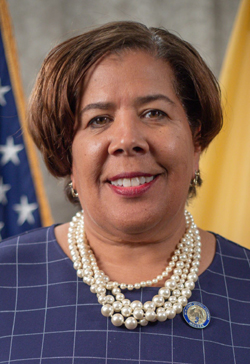
Asm. Linda Carter
Sponsored bills
Maddy summaryThis bill (A 2132) requires operators of New Jersey's Access Link paratransit service to announce every scheduled stop on their route, either verbally or via a recording system. It directly affects Access Link drivers and the New Jersey Transit Corporation, which operates this ADA-compliant paratransit service for riders with disabilities. Currently, only fixed-route transit systems (like buses on set schedules) must announce stops, but Access Link - being a non-fixed-route service - was previously exempt. The bill extends the stop-announcement requirement to all Access Link vehicles to improve accessibility and rider awareness. It takes effect two months after enactment.
Maddy summaryThis bill exempts wages earned by poll workers during election cycles from being counted when calculating an individual's unemployment benefits. It directly affects poll workers who may otherwise have their unemployment compensation reduced due to income earned from temporary election work. The key provision amends New Jersey's unemployment law to exclude poll workers' wages from the "annual payroll" calculation used to determine benefit eligibility. This change ensures poll workers can receive full unemployment benefits without their election-season earnings affecting their claim. The bill focuses solely on adjusting the calculation method for this specific group of workers.
Maddy summaryThis New Jersey bill (A 1552) increases penalties for repeated violations of limousine safety and licensing laws. It specifically targets operators who: - Run unlicensed limousines or allow unlicensed drivers, - Fail to maintain $1.5 million insurance, or - Overload vehicles beyond seating capacity. For third or subsequent offenses, penalties jump to $7,500 fines, a six-month driver’s license suspension, and immediate vehicle seizure. The bill also raises fines for unregistered limousines or un-inspected vehicles to $7,500 with vehicle seizure for repeat violations.
Maddy summaryThis bill amends New Jersey's electric vehicle (EV) parking requirements to clarify how the number of required EV parking spaces is calculated. It specifies that if a fractional space is needed (e.g., 10.2 spaces), it must be rounded up to the next whole number. However, the rounded-up total cannot reduce the overall parking supply by more than 10 percent. This applies to developers building new multi-unit housing or parking facilities that must comply with existing EV parking mandates under P.L.2021, c.171. The rule ensures rounding up does not significantly limit available parking spaces.
Maddy summaryThis bill designates a specific segment of State Highway Route 35 in Laurence Harbor (from milepost 45.37 to 47.26) as the "James Francisco and Walter Schmidt Memorial Roadway" to honor two New Jersey veterans who died in the Vietnam War. It requires the Commissioner of Transportation to install signs bearing this name but prohibits using public funds for the signs. Instead, the bill allows the state to accept private funding from organizations or individuals to cover the costs of producing, installing, and maintaining the signage. The legislation takes effect immediately upon passage.
Maddy summaryThis bill authorizes the New Jersey Infrastructure Bank to spend $65.55 million in loans for transportation infrastructure projects during the 2027 fiscal year. The legislation allows the bank to provide funding to local government units for construction costs and includes specific provisions for forgiving up to $1 million in planning and design loans under certain conditions. Additionally, the act permits the bank to use additional funds to cover its own operational expenses, such as bond issuance costs and reserve requirements. While the text lists specific eligible projects, the summary of those details is incomplete in the provided document.
Maddy summaryThis bill, titled the "John R. Lewis Voter Empowerment Act of New Jersey," is a commemorative resolution naming a state initiative after civil rights leader John Lewis. It appropriates $2.5 million but does not establish new voting procedures or protections. The bill primarily includes recognition language affirming New Jersey’s commitment to voting rights for protected classes and defines terms like "covered entity" for future reference, though no specific implementation mechanisms are detailed. As it is pending technical review and lacks concrete policy changes, it functions as a symbolic gesture rather than a substantive legislative action.
Maddy summaryThis bill extends temporary rules allowing New Jersey medical facilities to hold individuals involuntarily for up to 72 hours without a court order, provided the person was referred by a screening service. It requires hospitals to initiate formal commitment court proceedings within 24 hours of admission and mandates that any extension of the hold beyond the initial 72-hour window must be approved by a judge or consented to by the patient. To obtain an extension, facilities must demonstrate they have exhausted efforts to transfer the patient to another appropriate facility and provide evidence from two psychiatrists indicating the individual poses a danger to themselves or others. The legislation also ensures that legal counsel is appointed to represent the patient during these emergency applications and that courts review the documentation before granting additional time.
Maddy summaryThis bill creates the School-Based Partnerships for Access and Resilience for Kids program within the Department of Children and Families to support student mental health. It requires school districts, charter schools, and renaissance schools to develop specific mental health support programs that connect students with high behavioral health needs to the new SPARK program navigator. The SPARK program, operated by the New Jersey Pediatric Psychiatry Collaborative, will provide same-day psychiatric consultations, referrals to community providers, and assistance with school re-entry after a mental health crisis. Access to these services is limited to students in kindergarten through grade 12 and requires written consent from a parent or legal guardian. Additionally, the bill mandates that schools have designated staff or formal agreements with external providers to ensure ongoing counseling support for their students.