

Maddy summaryThis bill designates the interchange between State Highway Route 42 and Interstate Highway Route 295 in New Jersey as the "Ensign John R. Elliott Memorial Interchange" to honor a U.S. Naval Academy graduate killed in a 2000 traffic accident. It requires the state transportation commissioner to install signs bearing this name but explicitly prohibits using public funds for the signage. Instead, the state must secure private donations or grants from nonprofits, charities, or other private entities to cover all costs related to the signs. The bill takes immediate effect and affects only the specific highway junction, with no broader policy changes.
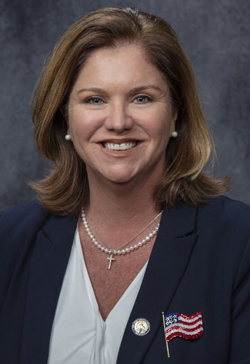
Asm. Claire Swift
Sponsored bills
Maddy summaryThis bill expands New Jersey's Mobility and Transportation Innovation Pilot Program from a Mercer County-only initiative to cover the entire state, allowing local governments and transit agencies statewide to apply for grants. It adds specific requirements for projects, including ensuring access for low-income residents without smartphones or credit cards and requiring wheelchair-accessible vehicles and accessible mobile apps. The bill appropriates $20 million in new state funding (beyond an existing $2 million) to support these grants. The program funds transportation projects using innovative technologies to improve mobility, accessibility, and sustainability in disadvantaged communities.
Maddy summaryThis bill would allow expectant mothers in New Jersey who are in their third trimester of pregnancy to receive a temporary parking placard. The $4 placard, valid for up to three months, permits mothers to park longer at metered spots or use disability parking spaces without needing a separate disability permit. To qualify, a mother must provide written certification from a doctor, nurse practitioner, or other qualified healthcare provider confirming her third-trimester status. The placard must be displayed on the vehicle and clearly show an expiration date.
Maddy summaryThis bill would exclude up to $50,000 of gross income from taxation for qualified small businesses under New Jersey's gross income tax and corporation business tax. To qualify, businesses must be independently owned with management owning at least 51% ownership interest, have principal operations located in New Jersey, be registered to do business in the state, earn gross revenues under $2 million annually, and employ no more than 20 full-time or part-time employees (with most being New Jersey residents). The exclusion applies to taxable years beginning after December 31, 2024. This provision would reduce the tax burden for eligible small businesses meeting these specific criteria. The bill provides targeted tax relief to small businesses operating within New Jersey.
Maddy summaryThis bill (A4538) caps annual tuition increases for in-state undergraduate students at New Jersey's public colleges and universities at 2% above the previous year's rate. It directly affects public institutions of higher education and resident undergraduate students by restricting how much tuition can rise each academic year. The law takes effect immediately for the first full academic year after enactment, applying to all public higher education institutions in New Jersey.
Maddy summaryThis bill amends New Jersey's bias intimidation law to specifically include Sikhism as a protected class, making it illegal to commit hate crimes against Sikhs based on their religious identity. It appropriates $100,000 annually for three years to fund Sikh awareness educational initiatives, including law enforcement training on Sikh identity features like turbans and religious symbols to prevent misclassification of hate incidents. The bill requires the Office of Attorney General to develop public awareness campaigns and educational programs about Sikhism for public schools, and mandates that all public entities incorporate anti-Sikh hate into their bias intimidation policies and diversity programs. These changes directly affect Sikhs in New Jersey (who are the second-most targeted religious group for hate crimes) and all public institutions across the state.
Maddy summaryThis bill creates a 10-year urban enterprise zone in Atlantic City to stimulate economic development. Businesses within the zone (excluding casino operations themselves, but including non-casino businesses operating on casino property that meet eligibility criteria) would qualify for a 50% reduction in sales tax on qualifying retail sales. The tax revenues collected from these businesses would be directed to a public safety trust fund specifically for Atlantic City to fund public safety services. The zone would be established within 90 days of Atlantic City submitting an application and zone development plan.
Maddy summaryThis bill expands the definition of "child" under New Jersey's Police and Firemen's Retirement System (PFRS) and State Police Retirement System (SPRS) to include disabled children of any age. Specifically, it adds a new category for children who are unable to work due to a long-term disability (lasting or expected to last at least 12 months), as verified by a medical board. This change directly affects adult children of retired or deceased police and firefighter members, allowing them to qualify for benefits they previously might not have received. The amendment modifies the eligibility criteria without altering other aspects of the retirement systems.
Maddy summaryThis bill prohibits unauthorized drone operations near schools in New Jersey. It makes it a disorderly persons offense to fly a drone below 250 feet over school property for surveillance, to hover over school grounds without permission, or to use school buildings/grounds as a drone takeoff or landing site. School administrators must provide written authorization for any drone activity within this zone. Violations carry penalties of up to six months in jail, a $1,000 fine, or both. The law specifically exempts authorized public employees and first responders operating drones for official duties.
Maddy summaryThis bill changes penalties for underage gambling in New Jersey from criminal charges to civil fines. It affects minors who gamble (now facing fines up to $2,000 for repeat offenses), casino employees or licensees who allow underage gambling (liable to the same fines), and Atlantic City (which will receive all collected fines). Key provisions set specific fine tiers: $500 for a first offense, $1,000 for a second, and $2,000+ for subsequent offenses. All fines collected will be deposited exclusively into Atlantic City's public safety services trust fund, with no criminal records or court proceedings involved.