

Maddy summaryThis bill requires New Jersey to amend its building code to ban burning high-emission fuels (like natural gas) in new construction. Starting 12 months after enactment, it prohibits such combustion in new buildings under seven stories; 36 months later, the ban applies to all new buildings regardless of height. Exemptions apply only to emergency systems, emergency facilities, and commercial food establishments, though these areas must still be designed to be "all-electric ready" where feasible. The bill also mandates a joint report on electric rate adjustments within 12 months and allows municipalities to impose stricter rules. (Pending before the Assembly Housing Committee as of 2026-01-13.)
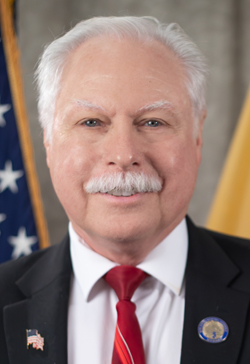
Asm. Robert Karabinchak
Sponsored bills
Maddy summaryThis bill establishes a licensing requirement for individual landscape professionals and a registration system for landscaping businesses in New Jersey. It directly affects landscape workers seeking to practice legally and landscaping companies operating within the state, while exempting those already licensed in related fields (like architects or engineers) who work within their scope of practice. The bill creates a Landscape Professional License Review Committee to oversee the process and ensures public members on licensing boards avoid conflicts of interest. It aims to protect public safety and interests by preventing unqualified individuals or businesses from performing landscape services. The legislation follows findings that landscape work is vital to New Jersey's economy, environment, and community well-being, with no existing statewide licensing for this field.
Maddy summaryNew Jersey's bill A 3913 creates a tax credit program to incentivize employers to hire military spouses affected by frequent relocations. Employers who hire nonresident military spouses (spouses of active-duty service members transferred to New Jersey, legally domiciled here, or on permanent change-of-station) can claim a tax credit equal to 15% of wages for 120-400 hours worked or 25% for over 400 hours annually, capped at $2,400 per employee. The credit reduces the employer's corporation business tax or gross income tax liability. This policy directly supports military spouses whose careers are disrupted by service-related moves, aiming to improve their employment stability.
Maddy summaryThis bill authorizes the construction of energy transmission and distribution infrastructure (like power lines and equipment) on preserved farmland, which is land protected by conservation easements. It requires landowner approval, limits installations to a 50-foot right-of-way along the farm's edge, and mandates specific installation methods (e.g., underground trenches deeper than 3 feet) to minimize disruption to farming. Projects not meeting these conditions must seek committee approval, balancing agricultural use with state energy needs. The bill was enacted as P.L.2025, c.390, after being introduced and withdrawn in 2026.
Maddy summaryThis bill requires New Jersey's Motor Vehicle Commission (MVC) to create an online application system for residents to obtain REAL ID-compliant identification cards and driver's licenses. It directly affects New Jersey residents who need these federally recognized IDs for activities like boarding domestic flights or entering federal buildings. The key provision mandates the MVC to accept digital copies of required identity and residency documents through its website, while ensuring applications meet federal REAL ID standards. The MVC must also establish privacy safeguards for personal information processed online, with rules to be adopted within 60 days of the bill's enactment.
Maddy summaryThis bill establishes a public awareness campaign about social media's risks to minors, targeting parents and guardians of children aged 13-17. It appropriates $500,000 from the General Fund for the New Jersey Department of Education to develop and implement the campaign within 180 days of enactment. The campaign will use statewide media channels - including newspapers, radio, TV ads, and social media - to share research on social media's mental health impacts, based on the U.S. Surgeon General’s 2023 advisory. The Commissioner of Education must report on the campaign’s progress to the Governor and Legislature within 24 months of the bill’s effective date.
Maddy summaryThis bill (A 2446) allows New Jersey counties and municipalities to make voluntary annual contributions of up to $70,000 to qualifying nonprofit veterans' organizations. The funds must be used for specific veteran services like housing assistance, mental health support, career transition programs, and family resources. Local governments must receive annual accounting from these organizations detailing how the funds were spent to support veterans within their jurisdiction. The bill defines eligible organizations as those meeting IRS 501(c)(19) tax-exempt status and providing services related to veterans' physical, emotional, or medical needs.
Maddy summaryThis bill allows large food waste generators (those producing 52+ tons of food waste annually within 25 miles of a recycling facility) to continue sending their food waste to sanitary landfills that capture landfill gas for renewable energy, if they were already doing so as of April 14, 2020. Generators using this method remain compliant with existing recycling requirements without switching to authorized recycling facilities. The bill maintains standard recycling rules for other generators and includes a waiver process if recycling costs exceed disposal costs by 10 percent. It also preserves penalties for non-compliance and requires the Department of Environmental Protection to publish facility details.
Maddy summaryThis New Jersey bill (A2303) clarifies that consent to being photographed, filmed, or recorded in an intimate or sexual context does not automatically allow the disclosure of those images. It requires separate, explicit consent for image disclosure - meaning a person’s permission to take a photo isn’t considered consent to share it. The law directly affects individuals in private settings (like dressing rooms) and anyone who might share such images without clear, separate permission. The key change prevents implied consent for disclosure, making it a distinct offense to share images without fresh, specific authorization.
Maddy summaryThis bill requires New Jersey's Department of Health (DOH) and Department of Environmental Protection (DEP) to create best practices for managing medical waste, focusing on public health and environmental protection. It directly affects hospitals (licensed under state law) and medical offices (non-licensed facilities providing medical services), mandating each to develop a written waste management plan based on those best practices. The plan must include clear guidelines for personal protective equipment use, visible waste sorting methods with signage, and instructions for properly identifying and sorting waste at its source. Additionally, facilities must train relevant employees on implementing these plans. The bill takes effect 180 days after enactment.