

Maddy summaryThis bill (A 2731) adds the right to use assisted reproductive technology (ART), including in vitro fertilization (IVF), to New Jersey's fundamental reproductive rights. It directly affects all individuals in New Jersey, including those under state control, by legally protecting their choice to access ART for starting or expanding a family. The key mechanism declares any state law, rule, or regulation limiting this right "deemed invalid" and unenforceable under New Jersey law. The bill responds to Alabama's 2024 court ruling that threatened IVF access, expanding existing protections for reproductive choices. It takes effect immediately upon enactment.
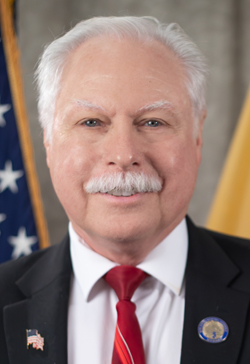
Asm. Robert Karabinchak
Sponsored bills
Maddy summaryThis bill requires New Jersey state agencies to offer businesses an optional electronic service for receiving legally required notices, such as violation warnings, underpayment alerts, and unemployment claims. It directly affects businesses operating in New Jersey that receive these official notices from state entities. State agencies must notify businesses about the electronic option within 60 days of the bill’s enactment and provide instructions for opting in. The bill does not change existing notice requirements but adds an electronic alternative, with the law taking effect 90 days after enactment.
Maddy summaryThis bill (A3955) requires New Jersey's Business Action Center to study vacant commercial real estate and its impact on small businesses. The study must examine how local governments track vacancies, assess existing programs aiding vacant space, survey business owners' experiences finding space, and recommend improvements. The report must be submitted to the Governor and Legislature within one year of the bill's effective date. This bill does not create new programs but mandates a review to inform future policy decisions. It directly affects small businesses seeking commercial space and local governments managing vacant properties.
Maddy summaryAJR 118 designates March 10, 2026, as "South Plainfield Day" in New Jersey to commemorate the 100th anniversary of the borough's incorporation (March 10, 1926). The resolution requires the Governor to issue a proclamation encouraging public observance and directs copies of the resolution to be sent to the Borough of South Plainfield. This ceremonial measure directly affects South Plainfield, honoring its centennial and historical significance without creating new laws or financial obligations.
Maddy summaryThis bill requires all New Jersey state agencies, counties, municipalities, school districts, and other local government entities to purchase at least 5% of their goods and services from the Central Nonprofit Agency (CNA), which supports rehabilitation facilities. It grants the CNA a "right of first refusal" for any goods/services typically bought through cooperative purchasing catalogs, provided they can match prices within 15% of fair market value. The bill also mandates that the Division of Purchase and Property create training protocols for all purchasing agents to ensure awareness of the CNA program, with annual reporting on compliance by all affected entities. These requirements apply to all state and local government bodies authorized to make purchases.
Maddy summaryThis bill requires drivers to stop at least 25 feet from school buses loading/unloading children or individuals with developmental disabilities on undivided highways, and to slow to 10 mph on divided highways. It establishes that violations captured by school bus monitoring systems (like cameras) will result in a $300 civil penalty instead of criminal charges or license points. The law directly affects drivers near school buses, school bus operators, and enforcement agencies. Key provisions include standardized stopping distances, speed limits for divided highways, and shifting penalties for monitored violations to a civil fine system. This changes enforcement by prioritizing evidence from monitoring systems to reduce penalties for documented violations.
Maddy summaryThis bill amends New Jersey's solar incentive program (SREC-II) to increase the state's solar energy development goal from 3,750 megawatts to 6,500 megawatts and extend the target deadline from 2026 to 2035. It maintains the existing system where solar energy producers earn SREC-II certificates for each megawatt-hour generated, which can be sold to utilities to meet renewable energy requirements. The policy directly affects solar developers, property owners with solar installations, and utilities required to comply with renewable energy standards. The change aims to accelerate solar adoption by providing long-term certainty for projects through 2035.
Maddy summaryThis bill creates the Division of Energy Resource and Development within the Department of the Treasury, transferring key energy policy responsibilities from the Board of Public Utilities (BPU) to the new division. It specifically moves BPU's energy efficiency programs, clean energy initiatives, electric vehicle incentives, and energy generation planning to the division. The division will focus on advancing New Jersey's clean energy goals through unified strategy development, public education on sustainable energy, and supporting state agencies in meeting greenhouse gas reduction targets. The division will be led by a governor-appointed director who will oversee the transition of BPU functions and develop crisis response plans for energy systems.
Maddy summaryThis bill requires New Jersey's Department of Education to partner with a nonprofit to create a free, public online registry of tutors and tutoring organizations. It allows eligible participants - including certified teachers, retired educators, college students, industry professionals, and relevant organizations - to list their contact details, subject expertise, and availability without charging students for services. All registrants (except certified teachers with prior background checks) must undergo a criminal history check, and the registry will include a disclaimer noting the information hasn't been verified or endorsed by the state. The registry will be accessible on the Department of Education's website to connect students with free tutoring support.
Maddy summaryThis bill amends New Jersey's "90-Day Law" to exclude pipeline construction permits for natural gas and petroleum products, along with related infrastructure like compressor stations, from automatic approval if the Department of Environmental Protection (DEP) doesn't act within 90 days. Currently, most construction permits (e.g., for waterfront development or coastal wetlands) automatically become approved after 90 days without a DEP decision, but this bill removes pipeline projects from that rule. Pipeline developers must now wait for an explicit DEP decision within the 90-day window instead of relying on automatic approval. The change applies only to pipeline permits and does not affect other types of permits covered by the 90-Day Law.