

Maddy summaryThis bill establishes minimum nurse-to-patient staffing ratios for hospitals, ambulatory surgery centers, and state developmental/psychiatric hospitals in New Jersey. It requires specific ratios, such as 1 nurse per 4 patients on medical/surgical units and 1 nurse per 2 patients in critical care, along with unlicensed staff ratios (1 per 7 patients during day shifts). Hospitals must implement an acuity-based staffing system approved by the health department to adjust staffing based on patient needs and unit conditions. The law aims to ensure safe staffing levels without reducing existing standards, directly affecting healthcare facilities and patient safety.
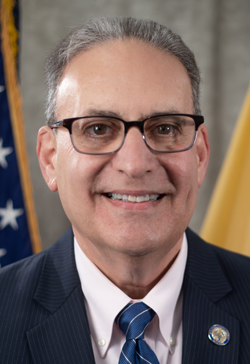
Asm. Roy Freiman
Sponsored bills
Maddy summaryThis bill allows dental service corporations (nonprofit organizations providing dental care to subscribers) to form a nonprofit parent corporation under specific conditions. It creates a new process requiring board approval and commissioner review to establish the parent structure, while ensuring the original dental service corporation maintains its nonprofit status and charitable purpose. The change aims to modernize corporate structures to better utilize technology, improve oral health services, and support business growth for subscribers. It directly affects existing dental service corporations and their subscribers in New Jersey, without altering the core mission of providing dental care.
Maddy summaryThis bill defines "Islamophobia" for New Jersey state law as a form of racism targeting Muslim identity or perceived Muslim identity, including discrimination, stereotyping, harassment, or violence against Muslims or Muslim-majority communities. It requires state officials and law enforcement to use this definition when reviewing civil or criminal cases involving anti-Muslim bias. The definition explicitly excludes criticism of Muslim-majority countries similar to criticism of other nations. The bill does not override First Amendment protections or existing anti-discrimination laws. This is New Jersey's first state-level definition of Islamophobia, adopted to standardize responses to anti-Muslim hate incidents.
Maddy summaryThis New Jersey bill provides a 20% refundable tax credit for eligible residents who pay for in-home care services through a health care service firm. It directly affects taxpayers with gross income under $150,000 who are permanently disabled or age 65+, covering expenses for companion services (non-medical supervision/socialization), health care services (non-licensed), or personal care services (assisting with daily activities like bathing or dressing). The credit excludes insurance-reimbursed costs and applies against income tax after other credits. It takes effect for taxable years starting after enactment.
Maddy summaryThis bill provides tax credits to New Jersey-based small businesses during their first three years of operation. It directly affects qualifying startups that are registered in New Jersey, maintain most operations within the state, have no more than 50 employees, and earn under $100,000 net income in their first taxable year. The credit reduces the business's gross income tax liability by 75% in year one, 50% in year two, and 25% in year three. Businesses must apply for approval from the state director to claim these credits, ensuring they aren't using the credit to offset taxes from other unrelated businesses.
Maddy summaryThis bill requires New Jersey's Board of Public Utilities (BPU) to study the feasibility of developing advanced reactors statewide within 18 months. The study must examine suitable locations (including retired power sites), regulatory requirements, economic viability, safety, environmental impacts, and public input through three stakeholder sessions. It directs the BPU to recommend a potential program for deploying small modular reactors and publish findings online. The study expires 30 days after the report is submitted to the Governor and Legislature.
Maddy summaryThis New Jersey bill (A 1509) creates a binding arbitration process for disputes between health insurance companies (carriers) and healthcare providers (like doctors' offices or clinics) over payment rates. If negotiations fail, either party can trigger arbitration by submitting their final payment offer to the state Department of Banking and Insurance, with the arbitrator selecting one of the two offers. The bill requires carriers to notify patients 30 days before open enrollment if a provider will be out-of-network starting the next plan year, while ensuring continued in-network coverage and reimbursement until the new plan year begins. It directly affects health insurers, healthcare providers, and patients who rely on these networks for coverage.
Maddy summaryThis bill allows eligible New Jersey educators (K-12 teachers, counselors, principals) and paraprofessionals (school aides) to deduct up to $250 of unreimbursed classroom supply expenses from their gross income tax. It covers costs like books, computers, software, and classroom materials, but excludes nonathletic supplies for health or physical education classes. To qualify, individuals must work at least 900 hours annually in a New Jersey public or private elementary/secondary school. The deduction applies to taxable years starting after the bill's enactment date.
Maddy summaryThis New Jersey bill (A 946), now law as P.L.2025, c.177, requires mental health services to be provided in the communication method preferred by each deaf or hard of hearing individual - such as sign language or oral communication - based on their assessment. It mandates that mental health professionals be fluent in that method, trained in cultural needs, and able to collaborate with interpreters. The law also requires a state resource guide listing specialized mental health services and ensures individuals can help shape their own care plans. It directly affects all deaf or hard of hearing residents seeking mental health support in New Jersey, addressing long-standing barriers in access and care quality.
Maddy summaryThis bill amends New Jersey's brewery licensing laws to permit certain licensed breweries to sell alcoholic beverages by the glass for on-premises consumption in designated salesrooms. Specifically, it expands the "Limited brewery license" (Section 1b) to allow license holders to sell up to 15.5 fluid gallons per person for off-premises consumption and to offer samples, while maintaining existing restrictions on food sales. The provision directly affects licensed breweries seeking to sell directly to consumers in tasting rooms or sales facilities. Note: The bill's title incorrectly references "wineries," but the text applies only to breweries producing malt alcoholic beverages, not wine producers. This bill was withdrawn after being enacted as P.L.2025, c.376.