

Maddy summaryThis bill establishes a two-year Statewide Animal Advocate Program within New Jersey's Administrative Office of the Courts (AOC). It allows courts to appoint a special advocate in criminal cases involving animal welfare (such as cruelty or dog fighting charges) to represent the animal's best interests, rather than the owner or state. The advocate monitors cases, reviews records from vets and officers, shares information with attorneys, and recommends animal placement to the court. The program expires after two years, requiring a report on implementation and recommendations for continuation.
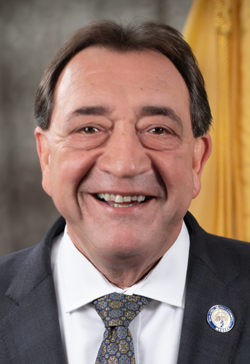
Asm. Anthony Verrelli
Sponsored bills
Maddy summaryThis bill (A 1512) allows trained operators of New Jersey’s Suicide Hopeline to make follow-up calls to minors aged 16 or older who contact the hotline and are identified as high-risk for suicide, without requiring parental consent. It directly affects minors in crisis by enabling immediate, confidential support from the Hopeline after an initial call. The key mechanism amends existing law to explicitly permit these brief, supportive follow-up calls - specifically for suicide prevention - while clarifying they do not constitute formal mental health treatment. The bill was withdrawn after being approved as part of P.L.2025, c.238, meaning the policy change is now in effect.
Maddy summaryThis bill provides financial adjustments for New Jersey state contractors who faced unexpected material cost increases exceeding 5% after awarding construction contracts. It directly affects contractors with pre-April 2020 bids for projects where materials were purchased after March 2020. The key mechanism allows contract price adjustments based on U.S. Department of Labor economic indices, requiring written applications with evidence and State Treasurer approval, while mandating downward adjustments if material costs later decrease. The relief applies only to contracts meeting these specific timing and cost thresholds and expires June 30, 2023.
Maddy summaryThis New Jersey bill (A 946), now law as P.L.2025, c.177, requires mental health services to be provided in the communication method preferred by each deaf or hard of hearing individual - such as sign language or oral communication - based on their assessment. It mandates that mental health professionals be fluent in that method, trained in cultural needs, and able to collaborate with interpreters. The law also requires a state resource guide listing specialized mental health services and ensures individuals can help shape their own care plans. It directly affects all deaf or hard of hearing residents seeking mental health support in New Jersey, addressing long-standing barriers in access and care quality.
Maddy summaryThis bill establishes the "Trenton Makes Commission" within New Jersey's Economic Development Authority to research and recommend strategies for supporting the state's manufacturing sector. The commission, composed of 13 members including appointments by the Governor, legislative leaders, and industry representatives (like the NJ Chamber of Commerce and manufacturing extension programs), will study how other states incentivize manufacturing. Its key duty is to identify cost-effective methods to attract new manufacturing businesses to New Jersey while strengthening existing ones, with a report due to the Governor and Legislature within one year. The commission itself does not implement policies but provides recommendations for potential future legislation.
Maddy summaryThis bill (A 901, "Max's Law") requires New Jersey public school districts to include age-appropriate instruction on the dangers of fentanyl and xylazine in health education for students in grades 6-12. Key provisions mandate teaching specific topics like abuse prevention, poisoning symptoms, emergency response, and legal protections for seeking help, using resources from federal agencies like the CDC and DEA. The bill also requires the state education department to provide resources, maintain online materials for schools and parents, and submit annual reports on the curriculum's effectiveness. The bill was withdrawn after being approved as P.L.2025, c.278.
Maddy summaryThis bill proposes a five-year pilot program requiring New Jersey's Juvenile Justice Commission to establish three arts-based education programs for youth in detention and correction facilities. The programs, developed through partnerships with arts organizations, community groups, and private funders, aim to build skills like critical thinking, problem-solving, and self-esteem using creative arts. Each program will undergo annual evaluation to measure impacts on educational outcomes and youth development, with final recommendations for continuation or expansion to be submitted after four years. The bill directly affects juvenile offenders in state correctional facilities and requires collaboration with the New Jersey State Council on the Arts for implementation.
Maddy summaryThis bill (A 1833) removes a specific requirement from New Jersey's Fiscal Year 2026 appropriations act that mandated the State Health Benefits Program (SHBP) achieve $100 million in cost savings during the first six months of 2026. It eliminates detailed procedures for a committee to propose, verify, and vote on cost-saving measures, including deadlines for negotiations, mediation, and potential legislative overrides. The change directly affects the SHBP, which provides health benefits to state employees and retirees, by removing the mandatory savings target. This simplifies the program's funding process without altering the underlying benefit structure or cost-sharing arrangements.
Maddy summaryThis bill requires all police basic training programs in New Jersey to include cultural diversity and implicit bias training. It directly affects police training schools, instructors, and new officers entering law enforcement. The key mechanism mandates that the Police Training Commission add specific curriculum materials developed under prior law, and requires instructors to have specialized training in this area. The bill defines "implicit bias" as unconscious attitudes or stereotypes about people. This is a concrete policy change to standardize training content, not a prediction about outcomes.
Maddy summaryThis bill requires municipal courts in New Jersey to notify applicants for public defender services about any application fee (capped at $200) and the process to waive it if they cannot afford the fee. It directly affects low-income individuals applying for municipal public defender representation in municipalities that charge such fees under existing law. The key mechanism mandates that courts provide this notice to all applicants, ensuring they know how to request a fee waiver based on financial inability. The bill does not change the fee amount or waiver standard but ensures courts proactively inform applicants of their options.