

Maddy summaryThis bill requires New Jersey law enforcement officers to reveal their facial identity during public interactions (e.g., stops, patrols) and present clear identification before detaining or arresting someone. Officers must show one of four acceptable forms of ID: a uniform with agency insignia, a photo ID card, a numbered badge, or verbally state their name and agency. Exceptions apply for undercover work, medical masks with physician approval, smoke protection during emergencies, or situations where revealing ID could compromise investigations, safety, or stealth operations. The law applies to all officers (federal, state, local) and directly affects members of the public during police encounters, aiming to increase transparency during interactions.
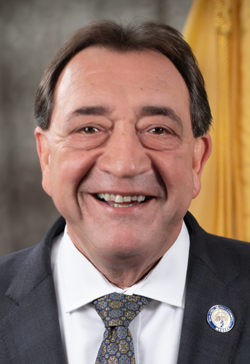
Asm. Anthony Verrelli
Sponsored bills
Maddy summaryThis bill requires New Jersey's State Treasurer to create and maintain a public registry of out-of-state contractors awarded public works contracts in the state. The registry must include the project description, trade name, owner name, and principal business address of each contractor. It must be displayed on the Department of the Treasury's website and provided upon request to any contractor, out-of-state contractor, or public body. The bill defines "out-of-state contractor" as one with a principal business outside New Jersey, excluding temporary satellite offices for a single project.
Maddy summaryThis bill (A6185) establishes requirements for on-demand micro transit programs in New Jersey, which provide app-based shared rides using technology. It directly affects entities operating these services, including NJ Transit, county transit agencies, and third-party contractors. Key provisions require drivers to hold commercial licenses and be paid fairly (matching directly employed drivers), mandate that programs add service in "transit deserts" (areas with poor public transit access) instead of replacing existing routes, and require contractors to offer jobs to existing transit workers under current terms. The bill also creates a Micro Transit Oversight Committee to review and certify program plans.
Maddy summaryThis bill requires New Jersey's Department of Environmental Protection (DEP) to establish a 14-day annual period when only New Jersey residents can purchase mobile sport fishing permits. These permits allow motor vehicle use on beaches for fishing (including annual, 3-day, weekday, and daily options). The DEP must create rules to verify residency during this window, but the core change is limiting initial permit sales to residents for 14 days each year. The policy directly affects non-residents seeking these specific permits during the designated period.
Maddy summaryThis bill creates a proportional property tax exemption for New Jersey veterans who are honorably discharged and have a service-connected permanent disability rated at 10% or higher. It directly affects qualifying veterans (and their surviving spouses) by reducing their property taxes in line with their disability rating, with a $10,000 cap for exemptions below 100% disability. Veterans deemed unemployable due to service-connected disability receive a full 100% exemption, matching current benefits for those with 100% disability ratings. The bill also requires the state to reimburse municipalities 102% of the tax costs for these exemptions, including administrative expenses, through annual reporting by local tax authorities.
Maddy summaryThis bill amends New Jersey's child labor law to allow minors aged 14-15 employed by national sports associations, leagues, or teams to work beyond 11:30 p.m. under specific conditions. It permits extended hours only if the work continues a prior workday that began before 11:30 p.m., such as during travel after a game or due to a match delay. A special written permit from the minor's parent or guardian, specifying approved hours, is required. The change directly affects young athletes in professional sports organizations who face scheduling constraints related to games or travel. This update modifies existing provisions that previously restricted such minors to work until 11:30 p.m.
Maddy summaryThis bill requires New Jersey's Medicaid program and Plan First program to cover fertility preservation services for individuals whose fertility may be impaired by medically necessary treatments like cancer therapy. It defines "iatrogenic infertility" as fertility loss caused by medical treatments affecting reproductive organs, and specifies that covered services include storage of sperm, eggs, embryos, and cryopreserved ovarian tissue. The coverage must be provided without discrimination based on age, gender, sexual orientation, or other personal characteristics, making these often-expensive services accessible to low-to-moderate income patients who would otherwise be unable to afford them.
Maddy summaryThis New Jersey bill prohibits most non-compete clauses for workers, including employees, independent contractors, interns, and volunteers, with specific exceptions for senior executives earning $151,164+ annually who meet certain requirements. It requires employers to notify workers that existing non-compete clauses are no longer enforceable and prohibits "no-poach" agreements between employers that restrict hiring from each other. For senior executives, non-compete clauses can remain only if limited to 12 months, protect legitimate business interests like trade secrets, and are reasonable in geographic scope. Workers can sue employers for violations, and employers who fail to comply face fines up to $1,000 for repeated violations.
Maddy summaryThis bill authorizes the State Treasurer to sell two parcels of surplus state-owned land in Mercer County to Mercer County for $1 each. The first parcel (1.3 acres on Lamberton Street in Trenton, previously used by the Department of Transportation) and the second parcel (26.3 acres at the Mercer County Fire Academy Dempster Training Center in Lawrence Township) will be transferred for public use. Both properties have been declared surplus to state needs, and the sale must be completed within nine months after the FY2026 budget is enacted. The properties must continue to be used for public purposes, with all existing federal restrictions on their use remaining in effect after the transfer.
Maddy summaryThis bill requires New Jersey state and local agencies that provide funding or issue licenses for substance or alcohol use disorder treatment to assess providers for conflicts of interest before distributing funds or granting licenses. Providers must submit financial statements, lists of board members and investors, and details about staff with outside jobs. If a conflict is found that could affect care, the provider must fix it to regain eligibility for state support. The assessment must occur at least once annually, ensuring decisions aren't unduly influenced by outside financial interests.