

Maddy summaryS 2825 removes the time limit that required municipalities to issue or transfer special licenses for bars and restaurants within areas formerly occupied by federal military installations. Under current law, municipalities had three years to issue these licenses and two additional years to transfer unissued licenses to other municipalities in the project area. This bill eliminates those deadlines, giving municipalities more time to act without penalty. The change applies to the three host municipalities in a "project area" (a redevelopment zone of a former military base, like Fort Monmouth) that are entitled to issue these licenses. The bill does not alter the number of licenses, fee structure, or other rules governing their issuance.
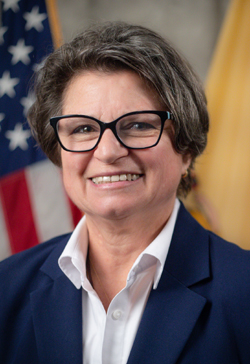
Asm. Luanne Peterpaul
Sponsored bills
Maddy summaryThis Assembly Resolution (AR 138) symbolically designates June 2024 as LGBTQIA+ Pride Month in New Jersey. It urges public officials and citizens to commemorate the month with appropriate activities, recognizing the contributions and struggles of LGBTQIA+ individuals (including lesbian, gay, bisexual, transgender, queer/questioning, intersex, asexual, and non-binary people). The resolution does not create new laws or policies but formally acknowledges the community's achievements and ongoing advocacy. It follows similar designations by federal and state governments, emphasizing visibility and equality.
Maddy summaryThis bill removes a 36-month deadline and a two-year transfer window for municipalities to issue special alcoholic beverage licenses in project areas (former federal military installations being redeveloped). It allows these municipalities more flexibility to issue licenses for hotels, restaurants, and bars within redevelopment zones without strict time constraints. The special licenses permit on-premises alcohol sales but do not change the number of licenses or fee structure for these permits. The bill specifically amends existing law (P.L.2018, c.101) to eliminate these time limits for all qualifying project areas.
Maddy summaryThis bill modifies New Jersey's down payment assistance program to provide additional support for first-generation homebuyers. It increases the maximum down payment assistance to $20,000 for first-time homebuyers, with an extra $7,000-$10,000 specifically for first-generation homebuyers (defined as individuals whose parents never owned residential property and who may have been in foster care). The program requires recipients to use the home as their primary residence for five years, complete homebuyer counseling, and repay the loan if they move before the five-year term. The assistance is structured as a zero-interest, forgivable loan if all conditions are met.
Maddy summaryThis bill modifies New Jersey's down payment assistance program to better support first-generation and first-time homebuyers. It increases the maximum zero-interest, forgivable loan amount from $15,000 to $20,000, adds an extra $7,000-$10,000 for first-generation homebuyers (defined as those without parental home ownership history or who were in foster care), and requires recipients to use the home as their primary residence for five years. The program must allocate at least 50% of annual funding to first-generation homebuyers, with detailed reporting on recipient demographics and program effectiveness. This directly affects low-to-moderate income homebuyers seeking to purchase single-family homes through the state’s housing agency.
Maddy summaryThis bill establishes two new benefit programs under New Jersey's Work First New Jersey (WFNJ) cash assistance program. It provides eligible participants with a $14 monthly benefit for menstrual hygiene products (tampons, pads, or cups) for individuals aged 18-50, and a $30 monthly benefit per child under 36 months for diaper products. Benefits are added to participants' existing WFNJ electronic cards on the same schedule as regular benefits, with unspent funds carrying over monthly. The $2.5 million appropriation funds these programs, which directly affect low-income WFNJ recipients and their dependent children.
Maddy summaryThis bill removes the requirement for teacher candidates in New Jersey to pass a basic skills test (such as the Praxis Core) to obtain certain teaching certificates. Specifically, it eliminates the need for candidates seeking a certificate of eligibility, certificate of eligibility with advanced standing, provisional certificate, or standard instructional certificate to complete a Commissioner-approved test of basic reading, writing, and math skills. The change directly affects individuals pursuing teaching certification in the state by streamlining the certification process. It repeals the existing law requiring these tests, making certification more accessible for educators meeting other standard qualifications. The bill takes effect immediately upon enactment.
Maddy summaryThis New Jersey Assembly Resolution (AR 148) condemns Republican members of the U.S. Congress for failing to support Senate Bill 3612 (SB3612), a federal bill designed to protect access to in vitro fertilization (IVF) and other assisted reproductive technologies. The resolution specifically notes that 48 Republican senators voted against advancing SB3612 (which would have barred restrictions on IVF access and granted individuals rights to treatment and genetic material), while two Republicans supported it. It affirms New Jersey’s existing commitment to reproductive freedom, including full access to IVF services, as part of the state’s longstanding policy. The resolution serves as a formal statement to federal lawmakers, highlighting the contradiction between Republicans’ public support for IVF and their opposition to the federal legislative protection.
Maddy summaryThis bill increases the maximum contingency fee cap for attorneys representing injured workers in New Jersey workers' compensation cases from 20% to 25% of the judgment amount. It directly affects injured workers' attorneys who typically work on a contingency basis (paid only if they win the case) and the injured workers themselves. The key change amends Section 34:15-64 of New Jersey's workers' compensation law to adjust this fee cap, which has remained at 20% since its establishment. The bill does not alter other fee structures, such as fixed fees for medical witnesses or the $400 witness fee limit. This adjustment aims to align attorney compensation with current practice demands in workers' compensation cases.
Maddy summaryThis bill requires private bus companies operating regular scheduled routes (excluding charter, casino, or tourism-focused services) to notify the public and government agencies before making major service cuts. Specifically, operators must provide 4 months' written notice to state agencies (NJ Motor Vehicle Commission and NJ Transit) and 3 months' notice to riders before reducing service. They must also hold a public meeting in the affected area within 15 days of notifying riders, with prior notice to local officials. Violations could result in civil penalties up to $10,000 per instance.