

Maddy summaryThis bill requires New Jersey's Department of Transportation (DOT) to add specific details to its annual pavement condition report, including the number of pothole repair projects, their costs, allocated resources, and estimated timeframes for all maintenance work. It also mandates a lifecycle cost analysis of pavement surfaces, factoring in user expenses like vehicle damage claims from potholes and associated repair costs recorded by the Division of Risk Management. Both the updated annual report and the lifecycle analysis must be published online for public access. The changes aim to increase transparency about road maintenance efforts and costs without altering current repair practices.
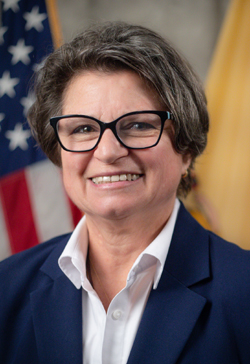
Asm. Luanne Peterpaul
Sponsored bills
Maddy summaryBill A5241 prohibits local governments (counties, municipalities, or other approving authorities) from approving site plans for large warehouses within 1,000 feet of a historic district. It defines a "large warehouse" as any storage facility of 100,000 square feet or more used for goods intended for sale or distribution, and a "historic district" as areas listed on both the National and New Jersey Registers of Historic Places (excluding waterway-designated districts). The law applies immediately to all pending construction permit applications that haven't yet been declared complete by the enforcing agency. This prevents new large warehouse developments near designated historic areas without requiring additional approvals.
Maddy summaryA5682 establishes New Jersey's "Problematic Sexual Behavior Program" to address cases involving youth under 18 who engage in or are impacted by developmentally inappropriate or potentially harmful sexual behaviors, including technology-facilitated behaviors like sexting. The program, administered by the New Jersey Children's Alliance, creates specialized care coordinators to connect youth and families to medical and mental health services, establishes a screening and referral process through the State Central Registry, and provides training for mental health providers in evidence-based treatment approaches. The bill appropriates $8.5 million from the General Fund, with $5 million allocated to a "Child Treatment Assistance Fund" to cover medical and mental health services and $3.5 million for program implementation including care coordinator positions and training. This legislation expands the responsibilities of the Child Advocacy Center-Multidisciplinary Team Advisory Board and aims to create a coordinated statewide response to cases involving problematic sexual behavior among youth.
Maddy summaryThis bill establishes a state-funded internship program for New Jersey legislators, allowing each member to hire interns using up to $10,000 annually from a $1.2 million state appropriation. It requires interns to be full- or part-time students at accredited higher education institutions (excluding law and PhD programs), with New Jersey residents or students at NJ schools receiving priority. Participants complete at least one work period in a legislator's district office and receive a $1,000 stipend per period, paid bi-weekly or monthly. The program aims to provide practical experience for students while supporting legislative staff capacity.
Maddy summaryThis bill prohibits the construction of new crematories within 1,000 feet of public or private schools, residentially zoned areas, or specific recreational spaces like parks, playgrounds, beaches, or conservation areas. It applies to all new crematory construction applications submitted after the bill's effective date, requiring the Cemetery Board to deny permits that violate these location limits. The restriction does not apply to crematories operated within funeral homes under existing law. This policy change directly affects developers and applicants seeking to build new crematories in New Jersey.
Maddy summaryS 3199 establishes the New Jersey-Haiti Commission within the Department of State to strengthen economic and cultural ties between New Jersey and Haiti, with a specific focus on addressing economic challenges faced by New Jersey's Haitian-American community - the state's fourth-largest Haitian population in the U.S. The 13-member commission, led by the Secretary of State and including 12 public members appointed by the Governor (based on legislative recommendations), will conduct research, hold quarterly public hearings, and analyze data on migration patterns, demographics, and economic impacts. It will identify opportunities for collaboration in areas like trade, healthcare, education, and cultural exchanges, then submit annual reports with policy recommendations to the Governor and Legislature. This bill creates a formal structure for ongoing dialogue and evidence-based policy development between New Jersey and Haiti.
Maddy summaryThis bill would require New Jersey Medicaid to reimburse providers for mental health rehabilitation services delivered through clubhouse programs. Clubhouse programs are defined as non-residential, community-based, membership programs accredited by Clubhouse International that help individuals with mental health challenges transition to less restrictive care, reintegrate into the community, and increase social connectedness beyond clinical settings. The bill would expand Medicaid coverage to include these services, which currently aren't covered under Medicaid reimbursement. This change would directly affect individuals with mental health conditions who participate in clubhouse programs and the providers who operate these programs, including Shore House in Long Branch, which had over 3,500 member visits in 2022 with an average cost of $43 per visit.
Maddy summaryThis bill (A1825) establishes guidelines for health insurance plans regarding "step therapy" protocols, which require patients to try lower-cost medications before coverage is provided for a preferred medication selected by their doctor. It requires insurers to base these protocols on clinical guidelines developed by expert panels with conflict-of-interest safeguards, and creates a clear process for patients to request exceptions when step therapy would be harmful or ineffective. Insurers must grant or deny exception requests within 72 hours (24 hours in emergencies), and must report on exception requests and outcomes to the state insurance commissioner. This affects all health insurance carriers in New Jersey, including those offering SHBP, SEHBP, and Medicaid plans, as well as the patients and healthcare providers who use these plans.
Maddy summaryThis bill allows members of New Jersey's State Police Retirement System (SPRS) to purchase retirement credit for time spent in military service academies (such as West Point or the Naval Academy), in the New Jersey State Police Academy, or as a class two special law enforcement officer before joining the police force. It amends existing law to permit purchasing credit for these specific service periods by paying into the retirement system's annuity savings fund, with options for installment payments over up to 10 years. The bill specifies that credit purchased for military academy enrollment, police academy training, or special law enforcement officer employment will be treated the same as actual police service for retirement benefit calculations. This applies to current and future SPRS members who want to count these pre-service periods toward their retirement eligibility and benefits.
Maddy summaryThis bill (A5589) provides accidental disability benefits to New Jersey police officers who contracted COVID-19 between June 5, 2021, and January 31, 2022, under specific conditions. To qualify, an officer must have contracted the virus while working at a location other than their home, be a police officer, and be permanently and totally disabled as a direct result of the illness. The benefits are retroactive to June 5, 2021, and explicitly state the law does not reduce any existing worker benefits. This applies only to police officers meeting all three criteria during the specified timeframe.