

Maddy summaryHR 10414 seeks to repeal the Impoundment Control Act of 1974 (2 U.S.C. 681 et seq.), a law that limited the President's authority to withhold funds Congress had appropriated. This bill would remove the legal restrictions requiring the President to seek Congressional approval before delaying or refusing to spend money already approved by Congress. The repeal would directly affect the executive branch's budget implementation powers, restoring the pre-1974 practice where the President could withhold funds without specific Congressional consent. This is a procedural change altering the legal framework governing federal spending, with no new provisions or direct impact on specific programs or citizens.
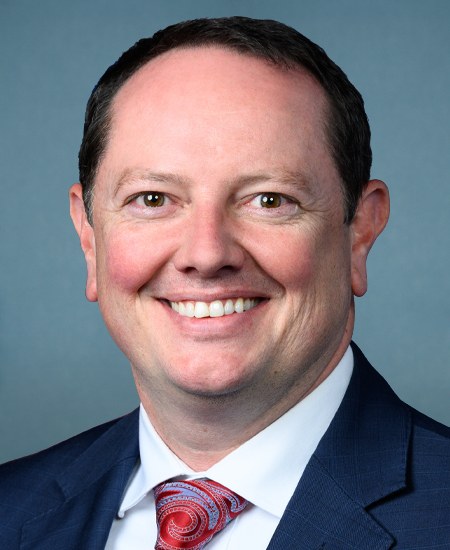
Rep. Eric Burlison
Sponsored bills
Maddy summaryHR 10299, the Medicaid Funds Integrity Act of 2024, amends federal Medicaid law to prohibit using federal funds for gun violence prevention or intervention programs. Specifically, it adds a new provision (paragraph 28) to Section 1903(i) of the Social Security Act, blocking federal financial participation for such programs under Medicaid. This directly affects state Medicaid programs that might have sought federal funding for initiatives addressing gun violence. The bill creates a concrete funding restriction, ensuring Medicaid dollars cannot be spent on these specific types of programs.
Maddy summaryHR 374, titled the "Abolish the ATF Act," would eliminate the Bureau of Alcohol, Tobacco, Firearms and Explosives (ATF) as a federal agency. This bill directly affects the ATF itself, ending its existence and all its current operations. The key provision is a single, straightforward legislative action to abolish the bureau, without specifying alternative agencies or processes for handling the functions it currently performs. The bill does not detail how firearm regulations, tobacco enforcement, or other ATF responsibilities would be managed after abolition.
Maddy summaryThe No Discrimination in Housing Act would deny the federal low-income housing tax credit (LIHTC) to housing developers and entities that implement diversity, equity, and inclusion (DEI) initiatives. This credit, a key incentive for building affordable housing, would no longer be available to entities with DEI programs, including partnerships and S corporations. For business structures like partnerships, the denial applies to the entire entity - not just individual owners - meaning the credit is lost at the organizational level. The provision would take effect for tax years beginning after the bill is enacted.
Maddy summaryThis bill amends the District of Columbia Code to clarify that nonprofit organizations holding meetings with federal officials (including Members of Congress or government employees) do not count as "doing business" in the District. It specifically adds this activity to the list of non-business activities under D.C. law (Section 29-105.05(a)(11)). The change directly affects nonprofit organizations that regularly engage with federal government representatives. The policy shift removes potential regulatory barriers for these groups when meeting with federal officials in D.C.
Maddy summaryHR 8706, the "Dismantle DEI Act of 2024," would prohibit federal agencies from maintaining diversity, equity, and inclusion (DEI) offices, programs, or training by requiring the closure of existing DEI offices within 90 days and banning federal funding for DEI-related activities. The bill defines "prohibited diversity, equity, and inclusion practices" as those that discriminate based on race, color, ethnicity, religion, biological sex, or national origin, or require training that asserts a particular group is inherently superior or inferior. It would rescind several executive orders related to racial equity and gender inclusion, and prohibit the use of federal funds for DEI-related activities across all federal agencies, contractors, and grant recipients. The bill contains limited exceptions for Equal Employment Opportunity offices and disability rights enforcement offices as historically organized and operated.
Maddy summary# Summary of Proposed Higher Education Act Amendments This document outlines significant proposed amendments to the Higher Education Act of 1965, primarily as part of the "College Cost Reduction Act." The key elements include: ## Accreditation Reform - Major overhaul of accreditation standards, requiring accrediting agencies to demonstrate independence from trade associations - New requirements for accrediting agencies to assess student achievement outcomes, including median value-added earnings relative to median total price charged - Introduction of an "Alternative Quality Assurance Experimental Site Initiative" to test non-accredited institutions - Protections for religious institutions, including a new process for appealing accreditation decisions related to religious mission - Removal of "litmus tests" that would require institutions to support specific political viewpoints ## Student Success Initiatives - Establishment of "Postsecondary Student Success Grants" to increase participation, retention, and completion rates for high-need students - Focus on evidence-based practices, with tiered requirements (tier 1, 2, and 3 reforms) - Mandatory inclusion of high-need student populations (low-income, first-generation, military-connected, etc.) - Requirements for institutions to report on completion rates, retention rates, and student demographics ## Regulatory Changes - Repeal of numerous existing regulations including: * Closed school discharges * Borrower defense to repayment * Pre-dispute arbitration * False certification requirements * Ability-to-benefit rules * Financial responsibility regulations - New restrictions on incentive compensation for recruiters - Changes to third-party servicer definitions and regulations ## Transfer and Credit Policies - New requirement that institutions cannot deny transfer credit based solely on the source of accreditation - Requirements for transparent transfer policies - Changes to reverse transfer policies ## Other Key Provisions - Modifications to the National Advisory Committee on Institutional Quality and Integrity (NACIQI) - New definitions for "total price" and "value-added earnings" - Changes to the process for institutions to change accrediting agencies - New requirements for institutions to report on student outcomes The overall focus of these proposed amendments is to reduce regulatory burden on institutions, promote transparency, improve student outcomes (particularly for high-need students), modernize accreditation processes, and protect religious institutions' rights in accreditation decisions.
Maddy summaryThe Sunshine Protection Act of 2023 would end the practice of changing clocks twice a year for daylight saving time (DST) by making DST permanent nationwide, unless a state chooses to remain on standard time. It repeals the requirement to switch clocks back to standard time in the fall, directly affecting all U.S. states and territories that currently observe DST. The bill allows states that previously opted out of DST under the Uniform Time Act (like Arizona and Hawaii) to maintain their current time zone choices without further action. Key provisions include adjusting time zone offset language in existing law and granting states the authority to select either permanent DST or standard time based on their current arrangements. This change would eliminate seasonal time changes for most Americans, though states could still choose to stay on standard time if they prefer.
Maddy summaryHR 10111, the UAP Whistleblower Protection Act, expands federal whistleblower protections to cover disclosures about the use of taxpayer funds for researching unidentified anomalous phenomena (UAP). It amends existing laws to explicitly include "the use of Federal taxpayer funds to evaluate or research unidentified anomalous phenomena material" as a protected disclosure category. This applies to federal civilian employees, FBI personnel, Department of Defense personnel, DOD contractors, federal civilian contractors, and intelligence community workers. The bill ensures these individuals cannot face retaliation for reporting misuse of public funds related to UAP research, without altering how UAP investigations are conducted.
Maddy summaryThis bill limits the number of shareholder proposals that public companies must include in their proxy materials based on the company's filing status: non-accelerated filers must include no more than 2 proposals, accelerated filers no more than 4, and large accelerated filers no more than 7. Proposals must have a "material" financial effect on the company - defined as a substantial financial risk or return relevant to investor decisions - to be included, excluding those focused on non-financial goals like environmental or social issues. The Securities and Exchange Commission must update proxy rules within 180 days to implement these limits and require companies to disclose their selection method for proposals. It directly affects large public companies and their shareholders seeking to influence corporate policies on social or environmental matters through voting.