

Maddy summaryThis bill modifies Minnesota's child maltreatment reporting requirements and adjusts criminal penalties for failing to report suspected abuse. It expands the definition of mandatory reporters to include clergy members who receive information during ministerial duties, while maintaining protections for privileged communications. The legislation also clarifies that organizations cannot have policies that discourage reporters from filing abuse reports. Additionally, the bill increases penalties for failure to report, making it a felony when multiple children are abused by the same offender, and strengthens civil liability for knowingly making false reports. These changes aim to improve child safety by broadening who must report abuse and increasing consequences for non-compliance.
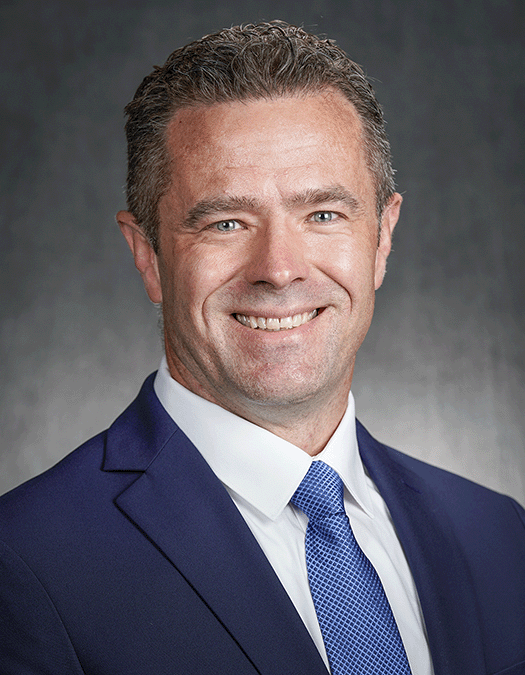
Rep. Pete Johnson
Sponsored bills
Maddy summaryHF 1044 adds occupational therapy services to Minnesota's mental health grant programs. It amends Minnesota Statutes 2024, section 245.4889, by explicitly including "occupational therapy services" as an eligible grant service for children with emotional disturbances. This change allows occupational therapists and assistants (defined in new sections 245I.02, subdivisions 29a-29b) to provide behavioral health services under existing children's mental health grant funding. The bill directly affects children with emotional disturbances who qualify for these grants and occupational therapy providers seeking to deliver these services through state-funded programs.
Maddy summaryThis bill modifies the maximum funding limit for port development projects in Minnesota by changing the cap from the previous percentage to 80% of the total project cost. It directly affects state agencies administering port assistance and commercial navigation facility developers who apply for state grants. The legislation also clarifies that state funds cannot be used to match other state funding sources and prevents the state from assuming ongoing financial responsibility for these projects. These changes aim to provide clearer guidelines on how much state money can be allocated toward port development initiatives.
Maddy summaryThis bill authorizes the Cloquet Area Fire District in Minnesota to collect a local sales tax of up to 0.5% in the cities of Cloquet and Scanlon, with voter approval required before implementation. The tax revenue would be used to fund the construction of a new ambulance and fire station, with up to $31 million available for the project and related bond debt service. The tax would expire after 20 years or once the project is fully funded, whichever comes first, and any remaining funds would go to the district's general fund.
Maddy summaryThis bill allows Minnesota's housing redevelopment authorities to partner with state colleges and universities on housing projects, including construction, development, rehabilitation, or improvement of real property. Under the new provision, these authorities can choose to offer standard construction warranties, provide reduced warranties, or waive them entirely for projects where a state college or university actively participates in the building process. The law clarifies that this partnership option applies only when the educational institution is directly involved in construction or development and does not change existing liability rules or federal warranty requirements.
Maddy summaryThis bill authorizes St. Louis County to sell two specific parcels of land through private sales instead of public auctions. The first parcel consists of tax-forfeited land, while the second includes county-owned fee lands in Brookston. The legislation requires that all land conveyances use forms approved by the attorney general, who may correct any errors in the land descriptions. St. Louis County determined that private sales would best serve its interests, with the tax-forfeited land sale specifically aimed at resolving a structure encroachment issue. This change allows the county to bypass standard competitive bidding requirements for these particular properties.
Maddy summaryHF 3407 prohibits the sale, possession, and distribution of "ghost guns" - firearms without unique serial numbers, undetectable by metal detectors, or made via 3D printing by unlicensed individuals. It restricts 3D printing of firearms to federally licensed manufacturers, bans sharing 3D gun design files, and requires all firearms to have engraved serial numbers. Owners of existing ghost guns must either have a licensed dealer add a serial number, remove the item from Minnesota, make it permanently inoperable, or surrender it within 180 days (or 30/60 days for inheritors/new residents). Violations carry penalties of up to five years in prison or $10,000 fines.
Maddy summaryHF 3401 modifies Minnesota law to clarify that firearms are generally prohibited on school property, even for individuals with permits, except for specific authorized groups like active law enforcement or military personnel on duty. The bill establishes new storage requirements for permitted carry, mandating that firearms must be unloaded, secured in a locked container or trunk, and out of plain sight when not actively on duty or participating in authorized activities. These rules apply to school buildings, grounds, buses, and event facilities with posted signs, but exclude active officers and military personnel. The law aims to balance permitted access with safety by ensuring firearms are secured during non-operational periods.
Maddy summaryThis bill requires local fire departments in Minnesota to report fires involving alternative energy systems, such as wind, solar, or geothermal installations, to the state fire marshal. The reports must include details about the fire's cause, damage, and any injuries or deaths, and must be submitted as soon as possible after the incident. The state fire marshal will then compile these reports annually and submit a summary to state legislative committees by February 15 each year. This law directly affects city and town fire chiefs, mayors, and town clerks who manage fire reporting, as well as state officials responsible for fire safety oversight.
Maddy summaryThis bill removes the legal authority for federal agents from U.S. Customs and Border Protection and U.S. Citizenship and Immigration Services to make arrests under Minnesota state law. It directly affects these federal agencies by eliminating their ability to conduct warrantless arrests within the state, except when assisting local law enforcement. The change amends existing statutes to delete provisions that previously allowed these officers to arrest individuals for specific crimes like assault or felonies when on duty or with a warrant. This policy adjustment limits arrest powers to state-authorized peace officers and private citizens, while still permitting federal agents to aid in executing warrants when requested by local officers.