

Maddy summaryThis bill establishes a minimum wage requirement for workers employed at Minnesota's covered airports, including Minneapolis-St. Paul International Airport and other public airports under the Metropolitan Airports Commission. It applies to private companies and contractors that employ workers performing airport-related duties or preparing food for departing flights, excluding independent contractors and salaried professionals. The law mandates that employers pay a "quality service wage" starting in 2026, which combines the applicable minimum wage with supplemental benefits calculated according to federal Service Contract Act standards. The Minnesota Department of Labor and Industry will set the specific wage rate each year and has authority to issue compliance orders with penalties for violations.
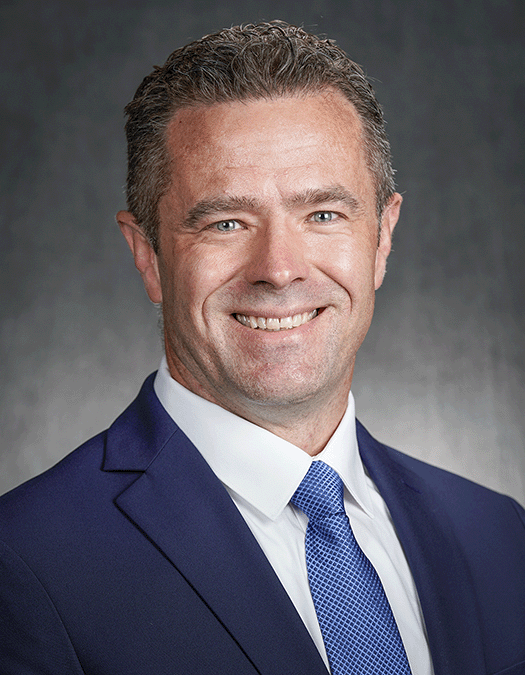
Rep. Pete Johnson
Sponsored bills
Maddy summaryThis bill modifies Minnesota's law on concealing identity in public places. It adds "protection from smoke, gas, or other airborne toxin" as a valid exception for wearing masks or disguises, while clarifying that the law generally prohibits such concealment (except for religious, entertainment, weather, or medical reasons). The bill specifically creates two new exceptions for law enforcement: undercover officers may conceal identity when necessary for investigations or safety, and tactical team members may wear face masks to prevent facial disfigurement. The law would not apply to these officers while performing official duties under these specified circumstances. (Note: This is a proposed bill pending in committee as of February 2026.)
Maddy summaryHF 3703 modifies the process for firefighter relief associations to terminate their retirement plans. It requires boards to precisely calculate assets, liabilities, and administrative costs before termination, and mandates that all retirement benefits be distributed within 210 days of termination. The bill also changes how any remaining surplus funds after benefit payments are allocated between the association and the affiliated municipality, requiring the municipality to receive a portion of the surplus or negotiate a shared allocation. This directly affects firefighter relief associations, their current and retired members, and the cities or towns that fund these plans. The changes aim to clarify financial accountability and ensure timely benefit distribution during plan termination.
Maddy summaryHF 3405 requires Minnesota's Bureau of Criminal Apprehension (BCA) to use its existing Use of Force Investigations Unit to investigate incidents involving federal agents. Specifically, it amends Minnesota Statutes 2024, section 299C.80, to include "federal agents" (defined as those employed by DHS, ICE, CBP, or USCIS) under the unit's duty to investigate cases involving peace officers or federal agents. The bill expands the unit's current mandate - which already covers incidents with state/local officers - to now cover all incidents involving the specified federal agencies. This change directly affects federal law enforcement personnel from those agencies operating in Minnesota.
Maddy summaryThis bill prohibits Minnesota law enforcement officers from detaining or transporting suspects in vehicles not specifically designed for human transport, such as standard patrol cars. It requires all such vehicles to be owned/leased by a law enforcement agency, clearly marked with the agency's identification, and equipped with seats and seat belts for each person transported. Exceptions apply during emergencies threatening life/safety or for undercover operations. The law directly affects police departments and officers who transport detainees, aiming to standardize safe transport conditions.
Maddy summaryHF 2909 modifies Minnesota's medical assistance and MinnesotaCare coverage to require equal payment rates for pharmacists providing services within both pharmacists' and physicians' scopes of practice. It mandates that medical assistance programs and MinnesotaCare reimburse participating pharmacists for these services at the same rate paid to physicians for equivalent care. This applies to fee-for-service programs and managed care plans under sections 256B.69 and 256B.692. The changes take effect January 1, 2026, or after federal approval, whichever is later. The bill directly affects pharmacists and pharmacies providing covered services under these programs.
Maddy summaryHF 2851 modifies Minnesota's rules for pharmacy benefit managers (PBMs). It prohibits PBMs from using "spread pricing" (charging health plans more than they pay pharmacies for drugs) and imposes new fiduciary duties requiring PBMs to act in health plan members' best interests. The bill also increases PBM license application fees to at least $15,000 and appropriates funds for enforcement. These changes directly affect PBMs operating in Minnesota, aiming to increase transparency and accountability in drug pricing.
Maddy summaryHF 3662 amends Minnesota's individual income tax code to require taxpayers to include certain employer-reimbursed travel expenses as taxable income. Specifically, it adds an "addition" for travel costs (like fares, meals, and lodging) paid by or reimbursed by an employer while traveling within Minnesota for immigration enforcement activities or supporting such activities. This provision applies only to expenses incurred in Minnesota and takes effect for tax years starting after December 31, 2025. The bill directly affects Minnesota taxpayers whose employers cover travel related to immigration enforcement within the state.
Maddy summaryHF 3659 requires individuals who earned income in Minnesota while participating in immigration enforcement activities or providing material support to such activities to file a Minnesota income tax return. This requirement applies even if the individual's income would normally be too low to trigger a filing obligation under standard tax rules. The bill amends Minnesota Statutes to add this specific filing requirement, which takes effect for tax years beginning after December 31, 2025.
Maddy summaryHF 3668 establishes an Office of Gun Violence Prevention within Minnesota's Department of Health. The office will coordinate prevention efforts, collect and report statewide data on gun incidents/deaths, conduct research, create public health campaigns, and support victims - working with agencies like Public Safety. It requires an annual report to legislative committees by February 15 each year. The bill appropriates unspecified funding from the general fund for the office's operations in fiscal years 2026 and 2027.