

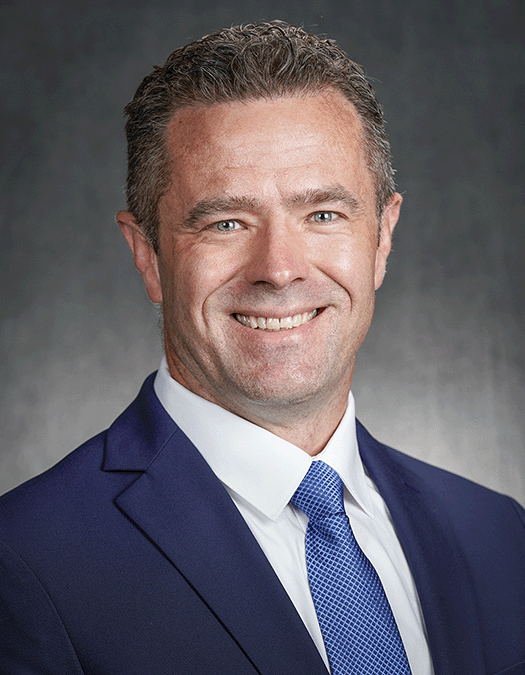
Photo of Pete Johnson
D Minnesota House · District 8A On the 2026 ballot

Rep. Pete Johnson

Compare
Total votes
464
all sessions
Attendance
100%
of floor votes
Higher than 92% of chamber peers
With party
99%
of cast votes
Higher than 89% of chamber peers
Bipartisan score
0%
crosses aisle rarely
Lower than 90% of chamber peers
Sponsored
240
bills & resolutions
Higher than 90% of chamber peers
Committees
3
assignments
240 bills and resolutions

Sponsored bills

Total
240
Primary
48
Co-sponsor
192
This page
240
matching current filters
Co-sponsor HF 4067
In committee · Minnesota House · Co-sponsor
Physical therapists and physical therapist assistants eligible for loan forgiveness under the health professional education loan forgiveness program, and money appropriated.

Maddy summaryThis bill expands eligibility for Minnesota's health professional education loan forgiveness program to include physical therapists and physical therapist assistants. Under the new provisions, these healthcare workers can receive loan forgiveness if they agree to practice in designated rural areas or underserved urban communities. The legislation amends existing state statutes to formally add these professions to the list of eligible health care professionals who can access this financial assistance. By broadening the program's scope, the bill aims to support workforce development in areas with healthcare shortages while providing debt relief to qualified practitioners.

In committee Mar 16, 2026 1 co-sponsor
Co-sponsor HF 362
In committee · Minnesota House · Co-sponsor
Licensure for massage therapy and Asian bodywork therapy established, fees established, criminal penalties provided, and money appropriated.

Maddy summaryHF 362 establishes a state licensing system for massage therapists and Asian bodywork therapists in Minnesota. It requires practitioners to meet specific educational standards (including minimum contact hours), pass a credentialing exam, and obtain a license from the Minnesota Department of Health. The bill defines both practices (e.g., Asian bodywork therapy uses techniques like pressing and stretching based on Chinese medical principles), sets application and renewal fees, and includes criminal penalties for practicing without a license. This directly affects therapists seeking to legally provide these services and ensures they meet standardized training and safety requirements, while also providing funding for implementation.

In committee Mar 16, 2026 1 co-sponsor
Co-sponsor HF 2334
In committee · Minnesota House · Co-sponsor
Dental organizations required to meet a loss ratio requirement.

Maddy summaryHF 2334 requires dental insurance organizations in Minnesota to maintain a minimum 85% loss ratio, meaning they must pay at least 85% of premium revenue in claims to policyholders. If organizations fail to meet this ratio, they must provide remediation to enrollees through direct rebates, increased benefit limits, or other approved methods. The bill also mandates annual reporting of loss ratios and financial details to the Department of Commerce, with this data published online for public comparison. This applies specifically to dental insurance plans, not general health insurance, and takes effect between 2026 and 2028.

In committee Mar 16, 2026 1 co-sponsor
Co-sponsor HF 4061
In committee · Minnesota House · Co-sponsor
Availability of appropriation for a grant to expand Minnesota's wild elk population and range extended.

Maddy summaryThis bill extends funding availability for a grant designed to expand Minnesota's wild elk population and range, specifically benefiting the Fond du Lac Band of Lake Superior Chippewa. The legislation authorizes $2,300,000 for the first year to support elk reintroduction efforts, including moving elk from existing herds in northwest Minnesota to the Fond du Lac State Forest and Reservation area. Funds must be used for thorough planning with the Department of Natural Resources to develop capture and handling protocols, disease management strategies, and postrelease comanagement plans between state and Tribal authorities. The appropriation is a one-time funding allocation available until June 30, 2029.

In committee Mar 12, 2026 1 co-sponsor
Primary HF 4249
In committee · Minnesota House · Lead sponsor
Historic Denfeld pipe organ funding provided, and money appropriated.

Maddy summaryThis bill allocates $250,000 from the arts and cultural heritage fund to restore a historic pipe organ at Denfeld High School in Duluth, Minnesota. The funding is directed to the Duluth Public School District and must be used for organ assessment, rehabilitation, and related arts education programs. The legislation requires that the restored organ remain accessible for student use, community performances, and public events to preserve Minnesota's cultural heritage.

In committee Mar 12, 2026 0 co-sponsors
Co-sponsor SF 3596
Passed · Minnesota Senate · Co-sponsor
Onetime emergency rental assistance aid for counties and Tribal governments establishment and appropriation

Maddy summarySF 3596 creates a one-time state-funded emergency rental assistance program for Minnesota counties and Tribal governments to help eligible households facing housing instability. Eligible households must have income at or below 200% of the federal poverty level, experienced financial hardship after August 31, 2025, and be at risk of eviction or homelessness. The program covers up to two months of prospective rent, past-due rent, utility costs, or related fees for qualifying households. Counties and Tribal governments must distribute funds within four months of the bill's effective date and return any unspent money to the state.

Passed Mar 12, 2026 1 co-sponsor
Co-sponsor HF 1944
In committee · Minnesota House · Co-sponsor
Recognition of federal standard time year-round beginning in 2025 and expiring upon enactment of a federal law authorizing states to recognize advanced standard time year-round provided.

Maddy summaryHF 1944 amends Minnesota law to require all state agencies, counties, cities, and towns to use federal standard time (not daylight saving time) year-round starting in 2025. It changes how time is referenced in state law to align with federal standards, meaning state government operations and references to time must follow federal rules. The bill automatically expires if federal law ever permits states to adopt year-round "advanced standard time." It directly affects all Minnesota local and state government entities that reference time in their operations or laws.

In committee Mar 12, 2026 1 co-sponsor
Co-sponsor HF 4132
In committee · Minnesota House · Co-sponsor
Duluth International Airport capital improvements funding provided, bonds issued, and money appropriated.

Maddy summaryThis bill authorizes the issuance of up to $4,000,000 in state bonds to fund capital improvements at the Duluth International Airport. The funds will be used by the Duluth Airport Authority to design, construct, and equip a new air traffic control tower base building, which will include office spaces, equipment rooms, and support areas. The project also covers site preparation, demolition of old buildings, utility installation, stormwater systems, and replacement of existing fuel tanks. A portion of the state funding will serve as a match for federal funding for this infrastructure project.

In committee Mar 9, 2026 1 co-sponsor
Primary HF 3942
In committee · Minnesota House · Lead sponsor
Continued enrollment for students for the remainder of the 2025-2026 school year authorized.

Maddy summaryThis bill allows Minnesota school districts and charter schools to keep counting students in their enrollment numbers for the rest of the 2025-2026 school year, even if those students haven't officially reenrolled. It applies only to students who were enrolled before January 1, 2026, and have not yet signed up for another Minnesota school. The law requires the state education commissioner to approve this continued enrollment count for the specified period and makes the change effective retroactively from January 1, 2026. This provision helps schools maintain their funding levels during a transition period when students may be temporarily unenrolled.

In committee Mar 9, 2026 0 co-sponsors
Primary HF 4066
In committee · Minnesota House · Lead sponsor
Functions performed by protective agent license holders and their employees classified, minimum preservice established, and training requirements for protective agents and their employees based on the functions performed by the person continued.

Maddy summaryThis bill establishes a tiered classification system for protective agent duties in Minnesota, requiring different training levels based on the specific functions agents perform. It creates five security service tiers ranging from basic access control to armed high-risk security, with each tier mandating specific preassignment training covering topics like de-escalation, first aid, legal use of force, and threat identification. The legislation also adds new continuing education requirements focused on community health issues, crisis response, and public safety protocols, while allowing the board to create an implementation plan that reduces training burdens for experienced workers. These changes directly affect security companies, license holders, and their employees by standardizing training expectations across the industry.

In committee Mar 9, 2026 0 co-sponsors
Showing 91 to 100 of 240 bills
Previous 1 9 10 11 24 Next