

Maddy summaryHF 1368 exempts tip income from Minnesota's individual income tax and eliminates the requirement for employers to withhold state income tax on tips. This affects service industry workers (such as restaurant servers and bartenders) who earn tips, as these earnings will no longer be included in their taxable income for state tax purposes. The bill amends state tax law to define "tips" as amounts reported to employers under federal guidelines or to the IRS as taxable wages, and removes withholding obligations for these amounts. The change takes effect for tax years beginning after December 31, 2024.
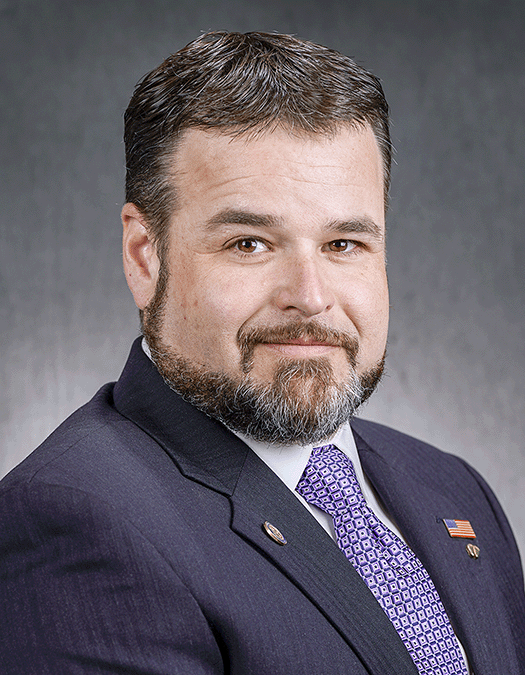
Rep. Josh Heintzeman
Sponsored bills
Maddy summaryHF 1331 requires the commissioner of natural resources to conduct an annual statewide survey to estimate Minnesota's wolf population. The survey must cover the entire state - not just historic wolf habitats - and be completed each year. This amendment to Minnesota Statutes section 97B.646 (wolf management) adds this requirement to the existing framework, which already includes a wolf management plan and quarterly mortality reporting. The bill directly affects state wildlife management practices under the Department of Natural Resources.
Maddy summaryHF 1206 appropriates specific funding for fiscal years 2026 and 2027 to establish an initiative protecting high-quality lakes and streams in Minnesota's upper Mississippi River basin. The bill directs the commissioner of natural resources to use these funds - potentially transferring some to the Board of Water and Soil Resources - to protect, preserve, and enhance forests through existing programs like "Minnesota forests for the future" (M.S. 84.66), aiming to improve water quality. This funding directly supports state agencies managing natural resources in the basin, focusing on forest conservation as a key mechanism to safeguard water quality.
Maddy summaryThis bill appropriates $500,000 for fiscal year 2026 and $500,000 for fiscal year 2027 from the general fund to support Minnesota's existing Loggers Safety Grant Program. The funds will be administered by the commissioner of labor and industry to provide safety grants directly to loggers and logging businesses. The program, established under Minnesota Laws 2021, First Special Session chapter 10, article 3, section 21, helps logging operations implement safety improvements. This funding ensures continued support for workplace safety initiatives in Minnesota's logging industry.
Maddy summaryHF 285 modifies Minnesota's firearm carry laws by eliminating the permit requirement for most public carry while creating an optional permit system. The bill states that eligible residents (not prohibited by law) may carry firearms openly or concealed in public places without a permit, excluding homes, businesses, gun shops, and hunting areas. It also establishes an optional permit process requiring applicants to be 21+, have firearm safety training, pass background checks, and meet specific criteria. The bill repeals existing permit mandates and amends Minnesota Statutes 624.714 to define "public place" and outline permit application procedures.
Maddy summaryHF 114 appropriates $500,000 for fiscal year 2026 and $500,000 for fiscal year 2027 from the arts and cultural heritage fund to provide grants to all 95 Minnesota county agricultural societies. The funds must be distributed equally to each county fair to enhance arts access, education, and the preservation of Minnesota's agricultural, historical, and cultural heritage. This grant program operates in addition to existing funding under Minnesota Statutes section 38.02. The commissioner of agriculture will develop grant criteria and seek public input to guide funding for projects supporting these goals.
Maddy summaryHF 469 requires anyone 16 years or older to carry a valid state trail bicycle pass when riding a bicycle on Minnesota state trails where bicycle use is permitted. The bill establishes an annual pass for $25 and a daily pass for $5, with fees collected by the Department of Natural Resources and deposited into a dedicated trail maintenance account. Passes must be presented for inspection by conservation officers, and the revenue funds repairs and maintenance of state trails open to bicycle use. This applies directly to cyclists using designated state trails across Minnesota.
Maddy summaryHF 447 allows high school students (grades 10-12) to enroll in summer college courses at Minnesota postsecondary institutions. The bill amends Minnesota law to require institutions to permit these students to take summer courses under the same policies applied to regular college students. It specifically adds a provision ensuring summer course access is consistent with existing institutional policies for postsecondary enrollment. This change directly affects secondary students seeking to earn college credit during summer breaks, without altering course requirements or enrollment priorities.
Maddy summaryThis bill modifies Minnesota's definition of sustainable aviation fuel under state law. It specifies that qualifying fuel must be derived from biomass, gaseous carbon oxides from biomass or direct air capture, or green hydrogen - excluding palm fatty acid distillates - and must achieve at least a 50% reduction in life cycle greenhouse gas emissions compared to petroleum-based fuels. The requirement uses either the Argonne National Laboratory's GREET model or the International Civil Aviation Organization's methodology for verification. This directly affects Minnesota taxpayers engaged in producing or blending sustainable aviation fuel. The change ensures state compliance with specific environmental standards for eligible fuel.
Maddy summaryHF 302 creates two annual tax holidays in Minnesota: one for non-handgun firearms (excluding handguns) and another for sport fishing equipment. During the seven days before deer hunting season begins, buyers of qualifying firearms pay no sales tax. Similarly, during the seven days before Memorial Day weekend, buyers of qualifying fishing gear pay no sales tax. These tax exemptions apply to sales and purchases made after June 30, 2025, and directly affect residents purchasing these items during the specified periods.