

Maddy summaryHF 1366 appropriates $9.9 million from Minnesota's renewable development account to Brainerd Public Utilities for energy efficiency projects in fiscal year 2026. The funding specifically supports upgrades, replacements, or structural improvements to turbine generators at Brainerd's facilities. This direct grant is available until expended and falls under the definition of "energy efficiency projects" as outlined in the bill. The legislation provides concrete funding for infrastructure modernization at Brainerd's public utility operations.
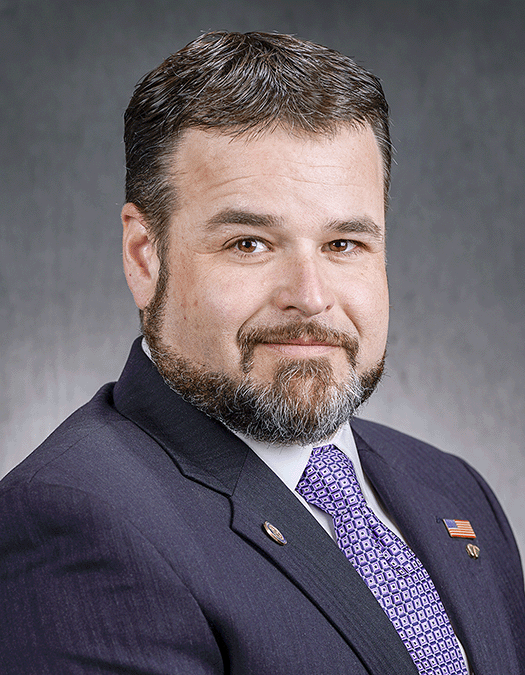
Rep. Josh Heintzeman
Sponsored bills
Maddy summaryHF 1209 appropriates one-time funding from the general fund for a voluntary well water testing program in Minnesota. The bill directs the state health commissioner, working with the University of Minnesota and nonprofits, to develop a program offering free well water testing through local clinics. This program will provide private well owners with testing services, information on water safety, treatment options, and guidance for creating well owner safety plans. The funding is specifically for fiscal year 2026 and applies only to private wells, not public water systems.
Maddy summaryThis bill, HF 1365, creates a tax benefit for Minnesota residents who earn overtime pay. It adds a new provision to the state's tax code allowing workers to subtract their overtime earnings from their taxable income. Specifically, it defines "overtime pay" as wages, salaries, tips, or other compensation for hours worked beyond the standard workweek under state or federal law. This change would reduce the taxable income of eligible workers, lowering their state income tax liability for the 2025 tax year and beyond. The provision applies only to Minnesota taxpayers with overtime earnings subject to state tax.
Maddy summaryHF 1018 proposes adding a new section to the Minnesota Constitution that would establish parents' right to direct their child's education as a fundamental liberty. It specifically guarantees parents the right to choose private, religious, or home schooling as alternatives to public school, and the right to make reasonable educational choices within public schools. The proposed amendment would require voter approval at the 2026 general election, with the ballot question asking whether the state constitution should protect these parental rights. If passed, this would change Minnesota's constitutional framework, not current education laws.
Maddy summaryHF 1423 amends Minnesota Statutes section 273.124, subdivision 8, to increase the maximum number of shareholders, members, or partners allowed for certain agricultural entities to qualify for homestead property tax treatment from 12 to 18. This change directly affects family farm corporations, joint farm ventures, limited liability companies (LLCs), and partnerships operating farms, allowing them to have up to 18 qualifying members while still qualifying for class 1b or class 2a property tax classifications. The bill does not alter tax rates but expands eligibility for existing homestead tax benefits by raising the shareholder cap. It takes effect for homestead applications filed in 2025 and later.
Maddy summaryHF 1363 prohibits Minnesota's Pollution Control Agency from banning the purchase or use of motor vehicles powered by internal combustion engines. The bill amends Minnesota Statutes to explicitly add this restriction to the agency's authority under section 116.07, which governs air quality standards for vehicles. This means the agency cannot restrict or eliminate the use of gasoline or diesel-powered vehicles through its regulatory powers. The bill directly affects the agency's regulatory scope and vehicle owners who use conventional engines, without altering emissions standards or promoting alternative vehicle types.
Maddy summaryHF 1369 requires voters in Minnesota to present a photo ID to register and to vote. It creates a new voter identification card (with no fee for vital records needed to obtain it), establishes provisional ballots for voters who lack ID, and mandates ID verification for individuals acting as absentee voter agents or providing polling place assistance. The bill also increases criminal penalties for certain election violations and appropriates funds for implementation. These provisions apply directly to all voters participating in Minnesota elections.
Maddy summaryHF 1370 allocates $155.3 million from Minnesota's Clean Water Fund for state agency projects in fiscal years 2026 and 2027. It specifically funds agricultural water quality monitoring ($3.1 million annually), best management practices loans for farmers ($2 million annually), and statewide agricultural water quality certification ($3.5 million annually) through the Department of Agriculture. The bill requires agencies to consult on disability access and diversity initiatives when using these funds. These appropriations directly affect state agencies managing water quality programs and indirectly impact farmers and communities through agricultural practices and water protection efforts.
Maddy summaryHF 1464 appropriates $1.2 million from the general fund in fiscal year 2026 to the Pollution Control Agency for a grant to Rice County, specifically to address water quality concerns at French Lake. Rice County may use these funds for water quality testing, infrastructure improvements, services, training, and maintenance related to the lake. The bill also extends the availability of an existing grant for the same French Lake project through June 30, 2027, under prior law. This legislation directly affects Rice County and French Lake residents by providing dedicated funding for water quality management.
Maddy summaryHF 1364 allocates $15 million in bond proceeds and $11.5 million from the general fund for fiscal year 2026, plus $15 million from the general fund for fiscal year 2027, to fund Minnesota's Local Road Wetland Replacement Program. The funds will allow the Board of Water and Soil Resources to acquire land or easements and restore or create wetlands to replace those drained or filled during repairs or upgrades of public roads, as required by state law. The bill specifies that land purchases must use fair market value and permits the board to partner with federal agencies, local governments, or conservation groups to secure wetland replacement credits. This directly affects local road projects needing wetland mitigation and the state agency managing these environmental restoration efforts.