

Maddy summaryHF 282 amends Minnesota's human rights law to prohibit employment discrimination based on political affiliation. It adds "political affiliation" to protected categories like race and gender, defining it as membership in a political party, support for a candidate or party, or lack of such support. The bill makes it illegal for employers, labor organizations, or employment agencies to discriminate in hiring, firing, promotions, or workplace conditions based on these political views. This applies directly to Minnesota workplaces covered under existing anti-discrimination statutes (sections 363A.08-363A.09).
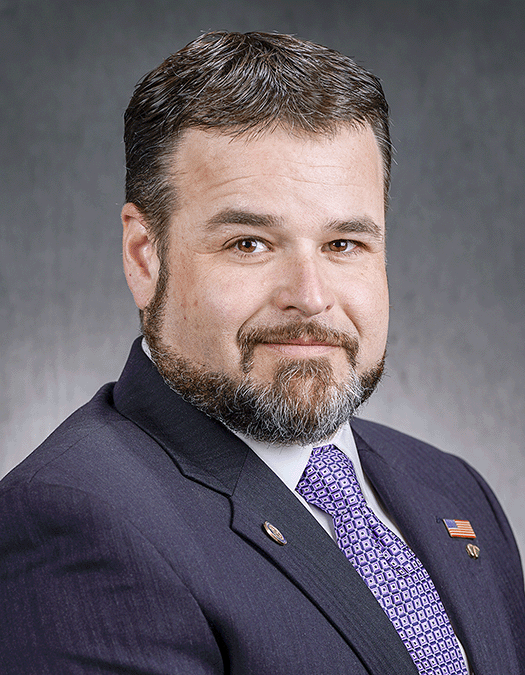
Rep. Josh Heintzeman
Sponsored bills
Maddy summaryHF 300 reduces Minnesota's individual income tax rates across all brackets. It lowers the top tax rate from 9.85% to 9.725% and proportionally reduces other rates for married couples filing jointly, single filers, and heads of household. These changes apply to all Minnesota taxpayers with taxable income, effective for tax years beginning after December 31, 2024. The bill amends tax brackets in Minnesota Statutes section 290.06 to reflect these lower rates.
Maddy summaryHF 189 imposes new surcharges on specific electric and plug-in hybrid vehicles in Minnesota. All-electric vehicles now face a $150 surcharge (up from $75), plug-in hybrid electric vehicles pay $75, all-electric motorcycles pay $30, and plug-in hybrid motorcycles pay $15. These surcharges apply during vehicle registration and fund the highway user tax distribution fund, with automatic adjustments tied to changes in the gasoline excise tax. The bill directly affects owners of these vehicle types when registering them in Minnesota.
Maddy summaryHF 288 requires the Minnesota legislature to approve any extension of a declared emergency beyond five days. It mandates that certain executive orders and rules must be enacted by the legislature to have legal effect, rather than taking effect automatically under current rules. The bill defines key terms like "public health emergency" and "bioterrorism" to clarify when emergency powers apply. Additionally, it repeals specific criminal penalties related to emergency management procedures.
Maddy summaryThis bill (HF 78) reorganizes the membership structure of the Cuyuna Country State Recreation Area Citizens Advisory Council by adjusting the numbering of its appointed positions. It specifies who serves on the council, including representatives from economic development groups, historical parks, Crow Wing County, state legislators, the Department of Natural Resources, local business and environmental groups, schools, and recreation user organizations. The bill does not create new policies or funding but formally updates the council’s composition to clarify membership roles. It directly affects the council’s operations and the groups designated to participate in advising on the recreation area. (Procedural bill; summary limited to 2 sentences as permitted.)
Maddy summaryHF 183 repeals a tax on retail delivery services and changes how transportation tax revenue is distributed. It creates a "Transportation Advancement Account" to allocate funds from sales taxes, directing 36% to metropolitan counties, 28% to county highway funds, and smaller shares to city and town road programs. The bill modifies several tax statutes (including sections 297A.94 and 270C.15) to implement these changes, effective July 1, 2025. This directly affects how Minnesota distributes transportation funding from sales tax revenues.
Maddy summaryHF 301 reduces all Minnesota individual income tax rates by 3.25 percentage points across every tax bracket. It directly affects all Minnesota individual taxpayers, including married couples filing jointly, single filers, heads of household, and non-residents with Minnesota income. The bill amends Minnesota Statutes to lower rates from 5.35% to 2.1%, 6.8% to 3.55%, 7.85% to 4.6%, and 9.85% to 6.6% for applicable income ranges. This change applies to taxable years beginning after December 31, 2024, and affects all income levels subject to Minnesota's progressive tax structure.
Maddy summaryHF 277 requires organizations receiving money from Minnesota’s environment and natural resources trust fund for children’s services to conduct criminal background checks on all employees, volunteers, and contractors who work with children. This applies specifically to "children's service providers" as defined by state law, including those receiving trust fund appropriations. Organizations must certify these background checks are performed as part of their required work plan submissions to the commission. The requirement takes effect July 1, 2025, for all trust fund recipients operating on or after that date.
Maddy summaryHF 80 provides state funding for landowners to restore or create wetlands eligible under Minnesota's wetland banking program. The bill appropriates unspecified funds for fiscal years 2026-2027 to the Board of Water and Soil Resources to administer a cost-sharing program. Eligible activities include site assessments, engineering work (like removing drainage systems), planting vegetation, and securing long-term easements on restored wetlands. This directly affects landowners seeking to participate in the state's wetland conservation program under Minnesota Statutes sections 103G.222 and 103G.2251.
Maddy summaryThis bill requires the Minnesota Secretary of State to put two questions on the 2024 general election ballot asking voters to approve or reject new designs for the state flag and the state seal. These designs were previously selected by the State Emblems Redesign Commission, and the bill mandates that the changes take effect on May 11, 2025, only if voters vote "yes" on both questions. If the proposals are rejected by the public, the existing flag and seal designs will remain in place. Additionally, the bill updates state laws to clarify how agencies should handle the transition between the old and new emblems and directs unused seal-making tools to the Minnesota Historical Society.