

Maddy summaryHF 3468 permits individuals injured due to a failure to render aid in specific legally defined circumstances to file a civil lawsuit. It directly affects victims who were not assisted when required by existing law, allowing them to seek compensation for damages, court costs, and attorney fees. The bill amends Minnesota Statutes 2024, section 609.662, by adding a new civil action provision. This change takes effect on August 1, 2026, applying to cases arising on or after that date.
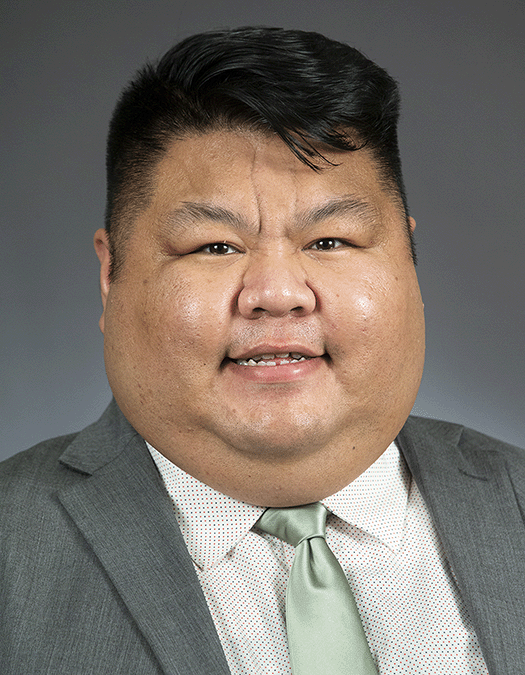
Rep. Jay Xiong
Sponsored bills
Maddy summaryThis bill appropriates state money from the general fund for fiscal year 2027 to support mobile crisis services and nonemergency medical transportation providers in Minnesota. The commissioner of human services will distribute these funds as mobile crisis grants and start-up grants for protected transport. Specifically, the money can be used to purchase or configure vehicles that meet protected transport requirements. The measure impacts organizations providing crisis intervention and medical transportation services to the public.
Maddy summaryThis bill appropriates $10 million from the state's general fund to support the Justice 4 Us The People nonprofit in Minnesota. The funding is designated to help the organization purchase vacant or foreclosed homes and renovate them for sale or rent to individuals earning at or below 50 percent of the local median income. Recipients of these homes must complete homeownership training, contribute to the renovation costs, and agree to maintain the property. The funds are a one-time allocation available for use until June 30, 2029, and up to ten percent of the budget may be used for counseling services.
Maddy summaryHF 4842 allocates $2 million from the state's general fund in fiscal year 2027 to Build Wealth MN. This one-time appropriation is intended to expand and administer a special purpose credit loan program that provides affordable mortgage financing to underserved borrowers in communities of color. The funds will be managed by the commissioner of the Housing Finance Agency to create a revolving loan pool for these specific lending activities.
Maddy summaryHF 4827 appropriates $20,000 from the state's general fund to help the city of Eagan create a memorial honoring women who served in the U.S. military since the nation's founding. The money will be given as a one-time grant to the commissioner of employment and economic development, who will then provide it to Eagan for designing and building the monument. This legislation is a procedural funding measure that does not change existing laws or create new programs beyond this specific allocation.
Maddy summaryThis bill increases the number of covered physical therapy visits for children under Minnesota's medical assistance program. Currently, the limit is 14 visits per year, but the bill raises this to 30 visits for children recovering from hospital-based surgeries while keeping the 14-visit limit for other situations. The new higher limit takes effect on January 1, 2027, or later if federal approval is required. Additionally, the bill clarifies reimbursement rates for physical therapy assistants, paying them the full rate when working on-site with a therapist and 65% of that rate when working remotely under a therapist's direction.
Maddy summaryThis bill prohibits Minnesota state and local government agencies, as well as law enforcement entities, from accepting military-grade weapons through the Pentagon's 1033 program. The legislation defines "military-grade weapons" to include combat vehicles, aircraft, and offensive arms while explicitly excluding non-weapon items like generators and medical equipment. By codifying this restriction in state law, the measure prevents these agencies from utilizing surplus military equipment intended for offensive purposes.
Maddy summaryThis bill restricts public utilities in Minnesota from including specific expenses in the rates charged to customers. It prohibits utilities from recovering costs related to executive travel and entertainment, lobbying, political donations, and compensation exceeding $300,000 for the ten highest-paid officers. Additionally, the law bars the recovery of funds spent on advertising, charitable giving, and penalties, while requiring utilities to submit detailed annual reports on these prohibited expenditures. If a utility charges ratepayers for these restricted costs, the bill mandates refunds with interest and imposes a penalty equal to 200 percent of the improper amount.
Maddy summaryThis bill directs Minnesota's Public Utilities Commission to establish rules and targets for the installation of energy storage systems by electric utilities. It requires utilities to install storage when upgrading power lines and mandates a statewide capacity goal of at least 3,000 megawatts by 2036. The legislation also clarifies how customer-owned solar and battery systems are measured for grid connection and creates a new compensation program to pay these customers for the energy they provide back to the grid. Additionally, the bill appropriates funds to support these initiatives and sets specific deadlines for the commission to issue necessary orders and tariffs.
Maddy summaryThis Minnesota bill requires employers to inform their employees within 72 hours if a federal immigration agency plans to inspect their employment records. It also prohibits employers from allowing federal immigration officers into nonpublic areas of their business, such as offices or storage rooms, unless the officers present a valid court warrant. To enforce these rules, the state will provide a standard notice template for businesses to use, and employers face civil fines ranging from $2,000 to $10,000 for failing to comply with the notification or access restrictions. The law directly impacts businesses in Minnesota and aims to ensure workers are aware of federal inspections while limiting unauthorized access to private workspaces.