

Maddy summaryThis bill appropriates $375,000 from the state's general fund to the Clemency Review Commission for fiscal year 2027. The funding is intended to help the commission process more clemency petitions, which are requests for forgiveness or reduction of criminal sentences. The money will support the commission's operations and staff to handle these requests. This legislation directly affects the Clemency Review Commission's ability to review and act on clemency applications from individuals seeking relief from their convictions or sentences.
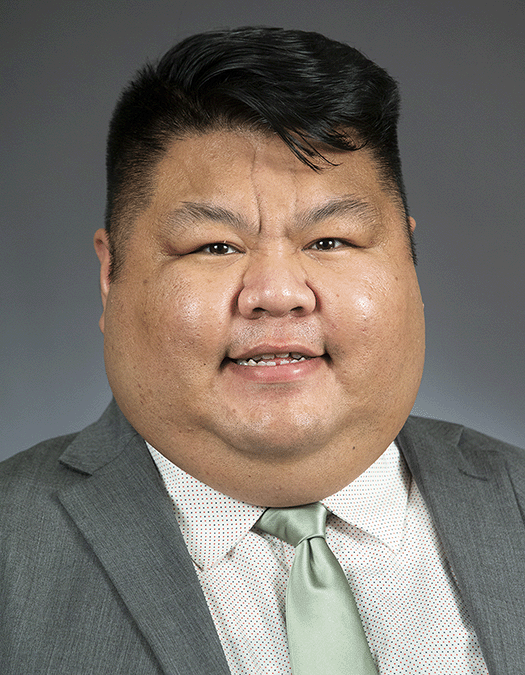
Rep. Jay Xiong
Sponsored bills
Maddy summaryHF 3555 establishes rules for small, portable solar panels (under 1,200 watts) that homeowners can install to offset personal electricity use. The bill exempts these plug-in solar devices from requiring utility connection agreements, net metering rules, and additional fees or approvals. It also clarifies that utilities cannot be held liable for damage caused by these devices. This directly affects residential users seeking simple, low-barrier solar energy solutions without utility bureaucracy. The bill creates specific definitions and exemptions within Minnesota's energy code for these devices.
Maddy summaryHF 3806 authorizes Minnesota to issue up to $200 million in housing infrastructure bonds for projects like affordable housing development and repairs. It requires annual transfers from the state general fund to a dedicated bond account, with specific yearly limits (ranging from $800,000 to $6.4 million) depending on the bond series. These transfers will occur each July 15 from 2028 through 2049 for the new bonds authorized under this bill. The funds will support housing infrastructure initiatives managed through the state’s housing finance program, directly affecting projects eligible for these bond-funded resources.
Maddy summaryHF 2906 establishes Minnesota's first legal framework for the therapeutic use of psilocybin (magic mushrooms) by adults 21+ with qualifying medical conditions. It creates a regulated program where patients must be certified by a licensed healthcare provider, enroll with the state health commissioner, and use psilocybin under supervision from registered facilitators during designated sessions. The bill sets rules for qualifying conditions, limits on cultivators, safety screenings, and requires the commissioner to develop detailed operational rules with input from an advisory committee. It also creates legal protections for participants, establishes fees for registration, and appropriates state funds to support the program. This is strictly a medical program with no recreational use permitted.
Maddy summaryHF 3328 requires Minnesota's Department of Education to increase awareness of library services for blind and print-disabled individuals. The bill mandates the department to develop an accessible online website with statewide resources and consult with agencies like Employment and Economic Development, Health, and Human Services to promote these services. It specifically directs the department to coordinate with the Minnesota Braille and Talking Book Library and its advisory committee to ensure resources reach blind and print-disabled Minnesotans. This bill directly affects blind and print-disabled residents by improving access to library services and related support programs.
Maddy summaryThis bill requires the Metropolitan Airports Commission to increase transparency regarding flights at Minneapolis-St. Paul International Airport that transport detained immigrants. Specifically, it mandates that the airport operator notify the commission whenever U.S. Immigration and Customs Enforcement arrives or departs with passengers being held in restraints. The legislation also requires the commission to install a live-streaming camera to record these flights and to submit monthly reports detailing the number of detained individuals, including minors, on each trip. These measures are designed to provide the public and state officials with real-time data and regular updates on immigration-related air traffic at the airport.
Maddy summaryThis bill authorizes $80 million in state funding to help the city of St. Paul upgrade West 7th Street from downtown to the Mississippi River. The money will be used for designing and building new roads, sidewalks, and underground water systems, while also adding traffic calming measures and a bus rapid transit line to connect downtown, the airport, and the Mall of America. The funds are a one-time appropriation available until the project is finished or canceled, and the law takes effect immediately upon final passage.
Maddy summaryThis bill establishes a state rapid start program to help Minnesota treat people living with HIV by ensuring they begin antiretroviral therapy quickly after diagnosis. It requires health plans to cover HIV treatment and prevention services without prior authorization, step therapy protocols, or cost-sharing requirements like co-pays and deductibles. The state will oversee local programs, provide grants to support treatment access, and report on program outcomes to improve care delivery.
Maddy summaryThis Minnesota bill creates a $100 million relief program to help small businesses that experienced significant revenue declines between July 2024 and February 2026, which the bill attributes to federal enforcement activity. The program provides grants to operators of indoor retail or food market spaces with at least 25 small tenant businesses, requiring that most funds be used to offer rent forgiveness to existing tenants. To qualify, businesses must be Minnesota-based, have fewer than 50 employees, operate from a physical location, and show at least a 20 percent drop in revenue or sales during the specified period. Grant applications will be processed through a lottery system, with funds usable for payroll, rent, utilities, inventory, and other operational expenses, and the state must report on the program's outcomes by December 2026.
Maddy summaryHF 2646 converts the "Governor's Council on an Age-Friendly Minnesota" into the "Age-Friendly Minnesota Council" to coordinate state efforts for older adults. The bill establishes a 15-member council including state agency representatives and public members to address disparities affecting older Minnesotans in greater Minnesota, communities of color, and Indigenous communities. Key provisions require the council to review grants, identify barriers to age-friendly services, promote equity, and make policy recommendations to state agencies and the legislature. The bill also codifies existing grant mechanisms and appropriates funds to support these coordinated efforts across state government, communities, and businesses.