

Maddy summaryThis bill requires health plans in Minnesota that offer maternity benefits to cover infertility treatment and standard fertility preservation services for their enrollees. It defines infertility based on medical criteria and specifies that coverage must match the cost-sharing terms applied to maternity care, including limits on oocyte retrievals but unlimited embryo transfers. The legislation also mandates that health plans cannot impose additional restrictions, waiting periods, or benefit maximums on these services beyond what applies to maternity coverage. Additionally, the state will reimburse health plans for the costs of providing these new benefits, but only for services that would not have been covered without this law.
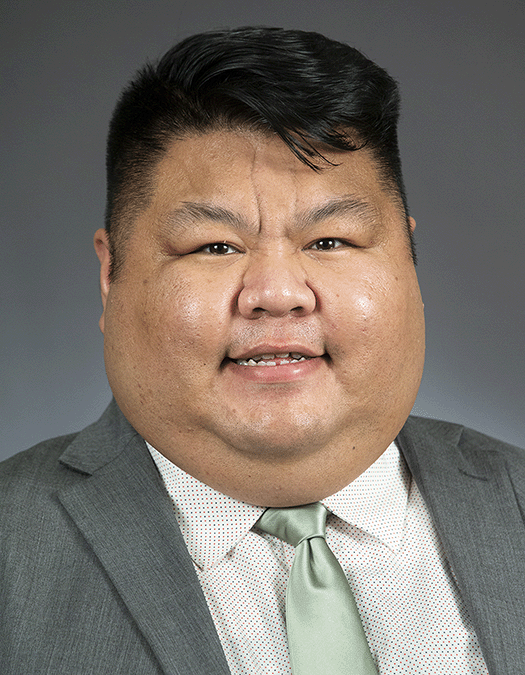
Rep. Jay Xiong
Sponsored bills
Maddy summaryThis bill creates the Minnesota Business Recovery Loan Program to help businesses that have suffered financial losses due to increased immigration enforcement activities in the state. It appropriates $100 million in fiscal year 2026, with $18 million designated for zero-interest loans to businesses in greater Minnesota and $82 million for zero-interest loans to businesses in the seven-county metropolitan area through nonprofit lenders. To qualify, businesses must be located in Minnesota, owned by state residents, demonstrate a revenue loss of more than 30 percent between enactment and December 1, 2025, and show that losses resulted from staffing shortages, reduced customer access, or other immigration enforcement-related factors. The program provides loans ranging from $25,000 to $200,000 depending on business size and location, which must be used exclusively for business operations in Minnesota and cannot be used to repay prior debt or for real estate speculation.
Maddy summaryThis bill requires Minnesota municipalities to hold at least two public hearings before approving data center development projects. The law mandates that specific information about the project, including the applicant and end user names, facility size and location, security guard details, and utility requirements, be disclosed to the public at least 48 hours before each hearing. These disclosure rules apply regardless of any private agreements that might otherwise prevent the sharing of such information. The requirements would take effect on August 1, 2026, and apply to counties, cities, and towns when considering rezoning petitions or special use permits for data centers.
Maddy summaryHF 3181 requires Minnesota counties to collect and submit detailed data on waiver case management staff (including wages, hours, turnover, and vacancies) to the state commissioner annually for public analysis. It increases case management service rates by 27.5% for programs supporting seniors aged 65+ who need community-based care instead of nursing facility placement. The bill mandates annual rate reviews with county input and requires the commissioner to publish statewide and county-level labor market reports. These changes affect seniors receiving essential community supports under Minnesota Statutes 256B.0922 and the providers (county agencies and contracted private firms) delivering these services. The provisions take effect July 1, 2025.
Maddy summaryHF 2901 expands the allowable uses of funds in Minnesota's housing tax credit contribution account to include funding supportive services for residents in existing supportive housing. This bill directly affects housing providers operating supportive housing programs, which assist vulnerable populations like seniors or individuals with disabilities. The key change amends Minnesota Statutes § 462A.40 by adding "funding supportive services in supportive housing" to the list of permitted uses, alongside existing options like construction and rehabilitation. It does not create new funding but allows existing account funds to cover essential services like case management or healthcare coordination within current supportive housing developments.
Maddy summaryHF 1758 requires all health plans covering maternity benefits in Minnesota to provide comprehensive coverage for infertility diagnosis/treatment and standard fertility preservation services. It applies to private health plans, MinnesotaCare, and medical assistance programs, effective January 1, 2026. The law mandates no cost-sharing beyond what's required for maternity coverage (e.g., no extra deductibles), prohibits benefit limits specific to fertility care, and allows up to four completed oocyte retrievals per year. The state will reimburse health plans for coverage costs that wouldn’t have been provided without this law, using funds appropriated annually. This directly affects Minnesotans seeking infertility care through qualifying health insurance.
Maddy summaryHF 1426 establishes a statewide program requiring manufacturers of electronic products (like circuit boards and batteries) to fund collection and recycling of covered items through a reimbursement board. It directly affects electronics manufacturers by mandating their financial responsibility for end-of-life products and consumers by creating designated collection sites. The bill prohibits mercury in batteries and defines specific categories of "covered products," including circuit boards and batteries (excluding lead-acid types), while exempting medical devices and vehicles. It also appropriates funds to implement the program and replaces outdated battery management rules.
Maddy summaryThis bill expands conditional release options in Minnesota prisons to include geriatric release for older inmates, family caregiver release for those caring for incapacitated relatives, and nonmedical release for extraordinary circumstances like terminal illness or pregnancy. It directly affects incarcerated individuals who meet specific age, medical, or family care criteria, allowing them to apply for supervised release from prison. The bill requires prison officials to review applications within 30 days, consider factors like offense severity and community safety, and maintain a public database tracking all requests and outcomes. A report on release data and cost savings must be submitted to the legislature annually starting in 2028. All provisions take effect on July 1, 2026.
Maddy summaryThis bill creates a one-time emergency rental assistance fund for counties and Tribal governments in Minnesota to help low-income households facing financial hardship after August 31, 2025. The program would provide financial support for up to two months of prospective rent and utilities, as well as unpaid rent and utility bills and related fines, to households earning at or below 200 percent of the federal poverty guidelines who are at risk of eviction or homelessness. Counties and Tribal governments would receive funding based on population and geographic factors, with 95 percent of funds designated for direct assistance and 5 percent for fraud prevention and compliance monitoring. Local governments, cities, nonprofit organizations, or groups of jurisdictions could administer the assistance, and any unused funds must be returned to the state.
Maddy summaryThis bill prohibits large meat retailers from owning stakes in livestock dealers or meat packing companies and from signing exclusive contracts that require those suppliers to sell only to them. It defines a "dominant retailer" as a company selling over $18 billion in meat annually with locations in at least 20 states, including Minnesota. The law requires these retailers to divest any existing ownership interests by January 1, 2028, with a possible 180-day extension if they show good faith efforts to comply. The attorney general will identify which retailers fall under this definition starting in 2027, and violators could face daily fines of $25,000.