

Maddy summaryHF 3586 establishes a $10 million annual grant program for regional food banks and Minnesota Tribal governments in Minnesota, funded through the general fund for fiscal years 2027-2029. The program distributes funds based on poverty and unemployment data in each area, requiring grantees to use money for purchasing, transporting, and distributing food and hygiene products (like diapers) at no cost to recipients. Funds cannot cover staff salaries or other ineligible expenses, and grantees must report spending and maintain records for oversight. This bill directly supports food banks serving low-income individuals and families by expanding access to essential food and hygiene supplies.
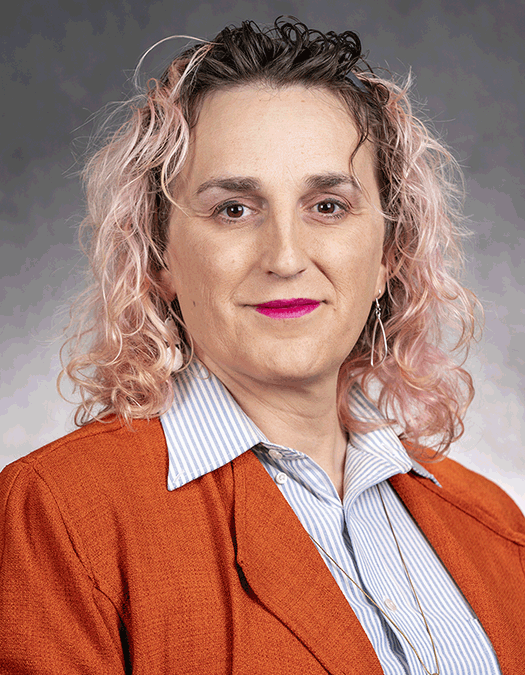
Rep. Leigh Finke
Sponsored bills
Maddy summaryThis bill establishes a one-year moratorium on issuing permits for new data centers in Minnesota, preventing their construction until a comprehensive report is completed. The Public Utility Commission is required to submit this report by July 1, 2027, or January 1, 2028, if an extension is granted, to state legislative committees. The report must analyze energy, water, and materials usage; environmental and cultural impacts on Tribal Nations; local and state economic effects; and suitable locations that minimize disruption to communities and infrastructure. Additionally, the commission must consult with Tribal governments and hire a third-party contractor who has no financial ties to data center developers to ensure the report's objectivity.
Maddy summaryHF 1073 requires pipeline owners in Minnesota to follow specific steps when abandoning pipelines. Pipeline owners must notify landowners 60 days before ceasing operations and remove all abandoned pipelines, equipment, and infrastructure within 90 days after certifying the pipeline is purged of materials. They are also responsible for restoring land by replacing topsoil, establishing vegetation, and controlling invasive species for five years. Landowners can request removal or ask to leave pipelines in place by submitting written requests to pipeline owners and state agencies.
Maddy summaryHF 2490 establishes the Companion Animal Board in Minnesota to promote the welfare of cats, dogs, and other nonagricultural pets (including rabbits, guinea pigs, and small reptiles). The board, composed of 13 appointed members representing veterinarians, communities, animal shelters/rescues, breeders, and human welfare professionals, will administer policies related to companion animals while excluding agricultural animals, wildlife, and veterinary practice. The bill appropriates funding for the board's operations and requires it to issue reports, though it does not alter existing laws governing veterinary medicine or animal health. This is a procedural bill creating a new state board with defined scope and funding.
Maddy summaryThis bill prohibits the sale and use of paraquat dichloride, a pesticide, in Minnesota. Starting January 1, 2027, no one can sell or distribute this product, and by January 1, 2028, its use is also banned. The commissioner of agriculture must collect and dispose of any remaining stock of this pesticide and submit a report on its historical use and current supply chain status by January 1, 2028. The law directly affects pesticide sellers, distributors, and agricultural users who currently handle or apply this chemical.
Maddy summaryThis bill authorizes the issuance of up to $2.5 million in state bonds to fund capital improvements for the Metropolitan Mosquito Control District's public health laboratory in St. Paul. The funds will be used to address safety concerns, expand testing capacity, and modernize procedures at the facility. The Metropolitan Council will receive a grant to oversee the design and construction of these upgrades. The legislation takes effect immediately upon final passage.
Maddy summaryHF 309 amends Minnesota Statutes §84.523 to tighten mining restrictions in the Boundary Waters Canoe Area Wilderness (BWCA) and Rainy River headwaters. The bill requires the commissioner of natural resources to determine that proposed mining (for taconite, sand, gravel, or granite) in the Rainy River headwaters would not harm the BWCA before any permits are issued. This modifies existing law by adding this specific assessment step, directly affecting mining operations seeking approval in these areas. The change maintains the general prohibition on mining without legislative approval but adds a new administrative requirement for the commissioner to evaluate environmental impacts. The bill focuses on protecting the BWCA's wilderness character through stricter permitting conditions.
Maddy summaryThis bill allocates $1.5 million from the arts and cultural heritage fund to the City of Minneapolis to create a public memorial honoring Renée Good and Alex Pretti. The memorial will feature statues, educational exhibits, and a space for community reflection, focusing on their deaths and the broader issues of civil rights and immigration enforcement. The project requires a collaborative planning process involving local residents, civil rights groups, artists, and historians, with oversight provided by a partnership including city officials and state legislators. While the state provides the initial funding, the city is permitted to seek additional private donations and partnerships to cover design, programming, and long-term maintenance costs.
Maddy summaryThis bill authorizes the state of Minnesota to issue up to $75 million in bonds to fund the renovation of the Roy Wilkins Auditorium in St. Paul. The funds will be used by the city to upgrade the facility's infrastructure, including its heating and cooling systems, electrical and plumbing networks, and security features. Additionally, the project will expand and reconfigure interior and exterior event spaces while improving accessibility and storage areas for equipment. The legislation also includes upgrades to visitor amenities such as restrooms, seating, and sound systems to support ongoing operations.
Maddy summaryHF 3779 requires all health insurance plans in Minnesota to cover doula services - providing emotional and physical support during pregnancy, birth, and postpartum - without any deductibles, co-pays, or cost-sharing for enrollees. It prohibits health plans from imposing referral requirements, utilization reviews, or quantity limits on this coverage. Starting January 1, 2027, the commissioner of commerce will reimburse health plans for the costs of covering doula services, funded by annual state appropriations beginning in 2028. This bill directly affects health plan enrollees, particularly pregnant people seeking doula support, and health insurance companies that must now include this coverage.