

Maddy summaryThis bill establishes new grant programs and provides funding for adult and children's mental health services in Minnesota, with specific priority given to areas affected by Operation Metro Surge. It creates culturally responsive mental health grants for adults and children, funds mobile crisis teams including vehicle purchases, and supports school-linked mental health services. The legislation also expands eligibility for various mental health services such as housing support, crisis intervention, and specialized care for youth at risk of psychosis or bipolar disorder.
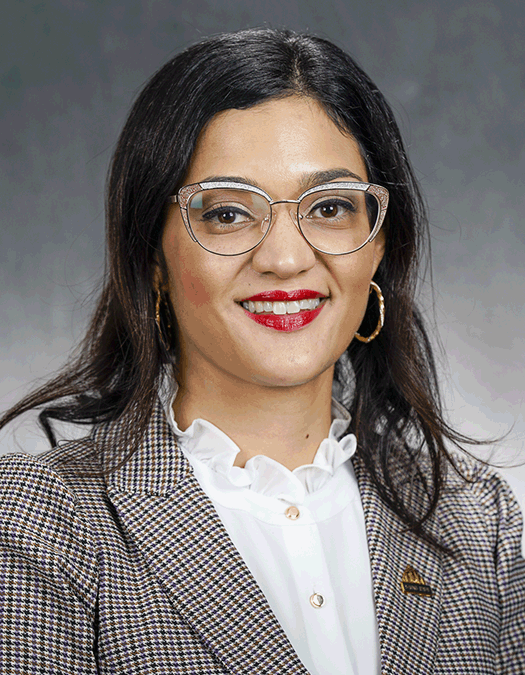
Rep. María Isa Pérez-Vega
Sponsored bills
Maddy summaryThis bill modifies Minnesota's child care assistance program rules regarding how providers are reimbursed for days when enrolled children are absent. It maintains a standard limit of 25 absent days per child per year but creates exemptions for children with documented medical conditions, young parents pursuing education, and families affected by extraordinary events like natural disasters. The legislation also clarifies how partial-day absences are counted, establishes notification requirements for families about their absent day usage, and allows parents to substitute cultural or religious holidays for standard state and federal holidays.
Maddy summaryThis bill allocates $1.5 million from Minnesota's general fund to support the Somali Museum of Minnesota in building a new facility. The money will be used to design, construct, furnish, and equip the new building in Minneapolis to preserve Somali cultural heritage and display artifacts. This is a one-time appropriation available until the project is completed or abandoned, and the funds are managed by the commissioner of employment and economic development. The legislation directly affects the Somali Museum of Minnesota by providing financial resources for its expansion and preservation efforts.
Maddy summaryThis bill allocates $175,000 from the state's general fund to support a pilot youth mentoring program called Bolder Options. The program will serve young people aged 12 to 21 in Minneapolis, St. Paul, and Rochester by introducing them to public service career paths, including opportunities with the Minnesota Army National Guard. The funding is designated as a one-time appropriation for fiscal year 2027 and is managed by the commissioner of public safety.
Maddy summaryThis bill requires sellers of emotional support dogs to provide written notice to buyers stating that the dog is not a service animal and does not have the special training required for service dogs. The notice must be printed in bold 12-point type and included on the purchase receipt or a separate document, informing buyers that the dog is not entitled to the legal rights and privileges granted to service animals. Additionally, the bill increases criminal penalties for intentionally misrepresenting an emotional support dog as a service dog, raising the offense from a petty misdemeanor to a gross misdemeanor for repeat violations. These changes apply to all sales of emotional support dogs and take effect on August 1, 2026.
Maddy summaryHF 3654 renames Minnesota’s "Local Optional Revenue Program" to the "Local Education Revenue Program" and increases its funding. The bill establishes a new calculation method using regional wage data to determine school district revenue, with a base allowance of $979 for fiscal year 2027 (adjusted annually). It also adds $132 per adjusted pupil unit to charter school funding and modifies how districts calculate local revenue levies based on property values. The changes directly affect Minnesota school districts and charter schools by altering their state education funding formulas, effective for fiscal year 2027 and beyond.
Maddy summaryHF 3279 proposes a constitutional amendment to increase Minnesota's sales tax rate by 0.375% (three-eighths of one percent) starting July 1, 2027, through June 30, 2052. The revenue would fund three dedicated housing programs: 25% to a homeownership opportunity fund for owner-occupied housing, 25% to a community and household stability fund for homelessness prevention services, and 50% to a rental opportunity fund for rental assistance and housing development. All Minnesotans purchasing taxable goods would pay the slightly higher tax, with funds specifically targeting housing stability for vulnerable households. The amendment requires voter approval at the 2026 general election before taking effect.
Maddy summaryHF 1099 changes how special education funding is shared between school districts and charter schools in Minnesota. Starting in fiscal year 2026, the state will cover 50% of the unreimbursed cost for special education services provided to students at charter schools (down from previous rates where districts paid more), while resident districts will pay only 50% of those costs instead of higher percentages. This bill directly affects charter schools receiving special education services and the school districts that host them, shifting more financial responsibility to the state. It amends Minnesota statutes 124E.21 and 127A.47 to implement this funding adjustment.
Maddy summaryThis bill increases funding for Minnesota's Family Homeless Prevention and Assistance Program, raising the annual appropriation from $10.27 million to $45.27 million. The additional funds will be used to reduce homelessness risks and improve program effectiveness, with a portion designated for the housing development fund. The legislation also grants agencies flexibility in awarding grants to existing grantees and allows new grantees in certain areas to work with advisory committees or local care systems without meeting specific statutory requirements. These changes take effect immediately and establish a future funding base of $10.72 million starting in fiscal year 2028.
Maddy summaryThis bill establishes a one-time $300,000 grant program in fiscal year 2027 to help children in foster care who are noncitizen immigrants obtain legal documentation. The funding will support partnerships between social services agencies and qualified nonprofit organizations to identify children lacking birth certificates or Social Security cards and assist them in gaining permanent legal status. To receive funds, applicants must demonstrate a collaboration between a social services agency and a nonprofit with specific expertise in immigration relief, legal representation, and serving diverse communities. The bill also includes confidentiality protections for the private data of children receiving services under the program.