

Maddy summaryThis bill allocates $130,000 from Minnesota's workforce development fund to provide a one-time grant to New Pathways, a program in Cambridge. The funding supports job readiness services for parents with children experiencing homelessness, including resume assistance, interview preparation, and connections to employers and training programs. The grant requires the program to use case management and community partnerships to help families achieve stable housing and self-sufficiency while overcoming employment barriers.
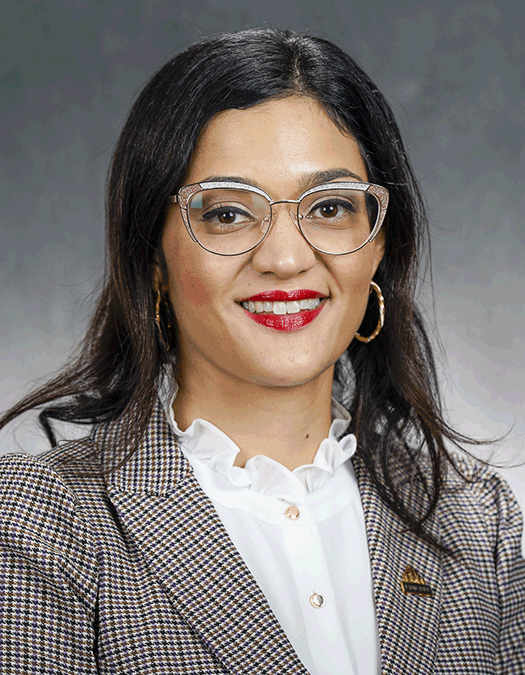
Rep. María Isa Pérez-Vega
Sponsored bills
Maddy summaryThis bill creates a new grant program to provide social services and mental health support to victims of Operation Metro Surge, a federal immigration enforcement operation. The program will fund organizations that help affected individuals with basic needs like housing, food, and employment assistance, as well as mental health care. Eligible applicants include nonprofits, government agencies, tribal nations, and legal service providers, with priority given to areas most impacted by the operation. The bill appropriates unspecified funding from the state's general fund for one-time use through June 2029, requiring grantees to report on program participation and outcomes.
Maddy summaryThis bill authorizes the issuance of up to $22 million in state bonds to fund the replacement of unsafe and undersized buildings and facilities at Dakota County regional parks. The funds will be used to upgrade infrastructure at Lebanon Hills Regional Park and Lake Byllesby Regional Park, including new swimming beach facilities with accessible restrooms and showers, improved campground lodges with storm shelters, and updated trails and amenities. The legislation directs the commissioner of employment and economic development to manage the grant process for designing and constructing these improvements, with the bond sale handled by the commissioner of management and budget.
Maddy summaryThis bill appropriates $10 million from state bond proceeds to fund physical safety upgrades at the Ordway Center for the Performing Arts in St. Paul. The funds will be granted to the City of St. Paul for designing, renovating, and equipping capital safety improvements, such as fire systems or emergency exits. The state will issue bonds up to $10 million to cover these costs, following established bond procedures under Minnesota law. The bill directly affects the Ordway Center's infrastructure and the City of St. Paul as the recipient of the grant.
Maddy summaryThis Minnesota bill restricts state and local government participation in federal civil immigration enforcement efforts, prohibiting agencies from using resources to investigate, detain, or arrest individuals for immigration violations. It defines civil immigration enforcement to exclude criminal law enforcement and clarifies that cooperation with federal authorities on criminal matters remains permitted. The legislation also establishes a cause of action for constitutional rights violations related to immigration, prohibits denying education based on immigration status, and requires hospitals to create policies for interactions with law enforcement. Additionally, the bill appropriates funding to support these provisions and amends existing state statutes regarding immigration-related activities.
Maddy summaryThis bill allocates $250,000 from the state's general fund to Minnesota's Rally to Read program, which operates under the Department of Children, Youth, and Families. The funding supports community reading coalitions that aim to improve reading proficiency across the state, with a specific focus on early childhood development from prenatal to age three. Grant recipients must match each dollar of state funding with private money and use the funds for activities like staffing, coordination, data tracking, and program evaluation. The appropriation is a one-time allocation available until June 30, 2028, and requires a targeted strategy to prioritize literacy resources for children who need them most.
Maddy summaryHF 3004 appropriates $650,000 for fiscal year 2026 and $650,000 for fiscal year 2027 to create a centralized digital platform targeting Minnesota youth aged 15-23. The platform will provide information on internships, mentoring, and job opportunities, with youth involved in its development and promotion through social media. By December 1, 2027, the provider must submit a report detailing platform engagement, user demographics, available opportunities, and youth feedback. This one-time funding, ending June 30, 2027, is intended to improve youth access to workforce resources.
Maddy summaryThis bill removes the legal authority for federal agents from U.S. Customs and Border Protection and U.S. Citizenship and Immigration Services to make arrests under Minnesota state law. It directly affects these federal agencies by eliminating their ability to conduct warrantless arrests within the state, except when assisting local law enforcement. The change amends existing statutes to delete provisions that previously allowed these officers to arrest individuals for specific crimes like assault or felonies when on duty or with a warrant. This policy adjustment limits arrest powers to state-authorized peace officers and private citizens, while still permitting federal agents to aid in executing warrants when requested by local officers.
Maddy summaryThis bill modifies Minnesota's law on concealing identity in public places. It adds "protection from smoke, gas, or other airborne toxin" as a valid exception for wearing masks or disguises, while clarifying that the law generally prohibits such concealment (except for religious, entertainment, weather, or medical reasons). The bill specifically creates two new exceptions for law enforcement: undercover officers may conceal identity when necessary for investigations or safety, and tactical team members may wear face masks to prevent facial disfigurement. The law would not apply to these officers while performing official duties under these specified circumstances. (Note: This is a proposed bill pending in committee as of February 2026.)
Maddy summaryHF 3413 prohibits Minnesota state, county, and local government units - including county sheriffs - from entering new agreements with the federal government that allow them to enforce civil immigration law. The bill also requires immediate termination of any existing agreements of this type within 24 hours of the law taking effect. It defines "immigration enforcement agreement" broadly to include contracts, memorandums, or intergovernmental agreements that authorize local entities to carry out federal immigration enforcement actions. This policy change directly affects all state and local law enforcement agencies that previously participated in such federal programs. The law takes effect the day after final enactment, eliminating both new and ongoing participation in these specific federal-local immigration enforcement partnerships.