

Maddy summaryThis bill repeals previous sales tax exemptions for preferred seating and amenities at athletic facilities, meaning these items will now be subject to sales tax when purchased with event tickets. It also provides funding for safe harbor shelter and housing grants to support homeless assistance programs. The legislation defines various retail sales for tax purposes, including bundled transactions and promotional items, while appropriating money for the housing grants.
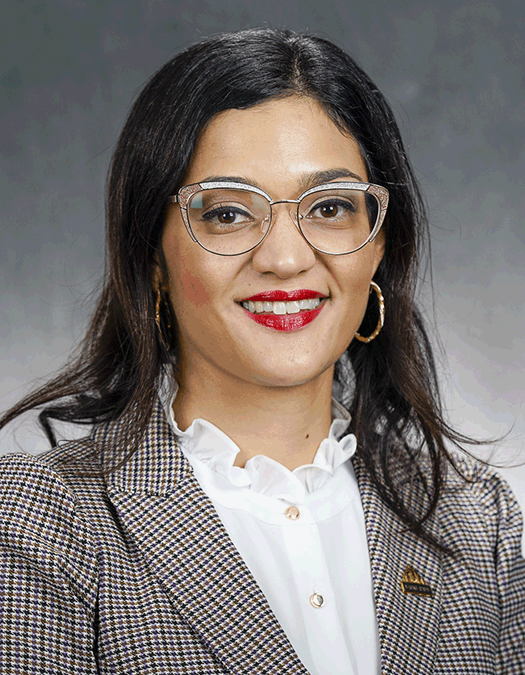
Rep. María Isa Pérez-Vega
Sponsored bills
Maddy summaryThis bill authorizes the state of Minnesota to issue up to $95 million in bonds to fund road and utility infrastructure improvements at the Sears site in St. Paul. The funds will support construction of sanitary sewer and clean water systems, public utilities, streets, sidewalks, lighting, and streetscape improvements needed to prepare the area for future development. The legislation also defines the Sears site boundaries and establishes the legal framework for managing bond proceeds, including provisions for environmental remediation and demolition of existing structures. This measure is designed to provide necessary infrastructure support for the redevelopment of the former Sears property.
Maddy summaryHF 3415 restricts federal immigration agents (like those from ICE, CBP, or USCIS) from entering Minnesota child care centers without specific authorization. Licensed or certified child care centers must require federal agents to present valid ID, a written purpose statement, a judicial warrant, and obtain approval from the center owner before entry. Even with these requirements, centers must limit agent access to areas where children are not present. This bill directly affects all licensed and certified license-exempt child care centers in Minnesota by establishing clear protocols for federal agent access.
Maddy summaryHF 3258 repeals two Minnesota statutes (3.226 and 16C.053) that previously prohibited state agencies and the legislature from entering contracts with vendors who discriminate against Israel or businesses operating in Israel. The bill removes the requirement to avoid such vendors, allowing state government to contract with any vendor regardless of their position on Israel-related business practices. This change applies to new contracts published or entered on or after the effective date, which is the day after enactment. The repeal affects all state procurement decisions involving vendors, eliminating the prior restrictions and exemptions for small contracts.
Maddy summaryHF 3714 modifies enrollment priorities for children in foster care in Minnesota's education and child care programs. It requires school districts to give foster care children the highest priority for community education programs like after-school care, and updates the Northstar foster care child care allowance system to stop providing assistance when children turn 13 (previously age 7). The bill also mandates that licensing agencies provide foster care providers with information about child care costs and early childhood education programs. These changes directly affect foster care children, their caregivers, and child care providers across Minnesota.
Maddy summaryHF 3455 renames Minnesota's State Office Building at 100 Rev. Dr. Martin Luther King Jr. Blvd. in St. Paul as the "Melissa Hortman State Office Building." The bill requires the revisor of statutes to update all official references to the building in Minnesota Statutes and Rules. This is a ceremonial renaming with no policy changes or direct impact on residents or government operations.
Maddy summaryMinnesota's HF 1269 requires health insurance plans to cover all FDA-approved medical services and prescription medications for treating dementia, including diagnostic tests to assess treatment effectiveness. It also prohibits health plans from using "step therapy" (requiring patients to try cheaper drugs first) for dementia treatments. The bill modifies prior authorization rules for certain medications, ensuring automatic 60-day coverage for brand-name mental health drugs when generics become available, and streamlines approval for oral liquid drugs used with feeding tubes. These changes apply to health plans offered in Minnesota starting January 1, 2026.
Maddy summaryHF 1148 establishes a state grant program to provide prepared meals for Minnesotans experiencing food insecurity who have difficulty cooking due to limited mobility, disability, or financial constraints. The program funds nonprofit organizations and federally recognized Minnesota tribes that prepare culturally tailored meals in licensed kitchens, prioritizing groups serving racially, ethnically, and geographically diverse communities at high risk of food insecurity. Grants require 50% of meal ingredients to come from Minnesota producers or donated/wasted food, and grantees must serve individuals aged 18-60 and their dependents while avoiding duplication with other meal programs. The bill appropriates unspecified funds for fiscal years 2026 and 2027, with grantees required to report on fund usage and retain expenditure records.
Maddy summaryThis bill allocates $4 million in state funding to provide economic development grants for small businesses in St. Paul and West St. Paul. The money is designated for businesses employing ten or fewer full-time employees and will be administered through the commissioner of employment and economic development. Funds can be used for technical assistance, creating loan programs including interest-free and forgible loans, and providing grants to cover operating expenses. The appropriations are one-time funds available until June 30, 2028, with West St. Paul's portion specifically requiring consultation with the Residents of Color Collective.
Maddy summaryThis bill provides funding for Minnesota's Board of Public Defense, which supports public defenders representing low-income individuals who cannot afford legal representation. The legislation appropriates $6.9 million for fiscal year 2026 and $13.7 million for fiscal year 2027 from the state's general fund, with an additional base funding of $183.529 million starting in fiscal year 2028. These funds are intended to supplement existing appropriations and ensure continued financial support for the public defense system. The bill takes effect immediately upon final enactment.