

Maddy summaryHF 107 modifies Minnesota's unemployment insurance rules for workers involved in labor disputes. It specifies that workers participating in or directly affected by a labor dispute can receive benefits until the end of the week the dispute was active, while those not involved are eligible until the dispute began. The bill clarifies that certain situations - like employer safety violations, lockouts, or being fired before a dispute starts - do not make applicants ineligible. This directly affects workers who stop working due to labor conflicts, ensuring they maintain eligibility under defined conditions. The changes amend Minnesota Statutes section 268.085, subdivision 13b.
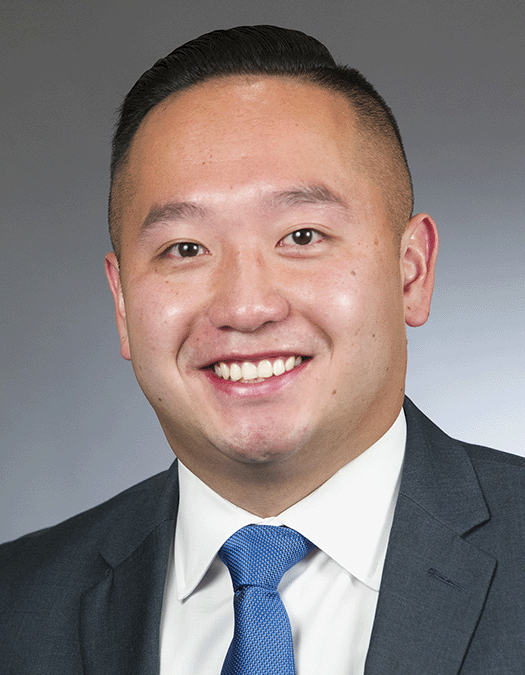
Rep. Fue Lee
Sponsored bills
Maddy summaryHF 958 requires Minnesota's medical assistance program to cover psychiatric collaborative care services for eligible clients. This model, defined as an evidence-based integrated approach involving primary care teams with psychiatric consultants, must be billed using specific codes (99492-99494, G2214, G0512). The bill mandates coverage for this service delivery method, which includes structured care management and regular clinical assessments. It takes effect July 1, 2025, or upon federal approval, whichever is later.
Maddy summaryHF 669 modifies Minnesota's children's mental health grant programs to expand services for students. It allows schools and providers to use funds for telehealth services, family support, school staff training, and student transportation to mental health appointments when school isn't in session. The bill requires grantees to seek third-party reimbursement (excluding public schools) but ensures services are available regardless of a student's insurance or ability to pay. It also clarifies rules for nonemergency medical transportation providers under Minnesota health care programs. The legislation appropriates state funds to support these expanded services for children and families.
Maddy summaryHF 1948 establishes Minnesota's Headwaters Community Food and Water Economic Resiliency Program to support sustainable local food systems. The program, administered by the commissioner of employment and economic development, directly assists urban and rural producers - especially Black, Indigenous, and people of color - engaged in regenerative food systems. Key provisions include providing financial and technical aid for infrastructure (like storage facilities, food commons, and weather-resilient water systems), operational support for food webs, training for new participants, and ensuring affordable fresh food access for all income levels. The bill also creates an advisory committee requiring diverse community representation to guide program implementation.
Maddy summaryHF 2778 transfers $371,000 from Minnesota's general fund to the Agricultural Research, Education, Extension, and Technology Transfer (AGREETT) account for fiscal year 2026. This funding specifically directs the Commissioner of Agriculture to allocate resources to the University of Minnesota Board of Regents for research on crop contamination and exposure to disease-causing proteins (prions) from animals with chronic wasting disease. The bill directly affects agricultural research programs at the University of Minnesota, enabling targeted studies on a specific animal health issue impacting crops. It does not change existing funding levels but specifies a new allocation for this particular research focus.
Maddy summaryHF 1509 limits when law enforcement can issue citations to pedestrians for crossing during certain traffic signal phases. It amends Minnesota Statutes § 169.06, subdivision 5, by clarifying that pedestrians facing a circular yellow traffic signal (not a dedicated pedestrian signal) cannot be cited for starting to cross when the yellow light first appears. The bill specifically prohibits citations for pedestrians who begin crossing during the yellow phase, as the signal warns there is "insufficient time to cross" before red. This directly affects pedestrians at intersections with standard traffic signals, ensuring they aren’t penalized for crossing during the yellow light warning.
Maddy summaryHF 1481 requires biofuel plants in Minnesota to monitor ethanol, biodiesel, and advanced biofuel production for neonicotinoid pesticides and perfluoroalkyl substances (PFAS) in the fuel, air emissions, wastewater, and byproducts like dried distillers grains. It mandates that plants maintain permanent records of these tests and make them available to the public and regulators. The bill also provides for voluntary biomonitoring of biofuel plant employees to assess workplace exposure to these chemicals, with $250,000 appropriated to the Department of Health for this purpose. The law appropriates a total of $1.1 million across state agencies for implementation, including $500,000 for wastewater and air monitoring under the Pollution Control Agency.
Maddy summaryThis bill appropriates funding for Minnesota's Local Food Purchasing Assistance Grant Program, which provides grants to organizations buying and distributing food within the state. Eligible groups include nonprofits, businesses, tribal governments, and schools, with preference given to those sourcing 100% of food from Minnesota, prioritizing farmers with limited market access, and distributing food at no cost in communities with low supermarket access or high need. The program aims to support local agriculture and improve food access in underserved areas, including food deserts and communities with significant aging or disabled populations. Funding is allocated for fiscal years 2026 and 2027 from the state general fund.
Maddy summaryHF 2579 appropriates $490,000 for each of fiscal years 2026 and 2027 to fund two grant programs under Minnesota's Agriculture Department. The AGRI Works program provides one-time grants of up to $20,000 to agriculture-related institutions and nonprofits, while the AGRI Support program offers grants between $20,000 and $200,000 to the same entities. Applicants must submit tax documents and complete a commissioner-approved application. These funds are drawn from the general fund and are designated as one-time appropriations.
Maddy summaryHF 2600 modifies Minnesota's voter registration rules to allow individuals in county jails to register using the address listed on their jail intake form. This change directly affects eligible voters currently incarcerated in county facilities, enabling them to register on election day without needing additional proof of residence. The bill also requires the secretary of state to allocate funds to sheriffs to implement jail-based voter registration procedures, with grants distributed based on the number of jail beds under each sheriff's authority. These funds are intended to support the administrative work needed for this new registration process.