

Maddy summaryHF 855 appropriates $1.5 million from the general fund to the Minnesota Commissioner of Agriculture for a study on microplastics in meat and poultry sold in Minnesota. The study, to be conducted in consultation with the Commissioner of Health and the University of Minnesota, must be completed by February 1, 2026, with findings reported to relevant legislative committees. This bill directly affects state agencies (Agriculture, Health) and the University of Minnesota, which will conduct the research. The funding is a one-time appropriation, and the bill does not establish new regulations but requires a factual assessment of microplastic presence in food products.
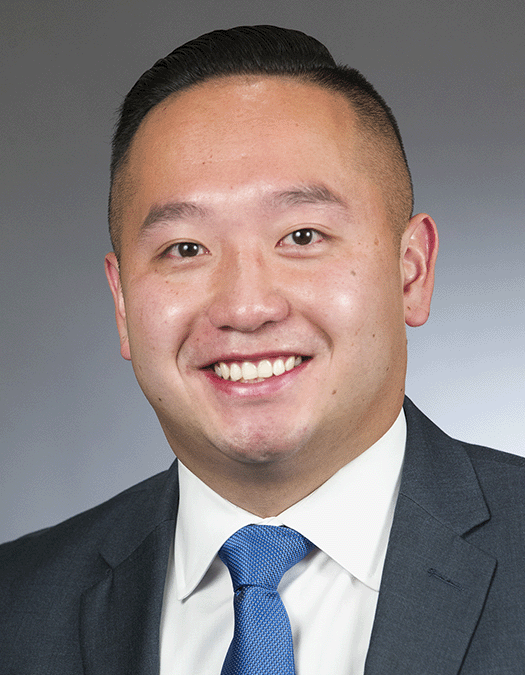
Rep. Fue Lee
Sponsored bills
Maddy summaryHF 2578 modifies Minnesota's rules for annexing unincorporated property. It clarifies that property owners can petition for annexation by gathering signatures from either 20% of owners or 100 owners (whichever is fewer) in the area. The bill specifically excludes owners or operators of aggregate mining facilities (as defined in section 298.75) from being eligible to initiate annexation petitions. This change affects property owners in unincorporated areas seeking to join a municipality and the process for starting annexation proceedings.
Maddy summaryHF 2010 raises Minnesota's age of consent for criminal sexual conduct from 16 to 18 years old in cases where the offender is 22 or older. The bill amends Minnesota Statutes 609.344 and 609.345 to remove consent as a defense and criminalize sexual contact between minors aged 16-17 and partners 22+ years old. It specifically targets situations where the age gap exceeds 36 months (3 years) and the offender holds authority over the minor. The law takes effect August 1, 2025, imposing criminal penalties for violations that previously might have been treated as consensual.
Maddy summaryHF 2481 modifies the membership and duties of Minnesota's Clean Water Council, which advises on water quality programs. The bill changes the council to have 17 voting members appointed by the governor from specific groups, including two farm organization representatives, two environmental groups, local government representatives (cities, counties, watersheds), tribal governments, and others. The council’s key duties include advising state agencies on water quality priorities, coordinating efforts across agencies, and recommending funding allocations from the Clean Water Fund. This directly affects the council members, state environmental agencies, and local organizations involved in water management across Minnesota.
Maddy summaryHF 2379 appropriates $1.5 million from Minnesota's arts and cultural heritage fund for the Mixtape Strategy to preserve Minneapolis's historic Black Camdentown neighborhood. The funding specifically supports building a cultural hub at 44th Avenue North, Minneapolis, with community gathering spaces. The hub will focus on fostering collaboration and innovation by empowering small, diverse businesses in the area. This bill directly affects the Mixtape Strategy organization and the Camdentown community through this targeted capital investment.
Maddy summaryHF 2485 authorizes $258.3 million in state bond funding for capital improvements to public infrastructure. It directly affects Minnesota's public universities (University of Minnesota and Minnesota State Colleges), school libraries, and state facilities. Key provisions include $40 million for campus infrastructure repairs (like heating systems and building code compliance at UMN campuses), $177.1 million for library construction grants (including $1 million for a new Clara City library), and $1.2 million for state academy facility upgrades. The bill specifies that funds must be used for capital improvements like building repairs, utility systems, and compliance with safety codes, with strict requirements for project planning and funding commitments before disbursement.
Maddy summaryHF 2468 appropriates $500,000 for fiscal year 2026 and $500,000 for fiscal year 2027 from the general fund to support mental health initiatives in Minnesota's construction industry. The funds, available until June 30, 2027, are designated for outreach, education, stigma reduction programs, and worksite strategies to prevent suicide. They can be used for grants to industry groups and developing resources targeting construction workers. This bill directly affects construction industry workers by funding concrete mental health support services through state-administered programs.
Maddy summaryHF 1845 expands Minnesota's definition of "veteran" to include two specific groups: (1) Hmong veterans naturalized under the federal Hmong Veterans' Naturalization Act of 2000, and (2) individuals who served honorably with secret guerrilla units or irregular forces operating from Laos in support of U.S. forces between February 28, 1961, and May 14, 1975. The bill amends Minnesota Statutes section 197.447 to add these categories to the existing definition, ensuring these veterans qualify for state benefits. It also creates an advisory task force of veterans, experts, and community members to help determine eligibility under the new definition. This change directly affects Hmong veterans and Laotian-based veterans who previously may not have met Minnesota's veteran criteria.
Maddy summaryHF 498 appropriates $400,000 for fiscal year 2026 and $400,000 for fiscal year 2027 from the workforce development fund to provide a grant to the Urban League Twin Cities. The funds are specifically designated to support and expand the organization's workforce training and wealth-building programs. This one-time funding directly affects the Urban League Twin Cities' ability to deliver these services in the Twin Cities area. The bill provides concrete financial support for these existing community programs without altering broader policy.
Maddy summaryHF 2121 appropriates $75,000 for fiscal year 2026 and $75,000 for fiscal year 2027 (totaling $150,000) from the general fund to the West Broadway Business and Area Coalition in Minneapolis. The funds are designated for the Coalition's ambassador program to manage, maintain, and oversee the West Broadway Avenue corridor. This one-time funding directly supports local business and neighborhood efforts to improve the corridor's appearance and functionality. The bill does not create new policies or regulations, but provides specific financial support for an existing community initiative.