

Maddy summaryHF 671 establishes two new grant programs to improve children's mental health services in Minnesota. It creates a competitive grant for training direct care staff in residential facilities and day treatment programs (via the "youth care professional grant"), requiring trauma-informed curricula and a registry for trained staff. It also launches a "high-fidelity wraparound grant" to fund comprehensive, family-driven mental health support for children with serious challenges, prioritizing evidence-based models. The bill modifies rates for certain children's mental health services, establishes a working group for psychiatric residential facilities, and appropriates funding for these initiatives. These changes primarily affect licensed residential facilities, day treatment programs, community service providers, and counties delivering children's mental health services.
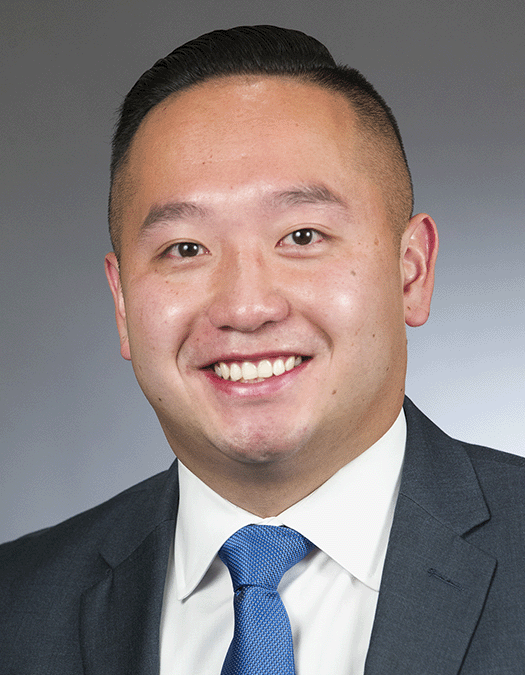
Rep. Fue Lee
Sponsored bills
Maddy summaryHF 2712 allocates $8.5 million from the state general fund for one-time improvements to the Capitol tunnel under Rev. Dr. Martin Luther King Jr. Boulevard and east of the State Capitol. The funds will cover designing, constructing, and equipping the tunnel to meet Americans with Disabilities Act (ADA) requirements, directly benefiting people with disabilities who use Capitol facilities. The bill specifies that the funding is available until the project is completed or abandoned, with no ongoing annual appropriations. This is a straightforward infrastructure funding measure focused on accessibility compliance, not a policy change affecting broader legislation.
Maddy summaryHF 2576 prohibits burning pesticide containers in Minnesota, directly affecting farmers, agricultural workers, and anyone handling pesticide containers. The bill amends Minnesota Statutes 18B.07, adding a specific prohibition against disposing of pesticide containers by burning, while requiring disposal to follow existing environmental and federal (FIFRA) guidelines. This law becomes effective January 1, 2026, replacing the previous allowance for burning containers under disposal rules. The change creates a clear legal requirement to avoid burning, aiming to prevent environmental harm from toxic fumes.
Maddy summaryHF 186 requires Minnesota's transportation department to conduct cumulative impacts analyses and alternative design studies for highway projects, incorporating community input through a new policy advisory committee. It creates a dedicated environmental justice ombudsperson position to address equity concerns and restricts highway funds from covering non-transportation uses like tourist kiosks, parades, or electric vehicle infrastructure. The bill directly affects highway planning decisions, funding allocations for the Minnesota Department of Transportation, and communities near proposed projects. Key provisions include mandating community input for project designs and clarifying eligible uses of highway funds under Minnesota Statutes.
Maddy summaryThis bill creates a $1 million one-time program to reimburse low-income homeowners for costs related to treating or removing ash trees infested with the emerald ash borer. Eligible local governments (cities, towns with 10,000+ residents, or Minnesota Tribal governments) will receive funds to reimburse homeowners with incomes below 200% of the federal poverty guideline for eligible tree treatment or removal costs incurred since 2020. The commissioner of revenue will distribute funds via a competitive grant program prioritizing areas with high infestation rates, residents' ability to pay, and population size. The funds are allocated for fiscal year 2026, with the Department of Revenue allowed to retain up to 3% for administrative costs.
Maddy summaryHF 422 appropriates $10 million for fiscal year 2026 and $10 million for fiscal year 2027 from state funds to support two existing Minnesota programs. The funding directly supports schools and communities by improving safe walking and biking routes to school (under Minnesota Statutes §174.40) and expanding broader active transportation infrastructure like bike lanes and pedestrian paths (under §174.38). This provides concrete financial resources for local projects that make it safer and easier for students and residents to walk or bike. The bill focuses on implementing specific, measurable infrastructure improvements rather than creating new policies.
Maddy summaryHF 2724 provides a sales tax exemption for construction materials used at Minneapolis' Upper Harbor Terminal Amphitheater. It exempts purchases made by contractors, subcontractors, or the amphitheater operator between July 1, 2025, and December 31, 2028, from Minnesota's sales and use tax. The tax collected on these materials will be refunded through the same process used for other qualifying projects under state law. This directly affects those purchasing construction materials for the specific amphitheater infrastructure project during the stated timeframe.
Maddy summaryHF 2577 modifies Minnesota's agricultural waste handling rules, primarily affecting farms, fertilizer distributors, and entities handling sewage sludge. The bill requires detailed record retention for all sewage sludge transfers - including date, amount, and parties involved - and mandates these records be available to the Department of Agriculture upon request. It also clarifies the Department's role in regulating PFAS-containing fertilizers and prohibits applying fertilizer or sewage sludge to impervious surfaces like driveways or parking lots. These changes aim to improve tracking of waste materials and prevent environmental contamination from improper handling.
Maddy summaryHF 2479 appropriates $500,000 for fiscal year 2026 and $500,000 for fiscal year 2027 from the workforce development fund to provide a one-time grant to Pillsbury United Communities. The funds will support job training and workforce development services for unemployed or underemployed residents in the community. This bill directly affects Pillsbury United Communities (as the grant recipient) and the local individuals who will access these job training programs. The appropriation is limited to these two fiscal years and does not establish ongoing funding.
Maddy summaryHF 1611 appropriates $1 million from the general fund for the 2026 fiscal year to fund a "Lawns to Lunch" pilot program. The program provides financial and technical assistance to help residents and communities convert lawns into food gardens featuring vegetables, fruits, pollinator plants, and other edibles. It prohibits using funds for commercial food sales, greenhouses, or buildings, and the money must be spent by June 30, 2030. This one-time funding supports local food gardening efforts without creating new regulations.