

Maddy summaryHF 2759 establishes a pilot program requiring Minnesota's Department of Transportation (MnDOT) to use qualification-based selection (selecting engineering firms based on their expertise and experience, not just lowest cost) for at least five road construction projects each year where consultant fees exceed $800,000. This applies from October 2025 through March 2028, with MnDOT required to submit two reports: a preliminary report by October 2026 and a final report by October 2028, detailing impacts on project timelines, quality, change orders, and sustainability. The bill appropriates a one-time $... for fiscal year 2026 to cover the pilot program and report preparation. The pilot expires January 15, 2029, or upon final report submission, whichever comes first, and directly affects MnDOT and the engineering firms hired for qualifying projects.
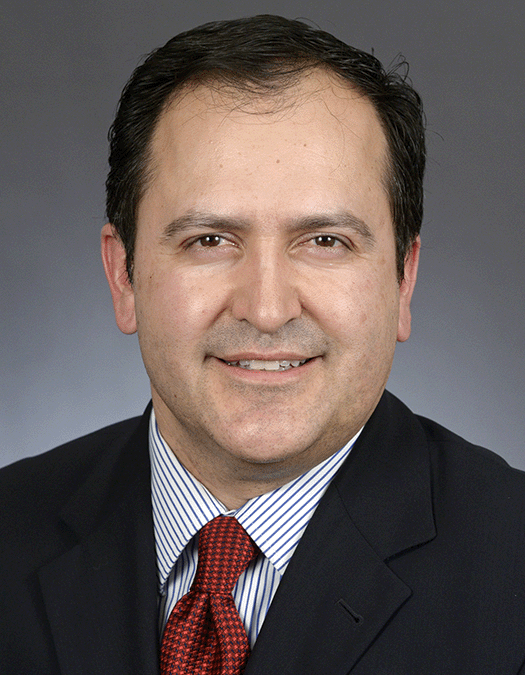
Rep. Jon Koznick
Sponsored bills
Maddy summaryHF 1401 expands Minnesota's definition of "endangered" for the missing and endangered persons program. The bill adds specific circumstances that classify a missing person as endangered, including needing urgent medical care, having cognitive impairments like dementia, or being lost in dangerous wilderness areas. This change allows law enforcement to activate immediate search and rescue resources when these new criteria are met. The bill directly affects local police departments and individuals who go missing under these expanded circumstances, ensuring faster response for vulnerable cases.
Maddy summaryHF 510 appropriates $2 million total ($1 million each for fiscal years 2026 and 2027) from the general fund to Enterprise Minnesota, Inc., to support small Minnesota manufacturers. The funding targets manufacturers with 250 or fewer full-time equivalent employees, providing services like business strategy, quality management, and peer advisory support through the "Made in Minnesota" program. Enterprise Minnesota must submit annual reports detailing funds distributed, estimated and actual financial impacts on recipient companies, and federal funds leveraged. This bill directly affects small manufacturing businesses in Minnesota by providing targeted growth support and requires transparency through mandated reporting.
Maddy summaryHF 1361 appropriates $8 million from state bond proceeds to fund improvements at CHS Field in St. Paul. The city of St. Paul will receive the grant to cover predesign, construction, and equipment for upgrades meeting Major League Baseball standards, including a new locker room, enhanced visitor amenities, and environmental remediation of contaminated soil. The state will issue bonds up to $8 million to fund this appropriation, following Minnesota's bond sale procedures. This bill directly affects CHS Field's operations and the city's ability to modernize the stadium.
Maddy summaryHF 4 proposes a constitutional amendment requiring Minnesota to return budget surplus funds to taxpayers. If approved, it would create a "Minnesota tax relief account" funded by revenue exceeding 105% of projected spending, using those funds to refund or reduce property and income taxes. Taxpayers would receive direct refunds or tax reductions, but only up to the amount they owe in taxes, with the account funded annually from the state's general fund surplus. The amendment must be voted on by voters in the 2026 general election.
Maddy summaryHF 2503 amends Minnesota's driver's license suspension rules for drivers convicted of criminal vehicular operation (causing injury) or criminal vehicular homicide. It requires peace officers to certify probable cause for these offenses before license suspension (amending Minn. Stat. § 629.344) and adds that suspended time counts toward future license revocation if convicted (amending Minn. Stat. § 171.187, subd. 3). The bill directly affects drivers facing these specific criminal charges, modifying the administrative process for license suspensions and revocations. The changes take effect August 1, 2025.
Maddy summaryHF 26, titled the "Never Again Act," shifts emergency declaration authority from the governor to the Minnesota legislature. It repeals the governor's power to declare emergencies and establish a new process requiring legislative approval for emergency declarations and extensions. The bill also prohibits the governor from issuing emergency orders with the "full force and effect of law" and explicitly protects citizens' rights, including free speech, religious freedom, assembly, travel, gun rights, and the ability to operate businesses. These changes amend multiple sections of Minnesota Statutes to clarify that only the legislature may enact emergency measures with legal force during crises.
Maddy summaryHF 23 amends Minnesota Statutes section 181.932 to strengthen whistleblower protections for public employees. It expands the list of protected disclosures to include reporting gross mismanagement or waste of public funds (subsection 7), clarifies protections for health care quality concerns (subsection 4), and adds specific scenarios like reporting truthful scientific studies (subsection 5) or classified service communications about state services (subsection 6). These changes directly affect state and local government employees who report violations of law, safety risks, or financial misconduct. The bill modifies existing anti-retaliation language to explicitly cover these new disclosure types while maintaining that protected disclosures cannot override other legal data protections.
Maddy summaryHF 748 requires Minnesota transportation agencies to assess new projects against greenhouse gas emission targets and vehicle miles traveled (VMT) reduction goals before including them in state or regional transportation plans. If a project doesn't meet these targets, agencies must either modify the project, add offsetting mitigation measures (like transit expansions or active transportation infrastructure), or halt the project. The bill modifies statutes to define "applicable projects" and sets an effective date of August 1, 2027, for portfolio-level assessments instead of project-by-project reviews. This directly affects state and local transportation planning entities developing projects that must align with statewide climate and mobility goals.
Maddy summaryHF 25 establishes a state grant program administered by Minnesota's Department of Health to fund nonprofit women's pregnancy centers and maternity homes. The program provides financial support for services like housing, medical care, parenting education, and mental health resources to help pregnant women and new mothers - particularly those facing homelessness or crisis - carry pregnancies to term and care for their children. Eligible organizations must be nonprofits offering free or low-cost services without promoting abortion, providing abortion care, or referring women to abortion providers. Grant funds cannot be used for abortion-related activities, and strict privacy rules require written consent before sharing personal information about clients. The bill appropriates state funds for this program while reducing other health-related appropriations.