

Maddy summaryHF 3446 appropriates $6.5 million from state bond funds to build a new swimming pool and aquatics center in South St. Paul, Minnesota. The city of South St. Paul directly receives this grant for site preparation, construction, equipment, and furnishings. The bill requires the facility to include specific sustainability features like energy-efficient lighting, water-saving plumbing, native landscaping, accessibility for active transportation, and photovoltaic-ready infrastructure. The state will issue bonds to cover the cost, with the funding effective upon enactment.
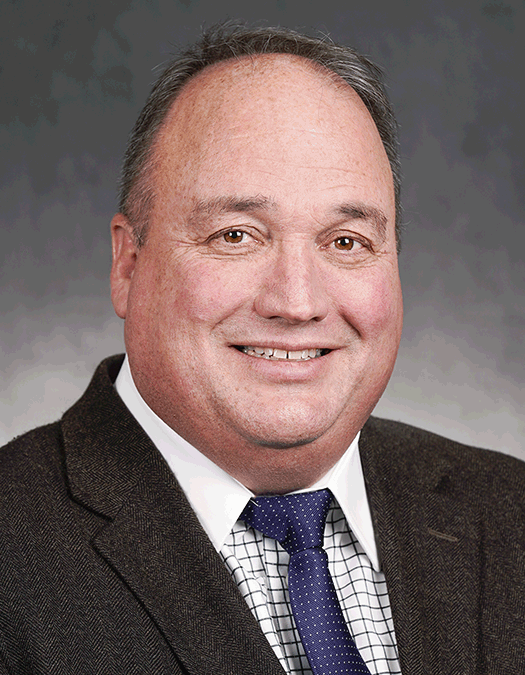
Rep. John Huot
Sponsored bills
Maddy summaryHF 3787 requires that smoke alarms replaced in residential dwelling units (such as apartments and single-family homes, but excluding hotels, motels, and commercial buildings) after August 1, 2027, must use sealed batteries (non-removable for a 10-year lifespan) and meet national testing standards. The bill specifies that these alarms must be tested and listed by a nationally recognized laboratory according to standards published on or after October 1, 2022. This applies to all replacements, including when alarms exceed their 10-year life as required by current fire code rules. Violations would be enforced under Minnesota's existing State Fire Code penalty structure.
Maddy summaryHF 3804 extends the deadline for natural organic reduction facilities to begin processing human remains from 24 hours to 30 days after accepting legal custody of a body. This change directly affects facilities offering natural organic reduction (a water-based decomposition process) and the families using these services. Key provisions now require facilities to keep bodies refrigerated beyond 4 days and embalm the body if processing isn't initiated within 30 days - unless the process starts before that deadline. The bill amends Minnesota Statutes sections 149A.91, 149A.94, and 149A.955 to update these timeframes. This adjustment provides facilities more flexibility while maintaining health and safety requirements for body handling.
Maddy summaryHF 3790 restores Minnesota school districts' ability to use property tax levies to lease space for high school graduation ceremonies. The bill amends state law to explicitly include graduation ceremonies as a permitted purpose for lease levies, which had been excluded under prior rules. School districts can now apply for additional levy authority to cover actual lease costs for graduation venues, subject to cost limits (e.g., $212 per adjusted pupil unit annually) and commissioner approval. Specifically, the bill requires the Department of Education to approve lease costs for the 2025-2026 school year's graduation ceremonies regardless of when the lease was finalized.
Maddy summaryThis bill prohibits Minnesota law enforcement officers from detaining or transporting suspects in vehicles not specifically designed for human transport, such as standard patrol cars. It requires all such vehicles to be owned/leased by a law enforcement agency, clearly marked with the agency's identification, and equipped with seats and seat belts for each person transported. Exceptions apply during emergencies threatening life/safety or for undercover operations. The law directly affects police departments and officers who transport detainees, aiming to standardize safe transport conditions.
Maddy summaryHF 3747 appropriates funds for a statewide driver education campaign about Minnesota's "Move Over" law. The bill requires the commissioner of public safety to run a campaign educating all Minnesota drivers on state law requiring them to slow down and change lanes when passing certain stopped vehicles, like emergency vehicles. It allocates a one-time, unspecified sum from the general fund for fiscal year 2027 to support this effort. The campaign directly affects all drivers who operate vehicles on Minnesota roads. This is a procedural funding measure focused on public education, not a change to the underlying law.
Maddy summaryHF 3734 requires entities administering very high deductible health plans (VHDHPs) to ensure prompt payment of emergency room and ambulance charges for enrolled patients. It amends Minnesota Statutes to mandate that these plan administrators comply with specific payment rules under section 62Q.025, subdivision 3, when handling VHDHPs. The bill directly affects patients in VHDHPs who face high out-of-pocket costs during emergencies and the insurers or administrators managing those plans. The key provision establishes a mechanism ensuring emergency medical bills are paid without delay, reducing financial barriers for patients in urgent care situations.
Maddy summaryHF 3628 appropriates $30 million from state bond proceeds to fund capital improvements at the Minnesota Zoo. The Minnesota Zoological Board will use these funds for asset preservation, including replacing outdated buildings, renovating trails and roads, and upgrading animal exhibits to meet modern welfare standards and safety requirements. The bill authorizes the state to issue up to $30 million in bonds under Minnesota statutes to cover these costs, with funds to be spent per specific guidelines in Minnesota Statutes, section 16B.307. This legislation directly affects the zoo's infrastructure and operations, focusing on physical facility upgrades rather than operational funding.
Maddy summaryHF 3632 allocates $40 million in state bond funds to improve Apple Valley's water treatment plant specifically to address PFAS chemicals (a type of contaminant found in drinking water) in the city's water supply. The funding covers all project phases, including planning, design, construction, and equipment for plant upgrades needed to remove these contaminants. This directly affects Apple Valley residents by enhancing the safety of their drinking water through infrastructure improvements. The state will issue bonds to finance this project, following Minnesota's bond procedures, with funds to be administered by the Public Facilities Authority.
Maddy summaryHF 3349 requires Minnesota public and charter high schools to permit students in grades 9-12 to possess and administer opiate antagonists (like naloxone) to other students experiencing an opioid overdose. The bill directly affects high school students and school districts by mandating this policy change. Key provisions include requiring schools to allow student possession/administration of these life-saving drugs and extending legal protections under section 604A.04 to cover this activity. The law aims to make overdose reversal more accessible in school settings without adding new administrative burdens to schools.