

Maddy summaryHF 3668 establishes an Office of Gun Violence Prevention within Minnesota's Department of Health. The office will coordinate prevention efforts, collect and report statewide data on gun incidents/deaths, conduct research, create public health campaigns, and support victims - working with agencies like Public Safety. It requires an annual report to legislative committees by February 15 each year. The bill appropriates unspecified funding from the general fund for the office's operations in fiscal years 2026 and 2027.
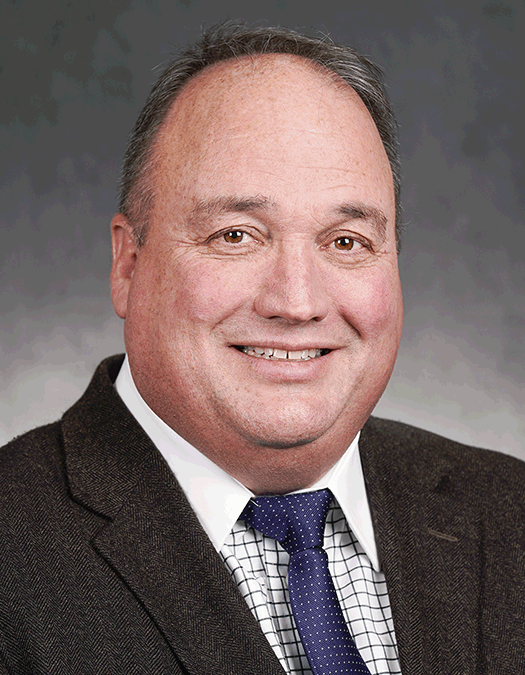
Rep. John Huot
Sponsored bills
Maddy summaryHF 3369 appropriates $50,000 from the arts and cultural heritage fund for fiscal year 2027 to establish the Centennial Barns Registry. The Minnesota Historical Society will operate the registry, allowing landowners to voluntarily register barns built before 1959 and share their history and location. This funding directly supports documenting historic barn structures across Minnesota without imposing requirements on property owners.
Maddy summaryHF 3346 creates a commission to evaluate all campuses in the Minnesota State Colleges and Universities system for potential closure or consolidation, directly affecting those campuses and their students, faculty, and staff. The commission must base recommendations on factors like operating costs, enrollment trends, graduation rates, and program reputation, while seeking input from faculty and staff unions. It must submit a report with specific recommendations by December 1, 2026, and the governor must approve or reject the entire package by December 31, 2026, with approved changes becoming part of the state budget. The commission expires on October 1, 2026, ending the evaluation process.
Maddy summaryHF 1357 requires Minnesota taxpayers to include an additional tax for nontaxed capital gains exceeding $1 million on certain inherited assets in their state income tax returns. It directly affects individuals who inherit assets like real estate, stocks, or businesses (excluding specific agricultural land classified as class 2a homestead) after a person’s death. The bill defines "nontaxed capital gains" as the portion of gains calculated as if the asset was sold at its federal estate value, minus $1 million. Taxpayers must report this addition on their returns, with automatic extensions available for filing. The law takes effect for tax years beginning after December 31, 2025.
Maddy summaryHF 3434 bans the possession of semiautomatic military-style assault weapons (like AR-15s and AK-47s) and large-capacity ammunition magazines (holding more than 10 rounds) in Minnesota. It defines these weapons by specific models (e.g., Colt AR-15, Beretta AR-70) or features (folding stocks, pistol grips, threaded barrels). The bill creates criminal penalties for possessing these banned items and amends state law to clarify prohibited firearms and magazines. It directly affects individuals who own or possess these specific weapons or magazines. The law does not cover all semiautomatic firearms but targets models and features associated with military-style weapons.
Maddy summaryHF 1066 increases annual funding for soil and water conservation districts in Minnesota. It amends state law to raise the annual appropriation from $15 million (for 2023-2024) to $20 million starting in 2025, paid from the general fund to the commissioner of revenue. This funding directly supports local soil and water conservation districts that provide technical assistance and cost-share programs for landowners. The bill takes effect for payments made in 2025 and subsequent years.
Maddy summaryThis bill directs $15 million from Minnesota's transportation advancement account to fund suicide prevention measures on Minneapolis's Washington Avenue Bridge. Specifically, it requires Hennepin County to award a grant to the University of Minnesota for designing and building physical barriers and providing suicide diversion resources on the bridge. The funds are allocated to address safety concerns at this specific location, where bridge-related suicide attempts have occurred. The measure changes how existing transportation funds are used, prioritizing mental health interventions at a high-risk location.
Maddy summaryHF 1372 allows Minnesota cities to create designated "social districts" where alcohol purchased at licensed bars or restaurants can be consumed in public areas adjacent to those venues. The bill requires cities to clearly mark district boundaries with signs showing permitted hours, include safety statements on containers (e.g., "Drink Responsibly - Be 21"), and restrict containers to non-glass, 16-ounce sizes with specific labeling. It mandates cities to report on community impact, safety concerns, and operational challenges within 24 months of implementation. This directly affects local governments, licensed businesses, and public safety management in areas where such districts are established.
Maddy summaryHF 1014 allows the Minnesota Insurance Guarantee Association (MIGA) board to request financial information from insureds to verify if their net worth exceeds $25 million on December 31 of the prior year. This specifically affects insureds whose combined net worth (including subsidiaries) meets or surpasses this threshold, as claims from such insureds would otherwise be excluded from MIGA coverage. The bill requires MIGA to inform insureds of consequences for failing to provide requested financial details within 60 days, after which their net worth is automatically deemed above $25 million. The key mechanism streamlines MIGA’s ability to assess claim eligibility by verifying high-net-worth status through direct financial requests. This change amends Minnesota Statutes section 60C.09, subdivision 2.
Maddy summaryHF 688 modifies Minnesota's housing law to include specific protections for individuals training service dogs. It defines a "service dog in training" as a dog actively trained under accredited organizations (like Assistance Dogs International), granting these individuals full housing access without extra fees. Landlords or homeowners associations must accept written certification from the training organization but may require it, and accommodations end when training concludes. This directly affects people training service dogs and housing providers across Minnesota, ensuring equal access to housing during the training phase.