

Maddy summaryHF 3705 establishes Minnesota's participation in the Respiratory Care Interstate Compact, allowing licensed respiratory therapists from member states to practice across state lines more easily. The bill creates a standardized framework where therapists licensed in one member state (their "home state") can obtain authorization to work in other member states ("remote states") without needing separate licenses, while preserving each state's authority to protect public health. Key provisions include defining terms like "compact privilege," requiring criminal background checks for licensure, and aiming to improve patient access to care, support military families relocating, and ease administrative burdens for states. This compact directly affects respiratory therapists seeking multi-state practice, healthcare facilities in member states, and patients in areas with workforce shortages.
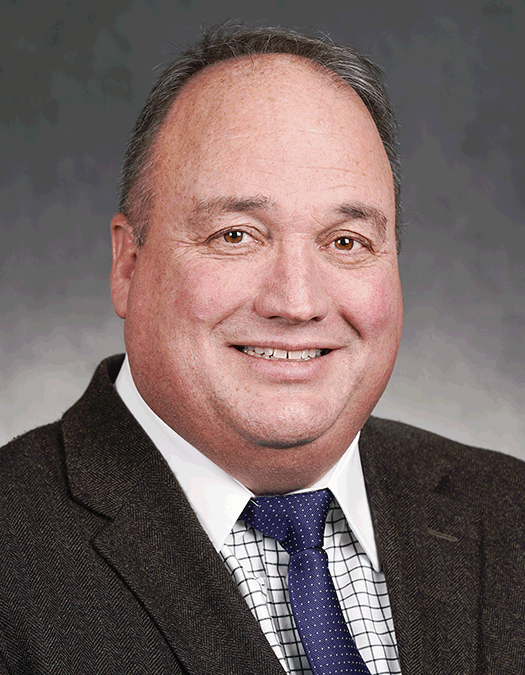
Rep. John Huot
Sponsored bills
Maddy summaryHF 3180 creates a special emergency fund within Minnesota's state treasury to support essential public health services if federal funding is unexpectedly reduced or eliminated. The fund, which receives a one-time transfer from the general fund, allows the Minnesota Department of Health (referred to as "commissioner of health") to continue critical services like disease outbreak response and waterborne disease prevention when federal support drops unexpectedly. Before using funds, the commissioner must notify legislative health committees and seek advisory review, and must submit an annual report detailing all expenditures and their justification. This bill directly affects the state health department's ability to maintain public health operations during federal funding disruptions.
Maddy summaryThis bill extends continued health insurance coverage to injured paramedics and emergency medical technicians in Minnesota who are disabled in the line of duty. It amends existing state statutes to include these first responders alongside police officers and firefighters in eligibility for ongoing employer-paid health benefits after a work-related injury. The legislation requires employers to maintain coverage for injured workers and their dependents for up to 60 months or until age 65, depending on the specific disability classification and approval timeline. Determinations of eligibility are made by retirement system officials, with provisions for administrative review if disputes arise over disability status.
Maddy summaryThis bill clarifies which specific actions are reserved exclusively for licensed peace officers in Minnesota, such as issuing citations, conducting lineups, and operating emergency vehicles with lights and sirens. It also establishes legal penalties for individuals who falsely claim to be peace officers or attempt to perform duties that only authorized officers can carry out. The law creates a process where the state attorney general prosecutes violations, while a separate law enforcement agency investigates complaints about unauthorized practice. These changes take effect on August 1, 2026, and aim to define the boundaries of law enforcement authority more clearly.
Maddy summaryThis bill allows both private and public cemeteries in Minnesota to bury certain domesticated animals alongside humans using environmentally friendly green burial methods. It specifically permits the burial of dogs, cats, and chickens that have been deceased for no more than 72 hours, provided they are not embalmed and are placed in biodegradable containers or shrouds without vaults. The legislation also allows the interment of cremated remains for these animals in biodegradable containers and exempts chicken burials from specific state health regulations.
Maddy summaryThis bill authorizes the state of Minnesota to issue bonds and appropriate $18.65 million to Dakota County for highway safety improvements on County State-Aid Highway 46, which runs through Coates, Rosemount, and Empire Township. The funds will be used to reconstruct the two-lane road into a divided four-lane highway and may cover design work, land acquisition, construction, pedestrian and bicycle facilities, and utility relocation. The commissioner of management and budget is directed to sell and issue state bonds up to the specified amount to finance the project, following existing state statutes and constitutional requirements.
Maddy summaryHF 3604 modifies Minnesota's exemption rules for bulk deliveries of nonoxygenated gasoline. It requires that such deliveries (500 gallons or less) must be made directly into either: (1) the attached fuel tank of a vehicle listed as exempt under existing rules, or (2) a bulk tank on the premises. This bill affects fuel suppliers delivering nonoxygenated gasoline to exempt vehicles, such as classic cars or certain machinery. The key change clarifies where the fuel must be delivered, replacing previous ambiguous language with specific requirements. The bill is currently in committee for review.
Maddy summaryHF 400 requires Minnesota's Commissioner of Commerce to pay health insurance companies to offset costs when new state-mandated health benefits increase premiums for consumers. This applies to health plans sold in individual, small group, and large group markets. The Commissioner must make these payments within 60 days of receiving a cost statement from the company, using the federal process for cost calculation to ensure accurate measurements. The bill takes effect January 1, 2026, for all new mandated health benefit proposals enacted after that date.
Maddy summaryHF 1322 modifies Minnesota's auto insurance rules for total loss claims. It requires insurers to offer a replacement vehicle option (with all taxes, fees, and license costs paid by the insurer, except the insured's deductible) when settling a total loss under a policy using actual cash value or replacement with like kind and quality, and the insured is not an auto dealer. This directly affects individual vehicle owners and non-dealer businesses who experience a total loss. The bill ensures insureds have a clear choice for a replacement vehicle without additional out-of-pocket costs beyond their deductible.
Maddy summaryThis bill changes the official title of "physician assistant" to "physician associate" in Minnesota law for licensed professionals. It clarifies that "physician associate," "physician assistant," and "PA" are synonymous terms, with no change to the scope of practice or rights for these professionals. The bill prohibits discrimination in employment, contracts, or healthcare relationships due to this title change and requires state agencies and documents to update all references to the new title. It directly affects licensed physician associates, healthcare facilities, employers, insurers, and government programs that interact with these professionals.