

Maddy summaryHF 2219 regulates surrogacy in Minnesota by making traditional surrogacy arrangements invalid (meaning parental rights automatically remain with the birth mother unless she voluntarily terminates them) and establishing enforceable rules for gestational surrogacy. It requires gestational surrogacy contracts to be in writing, signed by all parties including the surrogate's spouse, notarized, and accompanied by separate legal counsel for all parties and written acknowledgment of rights/obligations. The bill also creates a new criminal offense for operating a for-profit surrogacy agency (defined as entities connecting intended parents with surrogates, excluding licensed attorneys handling contracts). This directly affects intended parents, gestational surrogates, and surrogacy agencies seeking to facilitate such arrangements in Minnesota.
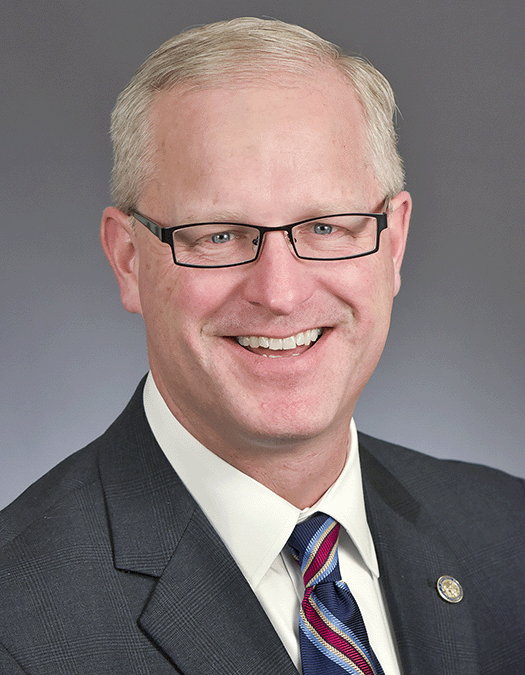
Rep. Jim Nash
Sponsored bills
Maddy summaryHF 3678 prohibits specific terms in state procurement contracts to protect Minnesota's interests. It directly affects state agencies and contractors by banning provisions like mandatory arbitration, unilaterally changeable terms, or requirements to use non-Minnesota law. Key mechanisms include voiding any prohibited term (such as those forcing the state to cover costs for others or restricting software choices on agency infrastructure) and making the contract enforceable without that term. The bill ensures contracts comply with Minnesota law and government data practices, with the commissioner required to post the rule online. This creates clearer, more predictable terms for all parties involved in state contracts.
Maddy summaryHF 2809 establishes a new crime for protesting directly in front of or about a person's home (excluding homes used as businesses). It makes this a misdemeanor, escalating to a gross misdemeanor if the person has a prior conviction under this law or ignores court orders like protection orders. The bill specifically allows peaceful protests about community meetings or assemblies held at locations commonly used for public discussion. This law applies to residential properties only and takes effect August 1, 2025.
Maddy summaryHF 3606 requires applicants for Minnesota's rental or down payment assistance programs to provide proof of citizenship or lawful immigration status for every adult in their household before receiving funds. This bill amends Minnesota Statutes to add a new requirement that housing assistance agencies must verify this status prior to issuing payments. It directly affects adult household members seeking rental subsidies or down payment assistance through state-funded housing programs. The bill is currently in committee referral after its introduction on February 23, 2026.
Maddy summaryHF 1 establishes a centralized Office of Inspector General (OIG) for Minnesota state government, replacing existing agency-specific inspector general offices. The OIG will oversee state spending, require agencies to halt payments when fraud is suspected, and mandate a fraud reporting hotline for employees and contractors. It directly affects all state agencies and recipients of state funds (such as contractors and organizations administering state programs) by requiring them to report suspected fraud and prohibiting retaliation against whistleblowers. The bill also specifies the OIG must coordinate with the legislative auditor and amends statutes related to fraud detection, waste prevention, and oversight.
Maddy summaryHF 3545 repeals a requirement for Minnesota to adopt new residential energy codes with specific efficiency targets. It removes Section 326B.106, subdivision 1(g), which would have mandated the commissioner to adopt updated residential energy codes starting in 2026, aiming for a 70% reduction in energy use by 2038. This repeal eliminates the obligation to implement these incremental code changes and the associated reporting requirements for residential construction. The bill directly affects residential builders, developers, and local building officials who would have been required to comply with future energy code standards. The repeal does not impact existing energy codes or commercial energy code requirements.
Maddy summaryHF 3491 authorizes Minnesota to participate in a federal tax credit program that allows scholarship-granting organizations (SGOs) to provide scholarships to students. These SGOs must be tax-exempt nonprofits that spend at least 90% of funds on scholarships, verify household income, prioritize returning students and siblings, and avoid earmarking funds for specific students. The bill requires SGOs to annually report compliance to the Minnesota Department of Education, which must then post a list of qualified organizations online. The law explicitly states it does not grant schools or districts additional control over nonpublic schools or students.
Maddy summaryHF 3529 increases safe schools funding for Minnesota school districts and expands eligibility to charter schools, cooperative school units, nonpublic schools, and Tribal contract schools. For school districts, starting in fiscal year 2026, safe schools revenue will be the greater of $32,000 or $44 multiplied by the district's adjusted pupil count. Charter schools, nonpublic schools, and Tribal contract schools will receive aid calculated as $44 multiplied by their student enrollment or pupil units, as reported to the state. Funds must be used exclusively for school safety measures, including security, drug prevention programs, and student safety initiatives.
Maddy summaryHF 1346 modifies the training requirements for mandatory reporters, such as teachers, healthcare workers, and social workers, who are legally required to report suspected child abuse or neglect. The bill updates current training standards to better equip these professionals with necessary knowledge and procedures. This change directly affects individuals in these roles who must complete the mandated training. The law became effective on August 1, 2025, following its approval by the governor on April 30, 2025.
Maddy summaryThis bill's title indicates it contains multiple provisions related to state/local government operations and elections, but the provided context does not include specific policy details or provisions. The timeline shows it passed the Senate on May 19, 2025, was approved by the governor on May 23, 2025, and became law. Without additional information on the bill's actual content, such as specific funding amounts, new requirements, or affected groups, a substantive summary cannot be provided. The context only confirms its procedural status and enactment date.