

Maddy summaryHF 1837 updates Minnesota's state government administrative procedures. It amends statutes to clarify the Department of Administration's role in implementing the federal 21st Century Assistive Technology Act, ensuring the Minnesota Assistive Technology Advisory Council remains permanent and properly staffed with experts from key agencies. The bill also requires state agencies to notify legislative committees before starting most capital projects (excluding ADA compliance or preservation work), and revises reimbursement processes for state revolving funds used by agencies. These changes directly affect state agencies managing capital projects, assistive technology programs, and administrative funding systems, with no new programs or funding created.
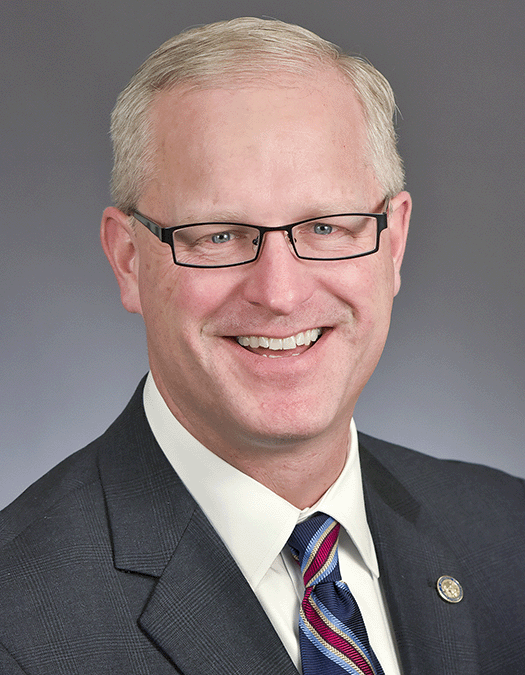
Rep. Jim Nash
Sponsored bills
Maddy summaryHF 932 requires Minnesota to place all Level III predatory offenders (those convicted of specific sex offenses under statutes like 609.342-609.3453) under electronic surveillance during their entire period of community supervision, such as parole or probation. The bill mandates this surveillance as a standard condition of release, replacing previous discretion, and includes requirements for proper setup at the offender's residence before monitoring begins. It also prohibits certain internet activities for these offenders, like maintaining social media accounts accessible to minors, and appropriates funding for implementation starting in fiscal year 2026. This policy directly affects individuals convicted of qualifying sex offenses who are under community supervision in Minnesota.
Maddy summaryHF 3232 modifies Minnesota's homestead tax classification requirements for property owners. It requires applicants to provide Social Security numbers or individual taxpayer identification numbers (ITINs) for all occupants and spouses, but explicitly states that ITINs assigned to noncitizens who are undocumented or not lawfully present in the U.S. will not be accepted. Property owners must file applications by December 31 each year to maintain homestead status, and failure to update occupancy changes within 30 days results in loss of homestead classification. This bill affects homeowners seeking reduced property tax rates on their primary residences, effective for applications filed in 2026.
Maddy summaryHF 3205 appropriates $235,000 from Minnesota's arts and cultural heritage fund for the 2026 fiscal year to reinstall the Christopher Columbus statue on the State Capitol Mall. The funds are directed to the commissioner of administration, who must work with the Capitol Area Architectural and Planning Board to complete the reinstallation. This bill is procedural, allocating existing funds for a specific physical display without creating new laws or affecting citizens.
Maddy summaryHF 2554 designates a specific bridge on Burnsville Parkway over Interstate Highway 35W in Burnsville, Minnesota, as the "Elmstrand * Finseth * Ruge Heroes Memorial Bridge." The bill amends Minnesota Statutes section 161.14 to formally name the structure and requires the transportation commissioner to adopt appropriate signage for it. This is a commemorative measure naming a physical location, not a policy change affecting residents or creating new laws. The bridge itself is the direct subject of the designation, with no broader legislative impact beyond the memorial name and signage.
Maddy summaryHF 2783 is a state budget bill that allocates funding for Minnesota's government operations during fiscal years 2026-2027. It provides specific appropriations for key entities including $123 million total for the Legislature (split between Senate, House, and related offices), $9.2 million for the Governor and Lieutenant Governor, $14.5 million for the State Auditor, and $47.4 million for the Attorney General. The bill also includes additional provisions such as establishing a legislative ethics code, allowing payment withholding for fraud allegations, and modifying insulin repayment accounts. These funds are primarily drawn from the general fund and other designated state funds to support ongoing state government functions.
Maddy summaryHF 3051 exempts sales of admission privileges for PGA World Championship golf tournaments and related events from Minnesota's sales and use tax. The bill directly affects tournament organizers and attendees purchasing tickets to these specific events. It amends Minnesota Statutes section 297A.68 by adding a new tax exemption for the "granting of the privilege of admission" to these PGA-sponsored tournaments. The exemption applies to all sales made after June 30, 2025.
Maddy summaryHF 2013 limits certain local regulations on residential development in Minnesota. It prohibits municipalities from requiring specific building materials, designs, or aesthetic features beyond the State Building Code (chapter 326B), and bans minimum square footage requirements for residential projects. The bill directly affects developers and homeowners seeking building permits, as local governments can no longer impose these specific restrictions. It includes an exception for developments built by the municipality itself. The law takes effect the day after final enactment.
Maddy summaryHF 926 exempts sales of cigars shipped out of Minnesota for interstate commerce from the state's tobacco excise tax. It directly affects cigar manufacturers and tobacco distributors who sell cigars for shipment outside Minnesota. The bill amends Minnesota Statutes section 297F.06 to add a new tax exemption provision for these specific interstate shipments. This change takes effect on July 1, 2025, and does not apply to cigar sales within Minnesota.
Maddy summaryHF 19 establishes education savings accounts (ESAs) for Minnesota students from low-income households, defined as families earning no more than four times the income threshold for free school meals. The bill allows parents to use state funds to pay for qualifying education expenses - including tuition at eligible nonpublic schools, tutoring, approved curriculum, and school supplies - at participating schools or providers. Participation is capped at 5% of public school enrollment in the first year, increasing by 3% annually, with priority given to kindergarten students and those who attended public school full-time the prior year. The program directly affects eligible students (ages 18 and under) and their families, with funds restricted to approved educational services and materials.