

Maddy summaryHF 3455 renames Minnesota's State Office Building at 100 Rev. Dr. Martin Luther King Jr. Blvd. in St. Paul as the "Melissa Hortman State Office Building." The bill requires the revisor of statutes to update all official references to the building in Minnesota Statutes and Rules. This is a ceremonial renaming with no policy changes or direct impact on residents or government operations.
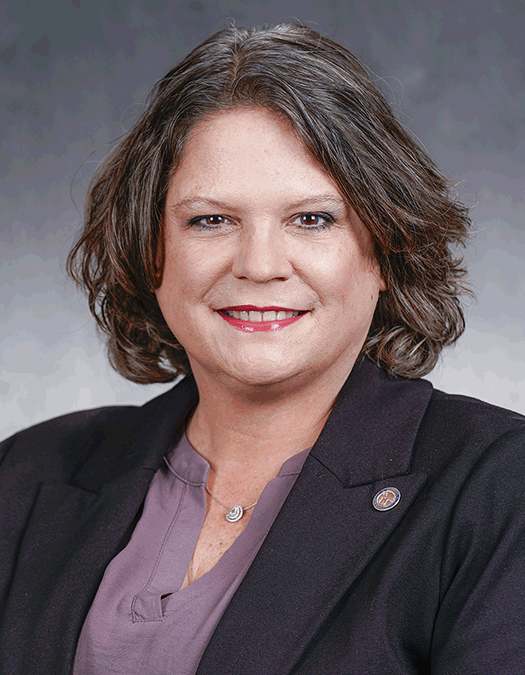
Rep. Cheryl Youakim
Sponsored bills
Maddy summaryMinnesota's HF 1269 requires health insurance plans to cover all FDA-approved medical services and prescription medications for treating dementia, including diagnostic tests to assess treatment effectiveness. It also prohibits health plans from using "step therapy" (requiring patients to try cheaper drugs first) for dementia treatments. The bill modifies prior authorization rules for certain medications, ensuring automatic 60-day coverage for brand-name mental health drugs when generics become available, and streamlines approval for oral liquid drugs used with feeding tubes. These changes apply to health plans offered in Minnesota starting January 1, 2026.
Maddy summaryHF 63 modifies Minnesota school board membership by requiring public school districts to select two student members starting in the 2025-2026 school year. Student members must be enrolled in grades 9-12, reside in the district, and be chosen through a process allowing all eligible students to vote. These student members gain voting rights on all board matters, serve two-year terms, and may serve no more than two terms. The bill directly affects all Minnesota public school districts and their student populations, aiming to increase student voice in school governance.
Maddy summaryHF 2216 protects residents of Minnesota assisted living facilities by prohibiting facilities from requiring a legal guardian as a condition for admission or continued residence. It requires facilities to get commissioner approval before raising fees by more than the Consumer Price Index, demanding detailed financial documentation including operational costs, balance sheets, and comparisons to similar facilities. The bill also prevents facilities from terminating or not renewing contracts based on certain grounds and updates arbitration rules for contract disputes. These changes directly affect assisted living facilities and their residents by increasing oversight of fees and residency terms.
Maddy summaryHF 2689 modifies Minnesota's physical therapy practice rules, primarily affecting licensed physical therapists, their assistants, and students in physical therapy programs. The bill clarifies supervision requirements: physical therapists must have direct patient contact during at least every second treatment session when supervising student physical therapists or student physical therapist assistants, and telecommunications (except within a facility) cannot satisfy "on-site supervision" for students. It repeals outdated sections of the law (148.65, subd. 9 and 148.77) and updates definitions for "physical therapy" and student roles. The bill does not specify the nature of the new criminal penalties mentioned in its title.
Maddy summaryHF 362 establishes a state licensing system for massage therapists and Asian bodywork therapists in Minnesota. It requires practitioners to meet specific educational standards (including minimum contact hours), pass a credentialing exam, and obtain a license from the Minnesota Department of Health. The bill defines both practices (e.g., Asian bodywork therapy uses techniques like pressing and stretching based on Chinese medical principles), sets application and renewal fees, and includes criminal penalties for practicing without a license. This directly affects therapists seeking to legally provide these services and ensures they meet standardized training and safety requirements, while also providing funding for implementation.
Maddy summaryHF 3657 establishes a task force to study property tax relief for primary homes (homestead properties) in Minnesota. The task force, composed of legislators, local government representatives, and tax officials, must analyze how current tax policies affect homeowners, compare tax burdens over time, and explore options for reducing property taxes with minimal impact on state funding. It will focus specifically on residential properties classified as homesteads under state law, including homes and adjacent land. The task force must submit its recommendations to the legislature by February 1, 2027, but cannot directly change tax rates. This is a study bill, not a tax law change.
Maddy summaryHF 3483 modifies Minnesota's trespass law to require law enforcement to obtain a warrant signed by a judicial officer before entering property for civil immigration enforcement. It also prohibits local law enforcement from detaining individuals solely based on federal civil immigration detainers. The bill amends Minnesota Statutes § 609.605 to add a specific provision (subdivision 1, clause (6)) requiring a warrant with probable cause for immigration-related trespass entries. This directly affects local police and sheriff's departments by restricting their ability to act on federal immigration requests without judicial oversight. The law applies to all trespass offenses involving immigration enforcement activities on private property.
Maddy summaryHF 2499 expands Minnesota's renter's credit to match the maximum refund amount available under the homestead credit for homeowners. The bill adjusts the calculation so renters with household incomes up to $137,789 can receive a maximum credit of $3,500, aligning with the homestead credit's highest tier. This change directly affects renters who pay rent considered equivalent to property taxes, ensuring they receive the same maximum tax credit as homeowners. The key mechanism revises the credit formula in Minnesota Statutes 290.0693 to eliminate the previous disparity in maximum benefit amounts between renters and homeowners.
Maddy summaryHF 3653 increases funding for school safety programs in Minnesota. It establishes new formulas: public school districts receive $100 per adjusted pupil unit for safe schools aid (starting 2027), plus a $36 per unit levy; charter schools get $100 per unit; and cooperative school units receive $35 per unit. The bill requires all funds to be used exclusively for specific safety purposes, including security upgrades, mental health services, drug prevention programs, violence prevention, and cybersecurity measures in schools. This affects all public school districts, charter schools, and cooperative school units statewide, with funding effective for fiscal year 2027 and later.