

Maddy summaryHF 2923 requires the Minnesota State High School League (MSHL) to contract for catastrophic injury insurance covering student athletes, managers, trainers, and cheerleaders participating in league-sponsored activities. The insurance must provide at least $10 million in lifetime coverage per injury (with a $50,000 deductible) for medical care, medications, and related expenses. The bill also mandates MSHL to make final payments to two specific athletes - those injured in a 2011 hockey game and a 2022 football game - to cover costs not paid by insurance, treating these payments as a tax subtraction. This directly affects all student participants in Minnesota high school athletic programs under the MSHL.
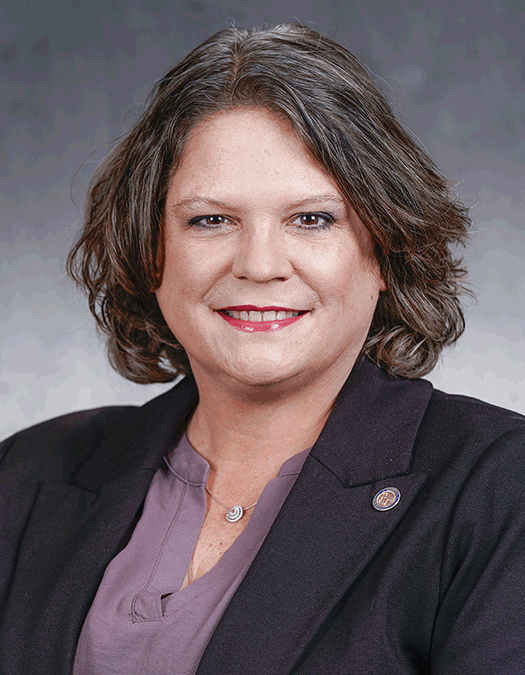
Rep. Cheryl Youakim
Sponsored bills
Maddy summaryHF 2817 amends Minnesota law to extend service line of duty death benefits to part-time, paid on-call, and volunteer firefighters. The bill updates the definition of "public safety officer" to include these firefighters when performing specific duties like firefighting, emergency medical services, or hazardous material response. This change ensures that the families of these firefighters who die while on duty receive the same death benefits previously available only to full-time firefighters. The policy applies to firefighters working for local government fire departments or independent nonprofit firefighting organizations.
Maddy summaryThis bill authorizes the city of Hopkins to extend the timeframes for using tax increment financing funds from 5 to 10 years and from 5 to 11 years for a specific district. It directly affects the city of Hopkins by allowing it to retain revenue generated by property value increases within Tax Increment Financing District 1-6 for a longer period. The key provision modifies existing state statutes to permit these extended timelines, with the changes taking effect after the city completes required administrative steps. This legislation does not create new funding but adjusts how long the city can use existing tax increment financing rules for one specific district.
Maddy summaryHF 3410 updates Minnesota law to give tenants facing eviction for nonpayment of rent more options to avoid losing their homes. The bill allows tenants to pay overdue rent plus interest, court costs, and up to $5 in attorney fees using a written guarantee from a qualified nonprofit rental assistance program (like a 501(c)(3) organization) or a third party who swears they will pay the landlord. This replaces a previous option that permitted guarantees from government agencies. The changes apply to eviction cases filed after the bill's effective date.
Maddy summaryHF 3421 requires Minnesota teacher preparation programs to provide a supervised early literacy field experience for teacher candidates who will teach early literacy, beginning with the 2027-2028 school year. The field experience must align with evidence-based reading practices, be integrated with reading instruction, and occur primarily during school hours with structured feedback. The Professional Educator Licensing and Standards Board must develop rules defining which teaching areas require this experience and ensuring its effective implementation. The bill also appropriates funds for this rulemaking process, effective July 1, 2026.
Maddy summaryThis bill modifies Minnesota's requirements for site-governed schools, which are schools operated with significant autonomy from the district. It allows school boards to approve new site-governed schools based on proposals that must include teacher support (at least 60%) and community involvement in development. The bill requires districts and employee bargaining units to create memoranda of understanding that outline how existing contracts will support the new school model, and it establishes a three-year initial agreement that can automatically renew for five years if performance expectations are met. Under the new rules, site councils would have expanded powers to determine leadership models, budgets, curriculum, hiring practices, and school policies, while retaining powers not specifically delegated remain with the school board.
Maddy summaryThis Minnesota bill establishes rules for artificial intelligence chatbots, requiring companies to clearly inform users they are interacting with an AI system and prohibiting chatbots from providing advice on medical, mental health, or legal matters without proper licensing. The legislation creates a legal cause of action allowing users to sue chatbot owners for damages if the AI provides unlicensed professional advice or causes harm, particularly in cases where companion chatbots encourage or enable self-harm. Companies deploying chatbots in Minnesota must display clear warnings in the same language and font size as the chatbot interface, and those operating companion chatbots must take reasonable steps to prevent self-harm while providing crisis support resources when risks are detected. The law defines specific terms like "companion chatbot" and "human-like" interaction to clarify which AI systems fall under these new requirements.
Maddy summaryThis bill establishes a new grant program in Minnesota to help schools create outdoor park-like spaces called community schoolyards that can be used by both students and the public. The program provides funding for two stages: up to $150,000 for planning and design work, and up to $850,000 for construction and improvements. To qualify, schools or local governments must partner with community organizations and agree to keep these spaces open for public use outside of school hours. The bill also requires the state education commissioner to review applications and submit a report on the program's progress.
Maddy summaryThis bill allocates $1,060,000 from the state's general fund in fiscal year 2027 to support the Minnesota P-20 Education Partnership through the Office of Higher Education. The funding is intended to strengthen collaboration between early childhood education, K-12 schools, and higher education institutions across Minnesota. The money will be managed by the commissioner of the Office of Higher Education in accordance with existing state statutes. This appropriation aims to enhance educational continuity from preschool through postsecondary levels.
Maddy summaryThis bill appropriates $200,000 from the state's general fund in fiscal year 2027 to provide a grant to Helping Paws, Inc. for breeding, training, and placing service dogs for individuals with physical disabilities, veterans and first responders with service-related PTSD, and professionals working in courthouse, educational, and mental health settings. The funding is designated as a one-time honorarium in memory of Speaker Emerita Melissa Hortman. The commissioner of health may also accept private donations to supplement the state appropriation, with all such funds deposited in a dedicated account that expires on July 1, 2028.