

Maddy summaryHF 3792 creates a tax subtraction for Minnesota residents who receive AmeriCorps stipends or living allowances. It specifically excludes from taxable income four types of payments: AmeriCorps volunteer stipends (42 U.S.C. § 4955), National Civilian Community Corps living allowances (42 U.S.C. § 12618), AmeriCorps Seniors stipends (42 U.S.C. §§ 5011, 5013(b)), and National Service Educational Awards (42 U.S.C. §§ 12601-12604). This change reduces the taxable income of eligible AmeriCorps participants in Minnesota. The policy takes effect for tax years beginning after December 31, 2025.
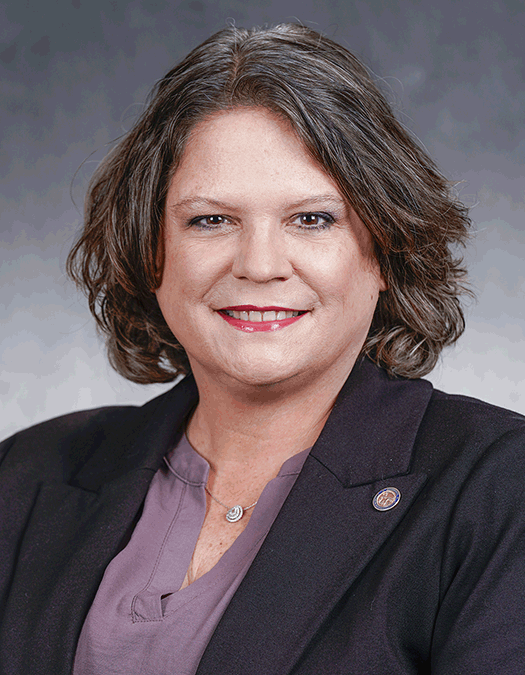
Rep. Cheryl Youakim
Sponsored bills
Maddy summaryHF 3695 establishes a task force to create a standardized identification system for Minnesota emergency responders (including police, firefighters, and EMTs). The task force, composed of state agency leaders and representative organizations, must design an ID card including a photo, name, role (e.g., peace officer or EMT), physical description, and certification details. It will also develop a plan for mandatory use of this ID by responders and their employers, and recommend whether the state or local governments should issue it. The bill appropriates funds for the task force’s work and requires a final report to the legislature by 2028. This is a procedural proposal to develop standards, not an immediate law.
Maddy summaryHF 3704 prohibits the sale or distribution of certain crop seeds (like corn, soybeans, and wheat) coated with systemic insecticides after January 1, 2029, unless a commissioner-issued waiver is provided. It also bans applying neonicotinoid insecticides (e.g., imidacloprid) to ornamental outdoor plants and turf, except in specific environmental emergencies approved by the commissioner. Farmers seeking seed waivers must complete integrated pest management training and submit third-party pest risk assessments. The bill requires annual training for applicators and allows limited emergency use if less harmful alternatives are ineffective. It directly affects farmers, gardeners, seed sellers, and pesticide applicators in Minnesota.
Maddy summaryHF 3643 establishes Melissa and Mark Hortman Memorial State Park in Ramsey County, specifically within St. Paul, as a new public park. The bill designates precise boundaries for the park using 18 directional points in St. Paul and requires that no park permit or entry fee be charged. It directs the commissioner of natural resources to manage the park under standard state park rules, while specifying that the commissioner of administration and Minnesota Historical Society retain authority over existing buildings and monuments within the park. The legislation also appropriates funds for the park’s establishment, directly affecting public access to this newly designated green space in the city.
Maddy summaryThis bill repeals previous sales tax exemptions for preferred seating and amenities at athletic facilities, meaning these items will now be subject to sales tax when purchased with event tickets. It also provides funding for safe harbor shelter and housing grants to support homeless assistance programs. The legislation defines various retail sales for tax purposes, including bundled transactions and promotional items, while appropriating money for the housing grants.
Maddy summaryThis bill requires Minnesota schools to provide paid orientation and professional development for paraprofessionals, Title I aides, and other instructional support staff, with at least eight hours annually required starting in the 2025-2026 school year. The legislation mandates that schools consult with employee representatives when planning training and establishes a reimbursement system to cover the cost of these training hours through the state commissioner of education. Additionally, the bill updates qualifications for paraprofessionals to include options such as two years of college credits, an associate degree, or passing a state-approved assessment, while also providing temporary funding for test preparation and additional training in fiscal year 2026.
Maddy summaryThis bill allocates state funding to support student mental health initiatives in Minnesota schools. It directs money from the general fund to the Department of Education for grants awarded to organizations that help students disconnect from electronic devices and social media, engage in physical activity, participate in collaborative experiences, and build in-person relationships. The legislation requires grant recipients to demonstrate that their programs improve mental health outcomes for students. The funding is a one-time appropriation available until June 30, 2029, and the bill becomes effective on July 1, 2026.
Maddy summaryHF 3435 limits access to Minnesota school sites by federal immigration officials. It requires U.S. Immigration and Customs Enforcement (ICE), Customs and Border Protection (CBP), and other DHS agents to show valid identification, provide a written statement of purpose, and obtain a judicial warrant before entering schools. School officials must also approve entry and restrict such agents to areas without students present, even if all requirements are met. The bill applies directly to federal immigration enforcement personnel and school districts operating under Minnesota law.
Maddy summaryHF 3402 bans the possession, manufacture, import, and transfer of large-capacity ammunition magazines in Minnesota. It defines these as feeding devices holding more than ten rounds (with exceptions for permanently modified devices, .22 caliber tubes, and lever-action tubular magazines). The law takes effect July 1, 2026, requiring current owners to surrender, modify, permanently alter, or remove their magazines by July 1, 2027. Violations carry felony penalties of up to five years in prison or $25,000 in fines. Law enforcement, military personnel, and licensed dealers are exempt under specific conditions.
Maddy summaryHF 2998 establishes a legal process for terminally ill Minnesota adults with a prognosis of six months or less to obtain medication for medical aid in dying. It requires two physician confirmations (an attending provider and a consulting provider), a mental health evaluation by a licensed consultant to confirm capacity, and mandates that patients self-administer the medication. The law prohibits providers from directly administering the medication and classifies related patient data as confidential. Violations of the process could result in criminal penalties, while providers following the law are granted immunity.