

Maddy summaryThis bill modifies Minnesota's ignition interlock program requirements and strengthens privacy protections for driver's license data. It establishes specific license revocation periods for out-of-state impaired driving convictions, requiring longer revocations for repeat offenders who must complete ignition interlock device programs. The legislation also classifies certain driver's license indicators as private data, limits how the Department of Public Safety can share this information with federal agencies, and allows individuals to request that their residence addresses be marked as private data for safety reasons. These changes directly affect drivers' license holders, the Department of Public Safety, and law enforcement agencies that handle driver records.
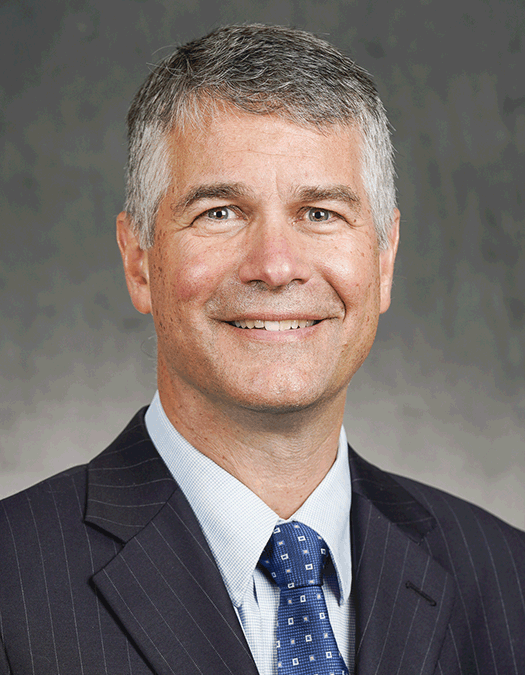
Rep. Larry Kraft
Sponsored bills
Maddy summaryThis bill authorizes the Metropolitan Council to sell transit-related merchandise, food, and beverages at retail locations, online, and within transit stations in seven specific Minnesota counties. The legislation allows the council to partner with private entities to help market and manage these sales. Any money earned from these sales must be used to fund improvements for the region's transportation capital projects.
Maddy summaryThis bill modifies the registration surcharges for all-electric and plug-in hybrid electric vehicles in Minnesota. It establishes a new $75 fee for all-electric vehicles and removes the existing surcharge for plug-in hybrid electric vehicles. The changes take effect for vehicle registration periods beginning on or after January 1, 2027. All revenue collected from these fees will be deposited into the highway user tax distribution fund.
Maddy summaryHF 4972 prohibits law enforcement from making civil immigration arrests against individuals attending court proceedings, including parties, witnesses, and their supporters like family members or translators. The law defines a 'civil arrest' as taking someone into custody for immigration violations and grants these individuals protection while traveling to, being at, and leaving court buildings or locations within 1,000 feet of them. This protection applies to all types of court matters, including civil, criminal, and administrative cases, and remains in effect regardless of whether a judge issues a specific order enforcing it.
Maddy summaryHF 3403 allocates $44 million for counties and $6 million for Tribal governments in fiscal year 2026 to provide emergency rental assistance. It requires counties and Tribal governments to use these funds solely for rental assistance to eligible households meeting three criteria: income at or below 200% of the federal poverty level, Minnesota residency, and homelessness or imminent housing crisis. Funds must be distributed within 15 days of the bill's effective date and spent within 180 days, with unspent money returned to the state general fund. This one-time appropriation directly supports low-income renters facing housing instability across Minnesota.
Maddy summaryThis bill requires Minnesota's commissioner of transportation to apply for federal funding to develop two new passenger rail routes: one from St. Paul to Fargo, North Dakota, and another from St. Paul to Kansas City, Missouri (with stops in Northfield, Albert Lea, and Des Moines, Iowa). It appropriates $1 million in fiscal year 2026 for planning, application costs, and state matching funds to secure federal grants for these routes. The funding covers activities like environmental analysis, cost estimates, and service development planning under the federal Corridor Identification and Development Program. The bill directly affects Minnesota's transportation agency and communities along the proposed rail corridors. The $1 million is a one-time allocation available until June 2028 for Minnesota's share of project costs.
Maddy summaryHF 1597 establishes a task force to design a public alert system for hit-and-run accidents causing injury or death in Minnesota. The task force, composed of public safety officials, law enforcement representatives, and community stakeholders, must collect data on such incidents, study similar systems in other states, and develop procedures for triggering alerts based on injury severity (bodily harm, great bodily harm, or death). It must submit recommendations to the legislature by January 15, 2026, including funding and legislative proposals for implementing the alert system. The bill appropriates unspecified funds from the general fund for the task force's work during fiscal year 2026.
Maddy summaryHF 2380 prohibits discrimination against individuals with disabilities in services, programs, or activities receiving state funding in Minnesota. It directly affects public and private entities (like schools, hospitals, and businesses) that receive state money. The bill requires these entities to provide reasonable accommodations and bans exclusion or denial of benefits due to disability. It also specifically prohibits businesses from banning service animals or charging extra fees for them, defining "disability" broadly to include conditions substantially limiting major life activities.
Maddy summaryThis bill requires tire producers in Minnesota to fund and operate a statewide system for collecting and recycling discarded tires starting in 2027. Under the new rules, anyone selling tires in the state must participate in a plan approved by the commissioner that ensures tires are collected free of charge, stored properly, and recycled or resold. The program would be financed entirely through fees paid by tire manufacturers, importers, or retailers, depending on who holds the tire brand. Covered entities such as auto dealerships and repair shops would serve as collection sites where consumers can drop off old tires at no cost. The legislation aims to create a structured approach to tire waste management without using taxpayer money.
Maddy summaryThis bill creates a new Greenhouse Gas Pollution Superfund in Minnesota to address climate change impacts. It establishes a program that requires fossil fuel companies responsible for over one billion metric tons of emissions between 1995 and 2026 to pay into a dedicated account. The collected funds will be used to finance climate change adaptation projects for state, local, and Tribal governments, as well as for disadvantaged communities. The bill defines specific terms like "responsible party" and "covered greenhouse gas emissions" to determine which companies must contribute and what types of projects can receive funding.