

Maddy summaryThis bill establishes how health insurance companies and pharmacy benefit managers must calculate an enrollee's contribution toward cost-sharing and out-of-pocket maximums in Minnesota. It requires these entities to include all amounts paid by enrollees or on their behalf when determining these limits, regardless of whether the prescription drugs are covered under medical or pharmacy benefits. The legislation also specifies that these calculations only apply after an enrollee has met their plan deductible if doing so earlier would affect eligibility for health savings accounts or catastrophic health plans. The changes will take effect on January 1, 2027, for health plans offered, issued, or renewed on or after that date.
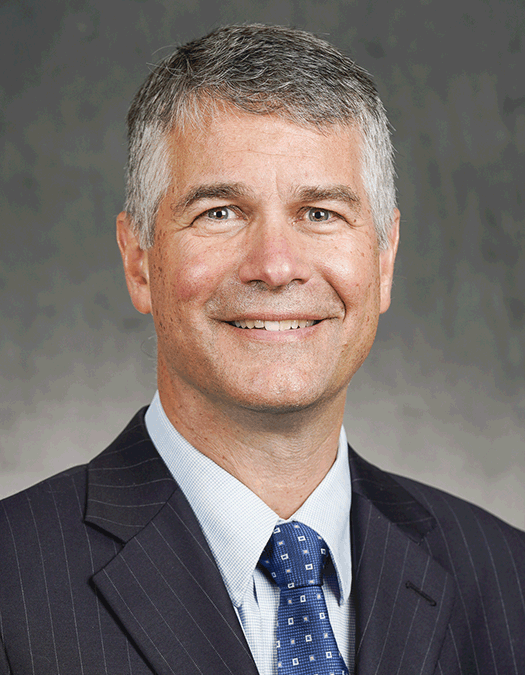
Rep. Larry Kraft
Sponsored bills
Maddy summaryThis bill designates thermal energy networks as public improvements and waterworks, allowing municipalities in Minnesota to acquire, construct, and maintain these systems alongside existing utilities like water and sewer infrastructure. The legislation amends state statutes to explicitly include thermal energy networks in the list of authorized municipal projects, enabling local governments to build and operate district heating systems as part of their public works responsibilities. By reclassifying these networks under existing legal frameworks for waterworks and public improvements, the bill provides municipalities with the authority to plan, fund, and manage thermal energy distribution without requiring new legislative approvals for each project.
Maddy summaryThis bill requires Minnesota's Department of Transportation to study and implement suicide prevention barriers (like nets or physical structures) for new bridge construction and major reconstructions. It mandates a study by January 2026 to identify high-risk bridges, evaluate barrier options, assess costs, and develop implementation criteria, with input from health, safety, and nonprofit organizations. The department must begin requiring these barriers in bridge projects starting January 2026, report annually on progress, and has $750,000 allocated for study and planning in fiscal year 2026. The policy directly affects all major bridge projects managed by the state transportation department.
Maddy summaryThis bill requires health insurance plans in Minnesota to cover cancer screenings for breast, colorectal, prostate, cervical, and lung cancers in accordance with current American Cancer Society guidelines. The law mandates that these plans provide coverage for all recommended examinations and follow-up tests without imposing any cost-sharing requirements, such as co-pays, deductibles, or coinsurance. Effective January 1, 2027, the provisions will apply to any health plan that is offered, issued, or renewed on or after that date.
Maddy summaryThis bill designates January of each year as "Snow Professionals Appreciation Month" in Minnesota to honor individuals and businesses who clear snow, maintain road safety, and manage winter weather. It recognizes snow professionals - including residential shoveling services, commercial plowing companies, and municipal crews - who keep streets and paths safe during winter. The bill allows the governor to promote public awareness of this observance but does not create new regulations, funding, or obligations. It is a ceremonial designation focused solely on recognition, with no direct policy changes affecting residents or businesses.
Maddy summaryHF 3624 appropriates $5,392,000 from the general fund for Minnesota's food shelf programs in fiscal year 2027. The funding, added to the base allocation, supports existing food shelf operations under Minnesota Statutes section 142F.14, administered by the state agency for children, youth, and families. This bill directly affects community food shelves that provide emergency food assistance to Minnesotans in need, without changing program eligibility or creating new requirements. The measure focuses solely on providing dedicated state funding for current food shelf services.
Maddy summaryHF 3586 establishes a $10 million annual grant program for regional food banks and Minnesota Tribal governments in Minnesota, funded through the general fund for fiscal years 2027-2029. The program distributes funds based on poverty and unemployment data in each area, requiring grantees to use money for purchasing, transporting, and distributing food and hygiene products (like diapers) at no cost to recipients. Funds cannot cover staff salaries or other ineligible expenses, and grantees must report spending and maintain records for oversight. This bill directly supports food banks serving low-income individuals and families by expanding access to essential food and hygiene supplies.
Maddy summaryThis bill appropriates $1,925,000 from Minnesota's general fund to support the operations of five public television stations in Greater Minnesota for fiscal year 2026. The funding is distributed as specific grants to Pioneer PBS, Lakeland PBS, KSMQ, PBS North, and Prairie Public television, with amounts ranging from $200,000 to $650,000 for each station. The legislation takes effect the day after it is officially enacted and directs the commissioner of administration to manage the distribution of these funds.
Maddy summaryHF 2904 requires certain Minnesota school employers - including school districts, charter schools, and vocational education centers - to join the state's public employees insurance program. It establishes an "educator group insurance program" specifically for school employees, mandating coverage tiers that match existing school employee pool options and including high-deductible plans. The bill creates a labor management committee with 12 members (including seven from Education Minnesota and representatives from unions and school administrators) to study program issues like cost efficiency. It also requires mutual agreement between the commissioner and the committee before changing cost-sharing plans. This bill directly affects school employees and their employers by integrating them into the state's insurance framework with specific administrative structures.
Maddy summaryThis bill requires homeowner's insurance policies in Minnesota to cover damage caused by peace officers using chemical irritants, smoke screens, or diversionary devices when the homeowner is entitled to compensation from the government. Effective January 1, 2027, insurers cannot exclude coverage for this specific type of damage and must allow homeowners to select their own mitigation contractors and industrial hygienists to address the harm. The law also permits insurers to require homeowners to transfer their right to claim compensation to the insurance company, while maintaining the government's obligation to pay just compensation for such incidents.