

Maddy summaryHF 2912 appropriates $2.57 million from Minnesota's renewable development account to fund a geothermal energy system at Macalester College in St. Paul. The funds will support constructing an aquifer-based system that provides heating and cooling for a new campus residence hall and welcome center, with design for future expansion to serve most campus buildings north of Grand Avenue. This bill directly affects Macalester College by providing capital for its infrastructure project, specifically targeting energy efficiency through geothermal technology. The appropriation is available until fully spent.
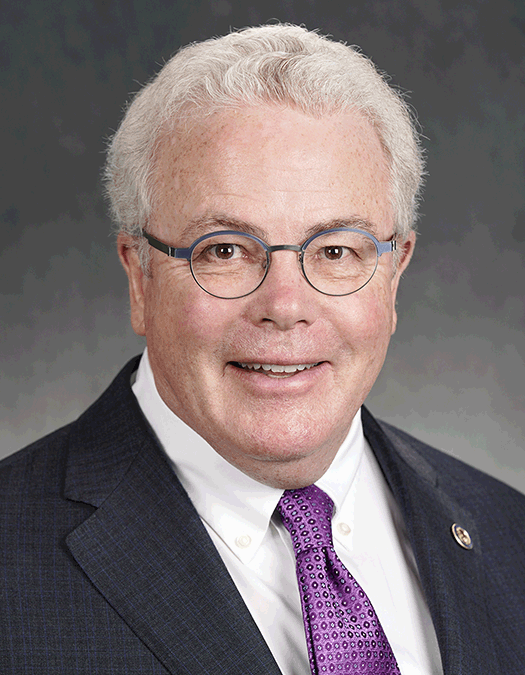
Rep. Ned Carroll
Sponsored bills
Maddy summaryThis bill authorizes the sale of state bonds to raise up to $5 million for the Hennepin County Sheriff's Office Forensic Science Laboratory. The funds will be used to design and renovate or expand the facility in Minneapolis to create a modern regional forensic science center. The appropriation comes from the bond proceeds fund and is directed to the commissioner of public safety for distribution to Hennepin County. The bill requires the commissioner of management and budget to issue the bonds according to existing state statutes and constitutional provisions.
Maddy summaryThis bill modifies a state appropriation for the city of Oak Park Heights to fund redevelopment of the Allen S. King power plant site. It authorizes a $2,190,000 grant for the city to acquire property and design public infrastructure including water systems, sewer systems, roads, trails, and sidewalks. The legislation extends the deadline for using bond sale proceeds and appropriations from the original timeframe to December 31, 2029. This change affects the city's ability to access state funding for infrastructure planning at the specified site.
Maddy summaryHF 3733 prohibits recreational camping area owners in Minnesota from charging campers extra fees for electricity beyond the base rate they pay their utility provider. The bill limits charges to only the "commodity rate" (the standard electricity rate the owner pays) and bans any additional costs like administrative fees, meter charges, demand charges, or taxes. It directly affects campgrounds that provide electrical hookups to recreational vehicles, ensuring campers are only charged for the actual electricity used. Violations would be treated as legal violations under existing statutes. This bill is currently in committee after its introduction on February 25, 2026.
Maddy summaryHF 3668 establishes an Office of Gun Violence Prevention within Minnesota's Department of Health. The office will coordinate prevention efforts, collect and report statewide data on gun incidents/deaths, conduct research, create public health campaigns, and support victims - working with agencies like Public Safety. It requires an annual report to legislative committees by February 15 each year. The bill appropriates unspecified funding from the general fund for the office's operations in fiscal years 2026 and 2027.
Maddy summaryHF 1766 appropriates $800,000 annually to the Minnesota Council on Economic Education to fund teacher training and classroom resources focused on economic and financial literacy. The bill directly supports K-12 teachers (especially those teaching grades 9-12 personal finance) by providing professional development, curricular materials, and direct student programs. It requires the Council to report annually on training participation, program content, and research results to the state education commissioner. This policy change aims to strengthen financial education standards across Minnesota public schools through targeted teacher support and measurable program evaluation.
Maddy summaryHF 1080 appropriates $25 million from state bond proceeds to fund trail improvements across 52 miles of Hennepin County's regional trail system. The funds will be provided to the Three Rivers Park District to build 10.7 miles of new trails, repair 11.4 miles of existing trails, and extend the life of 30.2 miles of current trails. The bill authorizes the state to issue up to $25 million in bonds to cover these costs, following Minnesota's bond issuance procedures. This funding directly benefits Hennepin County residents who use the regional trail network and the Three Rivers Park District as the project recipient.
Maddy summaryHF 3317 is a symbolic resolution passed by the Minnesota legislature condemning federal executive orders that target immigrants. It does not create new laws but expresses the state's opposition to policies it views as inhumane, urging the president to stop such actions and calling on Minnesota's congressional delegation to oppose these policies. The resolution also recommends federal passage of the Neighbors Not Enemies Act to repeal an outdated law and affirms that all people in Minnesota, regardless of immigration status, deserve due process under U.S. and state constitutions. It directs the Secretary of State to send copies to federal officials as a formal statement of the legislature's position.
Maddy summaryHF 2130 modifies several driver's license and ignition interlock requirements for individuals convicted of driving under the influence (DUI). It extends the required use period for ignition interlock devices after license reinstatement and adds criminal penalties for drivers who operate vehicles without these devices. The bill also adjusts procedures for license revocations, judicial review of extensions, temporary license issuance, and the process for reissuing impounded license plates. These changes primarily affect drivers with DUI convictions who are required to use ignition interlocks or face license restrictions.
Maddy summaryHF 2059 requires Minnesota local governments with over 5,000 residents to create automated online platforms for approving residential solar permits. These platforms must instantly issue permits for small solar systems (up to 200-amp capacity on single- or two-family homes) without manual review, processing at least 75% of typical applications. Local governments must submit an initial compliance report within 60 days of adopting the platform and annual reports starting in 2027 detailing permit usage and progress toward the 75% processing goal. The bill directly affects municipal permitting offices and residential solar customers by streamlining the approval process for rooftop solar installations.