

Maddy summaryThis bill authorizes the state of Minnesota to issue up to $95 million in bonds to fund road and utility infrastructure improvements at the Sears site in St. Paul. The funds will support construction of sanitary sewer and clean water systems, public utilities, streets, sidewalks, lighting, and streetscape improvements needed to prepare the area for future development. The legislation also defines the Sears site boundaries and establishes the legal framework for managing bond proceeds, including provisions for environmental remediation and demolition of existing structures. This measure is designed to provide necessary infrastructure support for the redevelopment of the former Sears property.
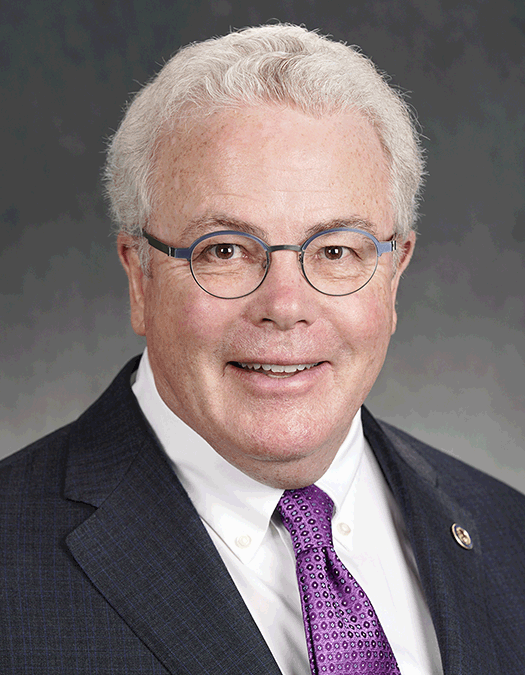
Rep. Ned Carroll
Sponsored bills
Maddy summaryHF 3807 requires Minnesota State High School League member schools to permit live and recorded broadcasts of all extracurricular competitions (like sports and events) for distribution on public, educational, or government access channels. This policy would apply to all member schools and must be adopted by the League, though it cannot override existing contracts signed before the policy takes effect. The bill mandates that schools allow these broadcasts without charging fees for the access. It directly affects high schools participating in the League by changing their broadcasting requirements for public access channels.
Maddy summaryThis bill expands the powers of Minnesota's Climate Innovation Financing Authority by allowing it to borrow money, sell financial instruments like notes and mortgages, and accept gifts or grants to fund climate projects. The legislation requires the authority to prioritize financing for greenhouse gas emission reduction projects across all regions of the state while coordinating with existing federal and state programs to avoid duplication. Key provisions include authority duties to develop eligibility standards, implement consumer protections, measure project impacts on low-income communities, and hire staff who reflect the communities they serve. The bill also mandates the authority to leverage private investment and stimulate demand through partnerships and targeted marketing strategies.
Maddy summaryHF 3617 bans the possession of semiautomatic military-style assault weapons in Minnesota, including specific firearms like AR-15 rifles and AK-47s, as well as weapons with features such as folding stocks, pistol grips, or detachable magazines. The bill defines these weapons broadly to cover both listed models and similar firearms with minor modifications, such as redesigned versions or enhanced features. Possessing a banned weapon would be a criminal offense under amended statutes, with penalties established for violations. This law directly affects individuals who own or possess these firearms, making such possession illegal under state law.
Maddy summaryHF 3618 bans the possession of specific semiautomatic military-style assault weapons (like AR-15s, AK-47s, and Uzis) and ammunition magazines holding more than 10 rounds in Minnesota. It defines these weapons broadly to include models listed in the bill, as well as firearms with features like folding stocks, pistol grips, or threaded barrels. The bill creates criminal penalties for possessing these banned weapons or magazines, directly affecting individuals who own them. The law would amend Minnesota statutes to enforce this ban and penalties, applying to anyone in the state who possesses such firearms or magazines.
Maddy summaryHF 974, the Equal Access to Broadband Act, updates Minnesota's broadband laws by defining key terms like "broadband" (meeting FCC standards for high-speed internet), "underserved areas" (lacking 100/20 Mbps wired service), and "broadband infrastructure." The bill requires broadband providers to coordinate with local governments when placing infrastructure in public rights-of-way, including notifying them before installation to minimize future disruptions. It preserves local governments' authority to require franchises from broadband providers, while excluding electric cooperatives and satellite-only providers from these requirements.
Maddy summaryThis bill increases funding for Minnesota's Family Homeless Prevention and Assistance Program, raising the annual appropriation from $10.27 million to $45.27 million. The additional funds will be used to reduce homelessness risks and improve program effectiveness, with a portion designated for the housing development fund. The legislation also grants agencies flexibility in awarding grants to existing grantees and allows new grantees in certain areas to work with advisory committees or local care systems without meeting specific statutory requirements. These changes take effect immediately and establish a future funding base of $10.72 million starting in fiscal year 2028.
Maddy summaryThis bill establishes a new legal right in Minnesota allowing individuals to sue if their name, likeness, or voice is used for commercial purposes without their permission. It defines likeness as any recognizable image of a person and voice as any sound that identifies a specific individual, covering both recorded and computer-generated versions. The law permits people to sell or license these rights and allows lawsuits to continue for up to 70 years after death if the person's identity was used commercially during that time. Courts can award damages for financial losses, profits made from the unauthorized use, and attorney fees, with triple damages available if the misuse was intentional. The bill includes exceptions for news reporting, criticism, satire, and other First Amendment-protected uses, ensuring free speech rights remain intact.
Maddy summaryHF 3739 names Minnesota's Trunk Highway 610 as the "Hortman Memorial Highway." This bill requires the state transportation commissioner to install signs identifying the highway by its new name, replacing or adding the name to existing route signage. It directly affects travelers on Highway 610 and the Minnesota Department of Transportation, which must implement the signage changes. The bill does not alter highway maintenance, funding, or traffic rules - only the official name displayed on signs. This is a commemorative naming bill with no substantive policy changes beyond signage.
Maddy summaryHF 3293 creates the Minnesota Consumer Financial Protection Bureau (MCFPB) to enforce consumer financial laws and protect residents from unfair or deceptive practices in banking, lending, and other financial services. The bill establishes a commissioner appointed by the governor to oversee the bureau, which will investigate complaints, monitor financial markets, and enforce anti-discrimination rules in consumer finance. It appropriates funding for the bureau’s operations in fiscal years 2026 and 2027, and directs the commissioner to recruit staff with federal CFPB experience. The bureau directly affects Minnesota consumers and financial institutions operating in the state by providing a dedicated enforcement agency for consumer financial protection.