

Maddy summaryThis bill extends the time limit for prosecuting certain theft and fraud crimes in Minnesota, particularly those involving public funds and medical assistance fraud. It directly affects prosecutors, law enforcement agencies, and individuals accused of these offenses by allowing more time to file charges. The key change increases the statute of limitations for theft of public money to ten years and adjusts timeframes for other financial crimes based on the amount stolen or number of victims. The bill also adds provisions that pause the clock if a defendant participates in pretrial diversion programs or if DNA evidence is being analyzed. These changes take effect on August 1, 2026, and apply to crimes committed on or after that date.
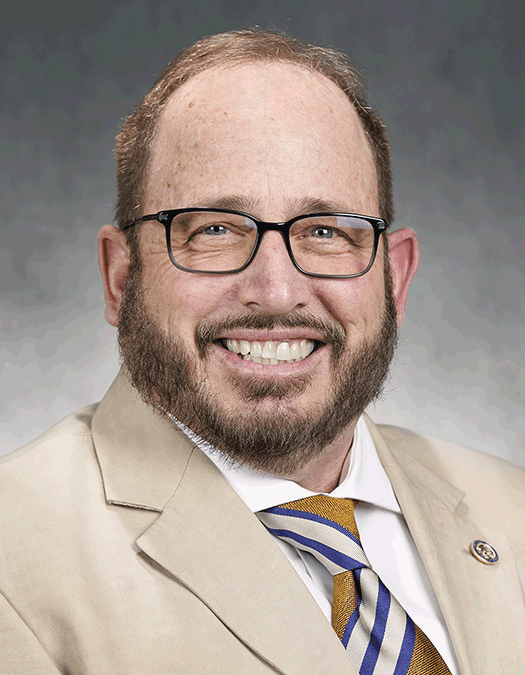
Rep. Roger Skraba
Sponsored bills
Maddy summaryThis bill establishes the SAVE Minnesota Act, which requires voters to present a specific photo identification card to register to vote and to cast their ballots. To obtain this new voter identification card, applicants must provide proof of their U.S. citizenship and may receive certain vital records, such as birth certificates, without a fee. The legislation also creates a new voter identification card program, modifies existing driver's license requirements, and sets up a process for handling provisional ballots. Additionally, the bill includes funding provisions to support the administration of these new election procedures and establishes a children's trust fund.
Maddy summaryThis bill creates a new 100% tax on money obtained through fraud by individuals or organizations, regardless of whether they have already paid fines or restitution. It applies to those convicted by a court, those identified by the state revenue commissioner as having committed fraud, and anyone paid to help facilitate such fraudulent activities. The revenue collected from this tax must be used exclusively to provide relief for state income or property taxes. The law takes effect retroactively for fraud cases determined after December 31, 2019.
Maddy summaryThis bill authorizes the Koochiching County Board to divide Independent School District No. 363, South Koochiching, if requested by eligible voters. The process begins with a petition signed by a specific percentage of voters, which must be submitted to the county auditor by July 1, 2027, to initiate proceedings. Following the petition, the county board holds a hearing and may issue an order to split the district, a decision that requires approval from the state commissioner of education. If the current school board does not approve the division order within 60 days, the matter will be put to a vote by the local residents. Ultimately, the bill establishes a formal legal pathway for splitting the school district based on voter initiative and administrative oversight.
Maddy summaryThis bill modifies how Minnesota counties share costs for mental health and substance use services, specifically exempting economically distressed counties from certain financial responsibilities. A county qualifies as economically distressed if more than 15% of its population lives in poverty and over 70% of its land is exempt from property taxes. The legislation also allocates funding for opioid response efforts, including grants for antagonist distribution, traditional healing practices for American Indians, safe recovery sites, and child protection services affected by addiction. These provisions aim to adjust financial burdens on struggling counties while directing state resources toward specific public health initiatives.
Maddy summaryHF 3513 defines key terms for autonomous vehicles in Minnesota Statutes, establishing a regulatory foundation for future rules. It adds definitions for terms like "automated driving system" (level 4/5 vehicles), "dynamic driving task," "minimal risk condition," and "on-demand autonomous vehicle network" to clarify operational standards. The bill does not impose new restrictions or requirements but creates the terminology needed for future legislation governing autonomous vehicle safety and operation. This procedural update prepares Minnesota’s legal framework for regulating self-driving technology as it develops.
Maddy summaryThis bill authorizes funding to help businesses in Two Harbors cope with disruptions caused by road construction on Trunk Highway 61. It directs the Department of Employment and Economic Development to create a grant program for local companies that face issues like reduced access, parking problems, or visibility loss due to the project. To qualify, a business must be located in the 55616 zip code, have 100 or fewer employees, and demonstrate specific negative impacts from the construction work. The grants can cover payroll and operating costs but cannot be used for bonuses, new equipment, or expanding facilities. Additionally, the bill requires the department to submit a detailed report on all awarded grants to state legislators by January 15, 2029.
Maddy summaryThis bill limits the implementation of Minnesota's traffic safety camera pilot program by establishing specific rules for red light and speed camera citations. It mandates that first-time offenders receive a warning instead of a fine, while second offenses are eligible for a traffic safety course that avoids a conviction. The penalties apply only to violations occurring between August 1, 2025, and the day following the bill's final enactment, with stricter rules for commercial drivers. Additionally, the law provides exemptions from fines for situations such as stolen vehicles, medical emergencies, and cases where the vehicle owner was not driving at the time of the violation.
Maddy summaryThis bill authorizes the issuance of up to $225 million in state bonds to fund clean water infrastructure improvements. The funds will be distributed through grants and loan matching programs to eligible municipalities for projects addressing emerging contaminants, water infrastructure upgrades, and point source pollution control. The legislation directs $22 million toward emerging contaminants, $19 million to match federal grants for water and drinking water revolving funds, $60 million for general water infrastructure grants, and $124 million for point source implementation projects. All funding is designated for qualified capital projects that must be approved under existing state statutes.
Maddy summaryThis bill appropriates $6 million from state bond proceeds to fund capital improvements at Duluth's Lake Superior Zoo, directly benefiting the city of Duluth through a grant for predesign, construction, and equipment upgrades. Key provisions include authorizing the sale of up to $6 million in state bonds under Minnesota law and exempting the funding from standard budget rules (Minnesota Statutes § 16A.86, subd. 4). The funds will support critical infrastructure like mechanical/electrical systems, utility infrastructure, and exhibit renovations to sustain zoo operations.