

Maddy summaryThis bill prohibits the use of sonar and related advanced technologies to locate or target muskellunge and northern pike in specific Minnesota waters. The restrictions apply only to lakes where these fish populations are naturally reproducing rather than primarily maintained through stocking. Anglers in these designated areas will be banned from using equipment such as live imaging sonar, drones, or systems that use artificial intelligence to track fish. The law also clarifies existing rules on artificial lights, allowing their use for spearing only under limited conditions while banning mercury batteries in fishing lures.
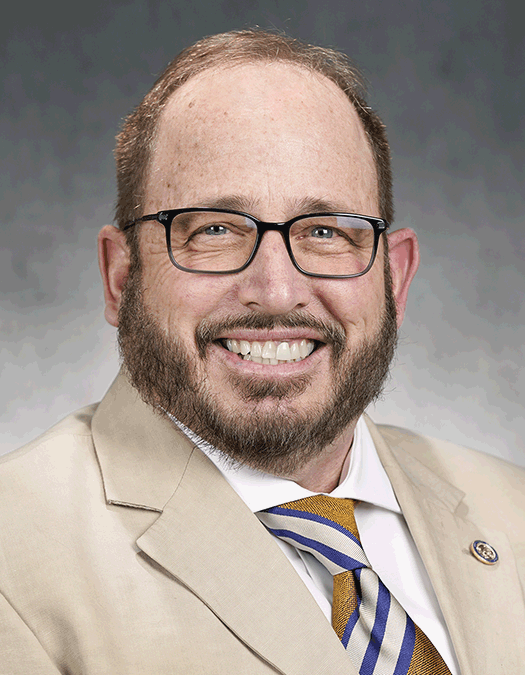
Rep. Roger Skraba
Sponsored bills
Maddy summaryThis bill modifies how the state of Minnesota calculates registration taxes for passenger automobiles and hearses, directly affecting vehicle owners and dealers. It lowers the tax rate from 1.54% to 1.25% for cars registered before November 16, 2020, and from 1.575% to 1.285% for newer vehicles, while also reducing the percentage of the vehicle's price charged in subsequent years of ownership. The changes take effect for registration periods starting on or after January 1, 2027, and include rules that prevent the total tax paid on a vehicle from exceeding the amount originally due.
Maddy summaryThis bill authorizes the Minnesota state government to issue bonds and allocate funds for capital projects on state-owned forest lands. It directly affects the Department of Natural Resources by providing financial resources for forest management activities such as reforestation, planting native trees, and site preparation on over 50 designated state forests. The legislation defines key terms like "reforestation" and "state forest land" to establish clear guidelines for how the appropriated funds will be used. By enabling bond issuance, the bill allows the state to finance large-scale forestry infrastructure improvements without immediately drawing from the general fund.
Maddy summaryThis bill modifies Minnesota law to allow county commissioners to enter into agreements with other government units for services that those units are authorized to provide themselves, even if the county does not currently have the specific power to perform that service. The legislation also mandates that county sheriffs must sign agreements with federal agencies to carry out authorized federal functions without needing prior approval from the county board. By creating these exceptions to the usual requirement that all parties in an agreement must share common powers, the bill expands the ability of local governments to collaborate on service delivery and fulfill federal mandates.
Maddy summaryHF 3609 prevents drug manufacturers from restricting how 340B program drugs are delivered to participating hospitals and clinics. It adds enforcement by treating violations as deceptive trade practices, allowing the attorney general to take action. The bill permanently removes an expiration date (previously set for July 1, 2027), making these restrictions permanent. This directly affects safety-net healthcare providers that rely on the 340B program for discounted medications.
Maddy summaryHF 1333 requires Minnesota to issue at least two moose hunting licenses annually through a public lottery and two through a public auction, with all applicants paying a $25 nonrefundable fee. The bill creates a "moose research account" funded by license fees and auction revenue, which must be used to study moose mortality, calf survival, disease, and habitat needs. It restricts lottery eligibility to Minnesota residents who haven't held a moose license since 1991, while auctions are open to all eligible applicants. The legislation amends existing statutes to implement these license distribution methods and direct funds toward specific moose conservation research goals. This directly affects residents seeking moose hunting permits and funds state wildlife management efforts.
Maddy summaryThis bill establishes a new mandatory health insurance pool specifically for school employees in Minnesota, requiring certain school districts and charter schools to participate. It creates a Labor Management Committee composed of representatives from various teacher and administrator unions to oversee the program, approve changes to cost-sharing plans, and study issues like benefits and cost efficiency. The legislation also defines key terms such as "school employer" and "retired school employee" to clarify who is covered under the new system. Additionally, the bill provides funding and grants the state commissioner authority to manage the program's administration and offer specific coverage options.
Maddy summaryHF 3786 clarifies which children's museums can receive competitive grants from Minnesota's arts and cultural heritage fund. It requires that only museums meeting the IRS's A52 tax-exempt classification (or a future equivalent) qualify for these grants. This directly affects children's museums seeking funding under the current grant program. The bill amends Minnesota law to specify this eligibility standard, ensuring grants are awarded only to qualifying institutions.
Maddy summaryHF 1420 allocates $20 million from state bond proceeds to fund a public realm project over Shepard Road in St. Paul, including adjacent rail lines and related infrastructure. The funds will be granted to Ramsey County for predesign, design, construction, and equipment of this public space. The bill authorizes the state to issue up to $20 million in bonds to cover this appropriation, following standard bond procedures under Minnesota law. This project directly affects Ramsey County and residents of St. Paul by creating new public infrastructure along Shepard Road.
Maddy summaryHF 482 establishes "Choose Life" special license plates for Minnesota motor vehicle owners. To obtain these plates, applicants must pay a $25 initial fee and $25 annual contribution to a dedicated "Choose Life account," in addition to standard registration fees. Funds collected are deposited into this account and distributed by Choose Life Minnesota, Inc., to non-profit agencies within each county that assist pregnant women making adoption plans - excluding any agencies involved in abortion services or charging fees for services. The bill also specifies plate design requirements (featuring the "Choose Life" logo and inscription) and limits administrative costs for the program to 15% of funds. The program becomes effective January 1, 2026.