

Maddy summaryThis bill proposes a constitutional amendment to modify how Minnesota's permanent school fund is invested, managed, and distributed to school districts. The key change would require the fund to be managed as a perpetual resource that preserves its purchasing power over time while providing annual distributions to support schools without raising individual taxes. The amendment establishes a board of investment led by the governor, state auditor, secretary of state, and attorney general, and prohibits the use of state funds to underwrite municipal securities. If approved by voters in 2026, the new policy would take effect on July 1, 2027, with specific rules for calculating distributable amounts and handling investment gains and losses.
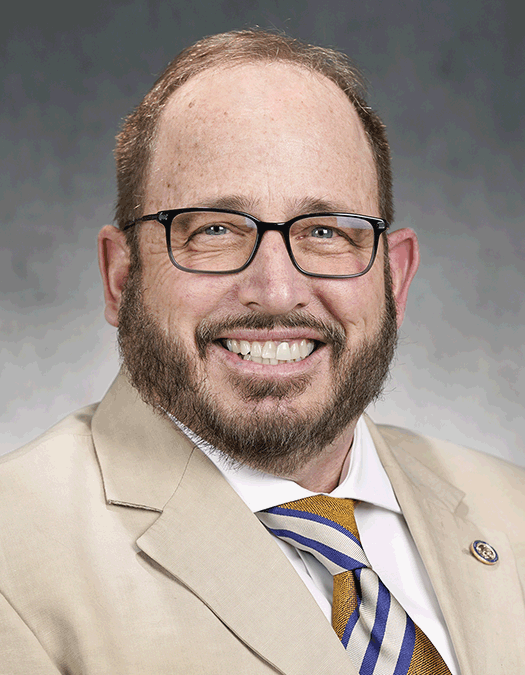
Rep. Roger Skraba
Sponsored bills
Maddy summaryHF 5092 modifies how Minnesota distributes revenue from mineral production taxes to school districts. The bill updates the specific dollar amounts and formulas used to allocate funds, ensuring that districts near taconite mines and those in designated tax relief areas receive their designated shares. It also clarifies how money from specific mining facilities is directed to particular school districts and establishes rules for funding early childhood programs in qualifying areas.
Maddy summaryHF 3393 creates supplemental unemployment benefits for workers in the iron ore mining industry and related explosive manufacturing firms that supply them. It provides additional benefits to employees laid off between January 15 and March 15, 2026, due to a 50%+ workforce reduction at their employer. Eligible workers must have exhausted regular unemployment benefits and meet standard eligibility requirements, receiving up to 26 weeks of supplemental payments matching their regular weekly benefit amount. The bill applies retroactively to January 15, 2026, and excludes those receiving federal Trade Readjustment Allowance benefits.
Maddy summaryThis bill temporarily suspends the state motor fuels tax in Minnesota for a specific period in 2026, directly affecting drivers, fuel retailers, and businesses that purchase gasoline and diesel. Under the legislation, the tax rate is set to zero cents per gallon or per thousand cubic feet for all fuel types during the designated timeframe, which begins shortly after the bill is enacted and ends in early September 2026. To offset the lost revenue from this suspension, the state will transfer money from its general fund to the Department of Transportation to cover the costs that would have been collected from fuel taxes. The bill also allocates a one-time appropriation to the Department of Revenue to cover the administrative expenses required to implement this temporary tax pause.
Maddy summaryThis bill expands Minnesota's fourth-degree assault laws to increase penalties for physically attacking specific first responders and healthcare workers. It makes assaulting firefighters, emergency medical personnel, or hospital emergency department staff a gross misdemeanor, but raises the charge to a felony with up to three years of imprisonment if the assault causes demonstrable bodily harm. The changes apply to crimes committed on or after August 1, 2026, and affect anyone who commits these acts against the listed individuals.
Maddy summaryThis bill appropriates $80,000 for the Civil Air Patrol in each of fiscal years 2026 and 2027, funded from the state airports fund and administered by the commissioner of transportation. It directly affects the Civil Air Patrol organization in Minnesota by providing dedicated state funding for its operations. The bill contains no policy changes or new requirements - only a specific funding allocation. As a procedural appropriation, it does not alter existing programs or create new obligations.
Maddy summaryHF 3586 establishes a $10 million annual grant program for regional food banks and Minnesota Tribal governments in Minnesota, funded through the general fund for fiscal years 2027-2029. The program distributes funds based on poverty and unemployment data in each area, requiring grantees to use money for purchasing, transporting, and distributing food and hygiene products (like diapers) at no cost to recipients. Funds cannot cover staff salaries or other ineligible expenses, and grantees must report spending and maintain records for oversight. This bill directly supports food banks serving low-income individuals and families by expanding access to essential food and hygiene supplies.
Maddy summaryThis bill removes the June 30, 2025 expiration date from Minnesota’s crossbow hunting and fishing allowance. It directly affects hunters and anglers who use crossbows to take deer, bear, turkey, common carp, or native rough fish during regular archery seasons. The key provision amends Minnesota Statutes section 97B.037 to eliminate the sunset provision, making the crossbow allowance permanent. This change ensures the existing crossbow hunting and fishing rules remain in effect without needing future legislative action to extend them. The bill does not alter the current requirements for licenses, transportation, or crossbow specifications.
Maddy summaryThis bill requires the state to grant a one-year extension without penalty to timber permit holders who request it before their current permit expires, provided they are not delinquent on payments or have active trespass violations. The law also mandates that permits for timber requiring frozen ground access must have a minimum term of four years, ending on May 31 of the fifth year, to ensure safe working conditions during winter. Additionally, the bill updates requirements for sale lists to include specific assessments on whether frozen ground access is needed for certain tracts of land. These changes directly affect current and future timber operators in Minnesota by altering how long they can legally harvest state timber and how sale information is presented.
Maddy summaryThis bill provides $1 million in state funding to counties, municipalities, and townships to help them plan and develop regional drinking water systems. The money can be used for planning activities like feasibility studies, engineering analyses, and community engagement to support shared water infrastructure projects. Local governments must contribute at least 25% of the grant amount in matching funds, and each recipient can receive up to $300,000 per year. The state health commissioner must create an application process by November 2026 that prioritizes projects addressing aging infrastructure, water quality, affordability, or economic development, and submit a progress report by January 2027.