

Maddy summaryHF 274 appropriates $25,000 from the all-terrain vehicle account to update the C.J. Ramstad/North Shore State Trail Master Plan, specifically allowing ATV use on portions of the trail within Cook and Lake Counties. The bill requires the commissioner of natural resources to complete this plan update by February 1, 2026, and submit a report to relevant legislative committees. This funding change directly affects the management of the trail in those counties by modifying its designated uses. The provision is a procedural update to the trail's master plan, not a new regulatory standard.
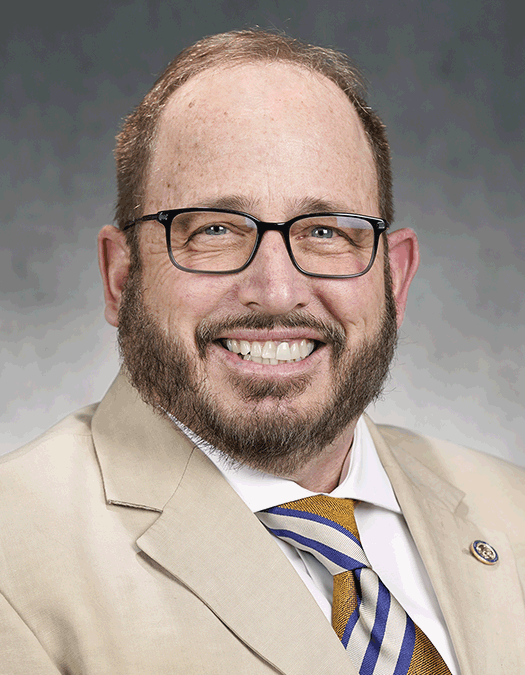
Rep. Roger Skraba
Sponsored bills
Maddy summaryThis bill appropriates $25 million from state bond proceeds to fund Minnesota's Small Cities Assistance Program, which provides infrastructure and community development support to smaller cities. The funds will be administered by the commissioner of transportation under Minnesota Statutes §162.145. The bill authorizes the state to sell up to $25 million in bonds through standard state bond procedures to cover this appropriation. It directly affects small cities eligible for the program's services, such as road repairs and public facility improvements. The funding mechanism is purely financial, with no new eligibility requirements or policy changes specified in the bill text.
Maddy summaryHF 278 increases fees for all-terrain vehicle (ATV) registrations and nonresident trail passes in Minnesota. It adds a $45 surcharge to all ATV registration fees (raising public-use fees from $6 to $20 annually) and increases the nonresident trail pass fee from $30 to $45 per year. The surcharge and higher pass fees fund grant-in-aid programs under Minnesota Statutes 84.927, specifically for constructing and maintaining ATV trails and use areas in counties and municipalities. This directly affects ATV owners (residents and nonresidents) who must pay these updated fees to operate on state or grant-in-aid trails.
Maddy summaryHF 1912 modifies Minnesota's rules for hospitals operating swing beds, which provide transitional care between hospital and nursing home settings. The bill requires hospitals to limit swing bed stays to 40 days (unless emergency approval is granted with specific documentation), restrict admissions to recently hospitalized or directly transferred patients, and submit annual reports on usage, charges, and patient data to the health commissioner. It specifically exempts Cook County critical access hospitals with attached nursing homes from the stay limits and admission rules, allowing them to use swing beds for nursing services without prior hospitalization. These changes directly affect hospitals seeking or maintaining swing bed licenses in Minnesota.
Maddy summaryThis bill appropriates $375,000 for fiscal year 2026 and $375,000 for fiscal year 2027 from Minnesota's arts and cultural heritage fund to the Lake Superior Zoological Society. The funding is specifically for developing educational exhibits and programs focused on Minnesota's history and cultural heritage. The Lake Superior Zoological Society directly receives these funds to support its educational initiatives. The bill provides concrete financial support through established state funding mechanisms without altering broader policies.
Maddy summaryHF 2306 appropriates $40,000 from the general fund for fiscal year 2026 to Lake County to plan a veterans memorial park honoring U.S. military veterans. The bill directly affects Lake County (as the grant recipient) and Minnesota veterans (as the honorees of the memorial). Key provisions include the specific funding amount, the purpose of planning the memorial park, and the requirement that funds be used solely to recognize and honor veterans of the U.S. armed forces. This is a straightforward funding allocation with no additional policy mechanisms beyond the grant.
Maddy summaryHF 25 establishes a state grant program administered by Minnesota's Department of Health to fund nonprofit women's pregnancy centers and maternity homes. The program provides financial support for services like housing, medical care, parenting education, and mental health resources to help pregnant women and new mothers - particularly those facing homelessness or crisis - carry pregnancies to term and care for their children. Eligible organizations must be nonprofits offering free or low-cost services without promoting abortion, providing abortion care, or referring women to abortion providers. Grant funds cannot be used for abortion-related activities, and strict privacy rules require written consent before sharing personal information about clients. The bill appropriates state funds for this program while reducing other health-related appropriations.
Maddy summaryHF 2363 grants residents of long-term care facilities in Minnesota the right to have one designated support person (such as a family member, partner, or close friend) physically present with them while receiving care. The bill amends Minnesota Statutes 2024, sections 144.651 and 144G.91, requiring facilities to allow this support person unless restricted for medical reasons (like during surgery) or if the person poses a safety threat. Facilities must follow internal grievance procedures if a support person is denied. This directly affects long-term care residents and facilities, ensuring they can choose a comfort person without facility interference, except in specific safety or clinical circumstances.
Maddy summaryHF 2364 establishes "Donate Life" special license plates in Minnesota. Vehicle owners who pay a $25 annual contribution to the organ and tissue donation account (in addition to standard plate fees) can obtain these plates, which must display a standard donation logo and "Donate Life" inscription. Funds collected through this contribution are deposited into a dedicated account and used to cover administrative costs, with remaining funds distributed to LifeSource, a nonprofit focused on organ donation activities like registry maintenance and public education. The bill takes effect January 1, 2026, for new plates issued on or after that date.
Maddy summaryHF 1225 eliminates all-terrain vehicle (ATV) registration fees for Minnesota veterans with a 100% service-connected disability. It amends Minnesota Statutes to exempt these veterans from paying the standard $60 (public use) or $6 (private use) three-year registration fee, instead providing free registration. Veterans must provide proof of their 100% disability rating from the U.S. Department of Veterans Affairs or military retirement board. This change directly affects qualifying veterans who own ATVs, removing a financial burden tied to vehicle registration. The policy modifies existing fee structures under Minnesota Statutes § 84.922, subdivision 5.