

Maddy summaryThis bill allocates $1.75 million from the state's general fund in fiscal year 2027 to help develop and implement a unified 911 center awareness platform. The money will be given to the Metropolitan Emergency Services Board to create a system that enables 911 centers to communicate and coordinate emergency responses across different jurisdictional boundaries in real time. The grant also covers two years of maintenance costs for the platform. This legislation directly affects public safety officials and emergency response centers by providing funding for improved communication infrastructure.
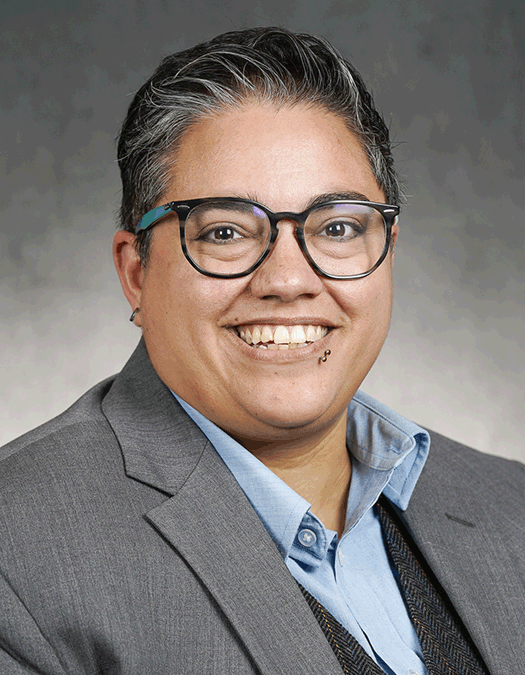
Rep. Brion Curran
Sponsored bills
Maddy summaryHF 32 prohibits Minnesota health insurance companies from requiring co-payments for mental health services provided to children under 18. This applies to all standard health plans and includes a specific provision for high-deductible plans, which must limit co-payments to the minimum level needed to maintain tax-advantaged health savings account benefits. The law directly affects children receiving mental health care and their insurers, eliminating out-of-pocket costs for these services. It takes effect January 1, 2026, applying to health plans offered, issued, or renewed on or after that date.
Maddy summaryThis bill creates a new tax in Minnesota that targets individuals and organizations convicted of fraud or those identified by the state revenue commissioner as having obtained money through deceitful means. The tax requires anyone who has successfully defrauded state programs to pay back 100 percent of the stolen amount, regardless of any existing fines or restitution already ordered by courts. The state revenue commissioner is tasked with investigating suspected fraud, setting up a system to collect these payments, and ensuring the recovered funds are used specifically for income and property tax relief. The law applies retroactively to fraud cases determined after December 31, 2019, and also covers people who were paid to help commit the fraud.
Maddy summaryThis bill requires health insurance plans in Minnesota to cover home care nursing services without imposing quantity limits on the number of visits or hours provided. It directly affects individuals enrolled in health plans who also receive medical assistance, ensuring they receive ongoing skilled nursing care without arbitrary caps on coverage. The legislation defines home care nursing services as continuous, medically necessary care that cannot be safely delivered through intermittent visits, and mandates that plans refer to these services by this specific name in all coverage documents. While cost-sharing like copayments may still apply, the bill prohibits plans from restricting coverage based on the total amount of services needed, with most provisions taking effect in 2026.
Maddy summaryHF 3468 permits individuals injured due to a failure to render aid in specific legally defined circumstances to file a civil lawsuit. It directly affects victims who were not assisted when required by existing law, allowing them to seek compensation for damages, court costs, and attorney fees. The bill amends Minnesota Statutes 2024, section 609.662, by adding a new civil action provision. This change takes effect on August 1, 2026, applying to cases arising on or after that date.
Maddy summaryThis bill authorizes the state of Minnesota to use a lease-purchase agreement and the sale of certificates of participation to fund improvements or replacement of its MAXIS system. Under this plan, the state would lease the project from a vendor or financing source and pay for it in installments over a period of up to ten years. The legislation establishes specific rules for how the state must manage the funds, including requirements for insurance, liability, and financial reporting within a dedicated project fund. It also allows the state to transfer money from its general fund to cover expected costs before the financing proceeds are received.
Maddy summaryThis bill increases funding for Minnesota's Independent Use of Force Investigations Unit by $550,000 for fiscal year 2027. The additional money will be used to hire two new special agents and one criminal intelligence analyst to investigate cases involving police use of force. The unit, which operates under the Bureau of Criminal Apprehension, will receive these resources to expand its investigation capacity. The funding takes effect on July 1, 2026, and is drawn from the state's general fund.
Maddy summaryThis bill creates the Minnesota Business Recovery Loan Program to help businesses that have suffered financial losses due to increased immigration enforcement activities in the state. It appropriates $100 million in fiscal year 2026, with $18 million designated for zero-interest loans to businesses in greater Minnesota and $82 million for zero-interest loans to businesses in the seven-county metropolitan area through nonprofit lenders. To qualify, businesses must be located in Minnesota, owned by state residents, demonstrate a revenue loss of more than 30 percent between enactment and December 1, 2025, and show that losses resulted from staffing shortages, reduced customer access, or other immigration enforcement-related factors. The program provides loans ranging from $25,000 to $200,000 depending on business size and location, which must be used exclusively for business operations in Minnesota and cannot be used to repay prior debt or for real estate speculation.
Maddy summaryThis bill requires high-risk medical assistance providers in Minnesota to complete compliance training focused on drug and alcohol policies before employees or volunteers have direct contact with program participants. It also mandates that applicants disclose any consultants used to prepare their license applications and strengthens requirements for identifying controlling individuals during the licensing process. The legislation updates application procedures to include stricter timelines for commissioner responses, clearer documentation requirements, and provisions for electronic communication with the licensing authority. These changes aim to improve transparency and oversight for organizations providing medical assistance services under state regulation.
Maddy summaryThis bill establishes a new Mental Health and Substance Use Disorder Education Center within Minnesota's Department of Health to address workforce shortages in mental health care. The center will analyze provider availability, create career exposure programs for students, develop a licensure guide website, and operate a job board for treatment providers. It also plans to track graduate numbers, identify licensure barriers, expand loan forgiveness programs, and train primary care professionals in mental health integration. The bill requires annual reports to the legislature starting in 2027 and appropriates unspecified funding from the general fund to support these initiatives.