

Maddy summaryHF 96 requires Minnesota's medical assistance program (like Medicaid) to cover home birth services for low-risk patients when specific conditions are met. It directly affects pregnant people choosing home births and eligible providers (certified midwives, doctors, or nurse practitioners) who must meet scope-of-practice standards. Key provisions include requiring providers to document low-risk status through prenatal care, obtain patient consent about home birth risks, and have a hospital transfer plan. The bill also sets payment rates: 100% for provider services and 70% for facility services compared to hospital rates for similar care.
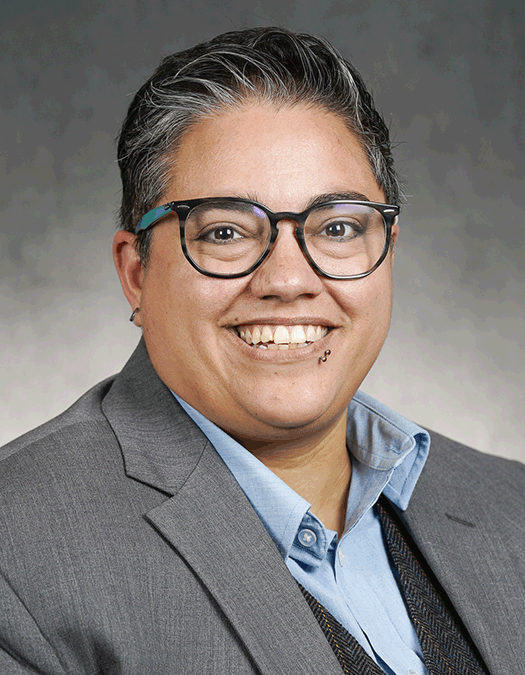
Rep. Brion Curran
Sponsored bills
Maddy summaryHF 2220 prohibits Minnesota state agencies from charging parking fees to state employees at facilities owned or operated by the state. It directly affects all state employees who park on state property, whether working or with manager approval for personal use. The bill amends Minnesota Statutes (sections 16B.04 and 16B.58) to require free parking, removing all fees, fines, or penalties for eligible employees. This change applies to all state parking lots managed under the Department of Administration, ensuring employees receive a free parking permit.
Maddy summaryHF 2032 establishes mental health case management and community support services specifically for adults with complex post-traumatic stress disorder (C-PTSD). It directly affects individuals meeting defined C-PTSD criteria, including significant PTSD symptoms interfering with daily life due to intergenerational, racial, or historical trauma, plus documentation from a mental health professional. The bill requires providers of emergency, outpatient, or residential mental health services to refer eligible clients to case management upon consent, documenting these referrals. Key provisions include mandating culturally sensitive assessments and written professional opinions verifying eligibility and the need for ongoing support to prevent worsening symptoms.
Maddy summaryHF 2254 adds a $400 "baby bonus" to Minnesota's existing child credit for each qualifying child born during the tax year. This directly affects Minnesota taxpayers with newborn children, increasing their state income tax credit. The bill modifies the child credit calculation by adding the $400 per newborn (without reducing the minimum credit amount) and allows for potential advance payments. It takes effect for tax years beginning after December 31, 2024.
Maddy summaryHF 31 modifies how Minnesota school districts calculate eligibility for compensatory revenue funding (used to support students from low-income backgrounds). It changes the method to combine both direct certification (using existing eligibility data) and application of education benefits to determine funding. The bill also allows districts to allocate up to 20% of compensatory funds off-site for broader student needs, while requiring 80% to stay at the school building level. Additionally, it establishes a Compensatory Revenue Task Force to review the system and updates professional development requirements for teachers under the Read Act.
Maddy summaryHF 1166 creates a $500,000 annual grant program (for fiscal years 2026-2030) to expand access to assistive technology and remote support services for Minnesotans with disabilities. The grant is awarded to nonprofit organizations meeting specific criteria, requiring them to fund training for service providers, schools, and individuals with disabilities; support advocacy groups; and develop accessible resources. Recipients must submit annual reports by June 30 detailing training participants, impacts on quality of life and safety, and final evaluations after the grant period ends. This bill directly affects disability service providers, advocacy organizations, and people with disabilities by improving technology access and community participation.
Maddy summaryHF 2144 appropriates unspecified funds from the general fund for the Family Homeless Prevention and Assistance Program under Minnesota Statutes § 462A.204, for fiscal years 2026 and 2027. The bill directly affects families in Minnesota at risk of homelessness by providing funding for prevention and assistance services. Key provisions include directing the Housing Finance Agency to administer the program using these allocated funds. This is a funding bill with no new policy requirements, solely authorizing budget resources for an existing state program.
Maddy summaryHF 1966 appropriates $55,000 annually from the general fund to the Minnesota Association of Alternative Programs for its STARS program, starting July 1, 2025. The funding supports students in alternative education programs by helping them develop employment, academic, and social skills through trainings and conferences. It directly affects students in alternative programs across Minnesota who participate in the STARS initiative. The bill establishes a base annual appropriation of $55,000 for fiscal years 2026 through 2027 and beyond, with specific funding amounts designated for those years.
Maddy summaryHF 1757 requires anyone who owns, possesses, or controls a firearm to report a loss or theft to local law enforcement within 48 hours. Failure to report can result in escalating penalties, starting with a minor offense for the first violation and increasing to a gross misdemeanor for repeated failures. The bill also provides immunity from prosecution for storage-related offenses if the report is made on time and mandates that law enforcement agencies report lost or stolen firearms to the state commissioner within seven days. Additionally, the bill appropriates $36,000 for a one-time implementation of a reporting system to support these requirements.
Maddy summaryHF 1399 requires Minnesota's Commissioner of Corrections to maintain a supply of opiate antagonists (like naloxone) at all state correctional facilities for immediate use during opioid overdoses. It mandates storing sufficient nasal doses throughout facilities for rapid response and provides training to correctional staff on recognizing overdose symptoms and administering the medication. This bill directly affects people in Minnesota's prisons and jails who may experience overdoses, as well as correctional facility staff responsible for safety. The law creates a specific protocol for overdose response within correctional settings, referencing existing statutes for definitions and administration procedures.